Sign up for Chalkbeat Philadelphia’s free newsletter to keep up with news on the city’s public school system.
Philadelphia principals are ramping up public pressure on school district officials to secure a new contract. But they’re not threatening to strike.
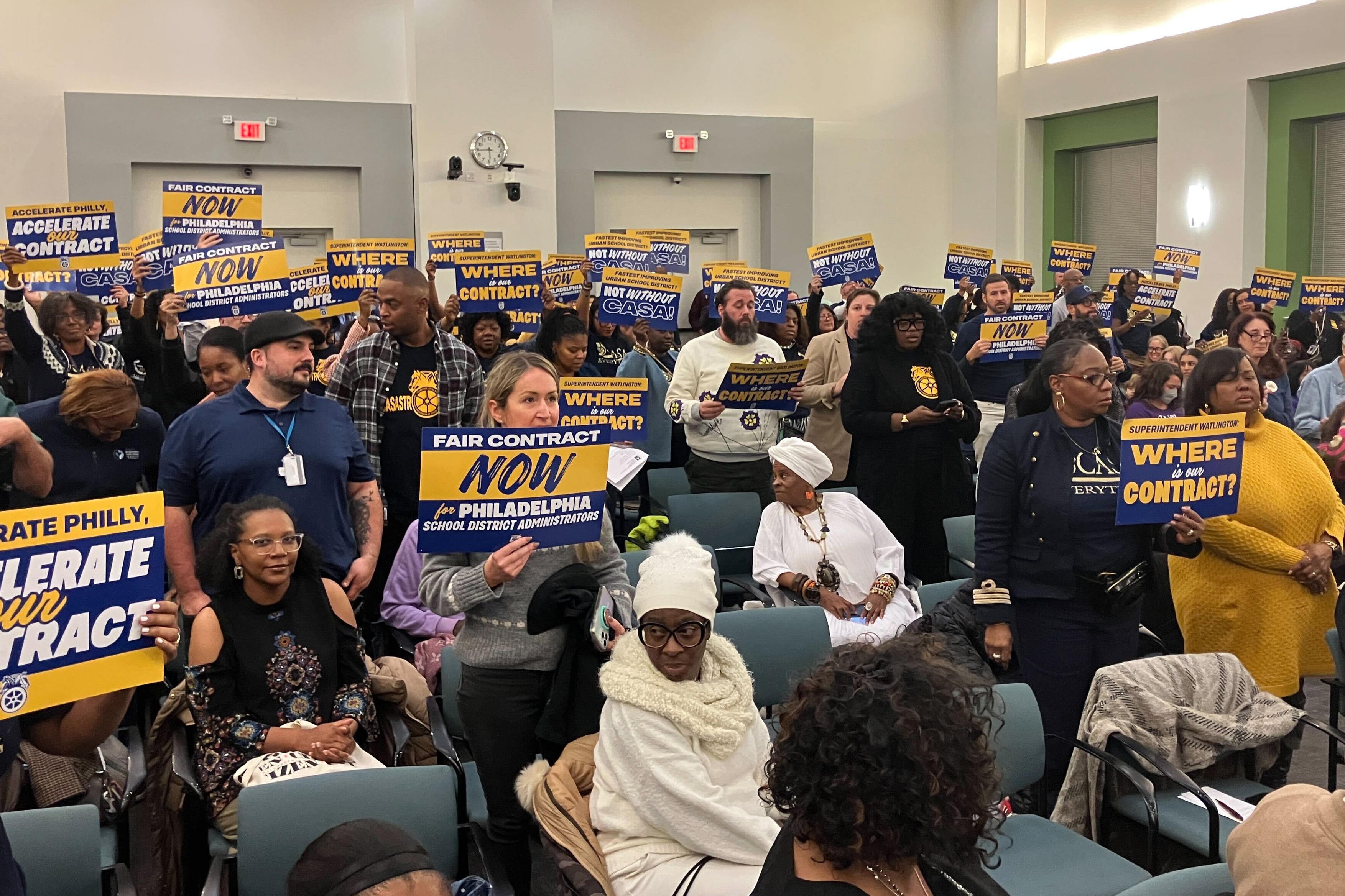
District principals, climate workers, and school safety supervisors packed the standing-room-only Board of Education meeting on Thursday in navy and gold Commonwealth Association of School Administrators Teamsters Local 502, or CASA, T-shirts. Union members have been working without a contract since their previous agreement expired in August.
CASA President Robin Cooper had strong words for Superintendent Tony Watlington and the district, saying contract negotiations have been “one-sided.” The union’s bargaining team has presented several counter proposals to end what Cooper calls “wage compression” and address increasing health premiums, but has been stonewalled by the district’s negotiators, according to Cooper.
“We have to fight our own district to properly support our needs,” Cooper said.
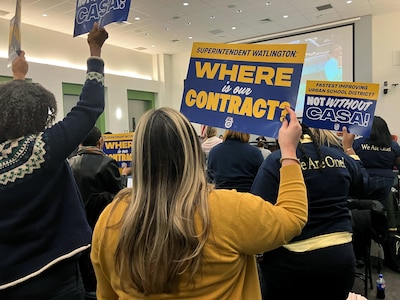
But she stopped short of calling a strike. Under the union’s prior contract, members agreed they would not “engage in, instigate, or condone any strike, work stoppage or any concerted refusal to perform normal work duties.” That commitment still holds, Cooper told reporters outside of the meeting room.
“This is our district and we’re gonna take care of it,” Cooper said. “We’re still going to stand by our schools because this is who we are, and this is what we do.”
Watlington told City Council members earlier this week he is optimistic about reaching a contract deal in the “near term.”
“We value you and we’re gonna get this done,” Watlington told the union members Thursday.
Meanwhile, several parents, advocates, and community members also testified at Thursday’s meeting demanding the district reconsider its plan to close some public schools.
“It’s true that some neighborhoods face real enrollment challenges, but those neighborhoods call for support, not closure,” education researcher Ryan Pfleger told Watlington and school board members at Thursday’s meeting. “If a building is crumbling, repair it.”
District officials have said the highly-anticipated plan — originally slated to drop at Thursday’s board meeting before being delayed — will include proposals for every school building across the city. Some will be closed and their buildings repurposed, others colocated, and the rest either renovated or left as-is.
The district pushed back releasing a draft of that plan to an unspecified date, in order to gather more community responses through a survey it launched this week.
Watlington said Thursday the goal of the survey, which will be open through Dec. 11, is to solicit big-picture feedback from parents about four main themes: how to better use building space, reduce “unnecessary” school transitions, reinvest in neighborhood high schools, and expand access to selective-admission schools.
“I want people to just step back and just dream a bit,” Watlington said. “We’re committed to not fumbling the football at the two-yard line.”
Board members approve school security contracts
While the facilities plan was not on Thursday’s agenda, board members did vote on several contracts for school security efforts, including:
— $195,000 to expand the district’s existing student-run “youth court” program which helps young people mediate conflicts in school. During the 2025-26 school year, the district plans to add new program sites at Science Leadership Academy at Beeber, William L. Sayre High School, and West Philadelphia High School. The three additional youth court program sites will all be active “no later than June 2026,” according to the district.
— $321,178 to GXC Inc. for walkthrough weapons detection devices and metal detectors at district high schools and middle schools.
— $732,094 to Safe at School Consulting LLC for state-mandated security assessments at all schools by the end of the 2025-26 school year. The assessments will “evaluate current safety measures, identify any vulnerabilities, and provide guidance for any enhancements to physical safety and security needed at each school,” according to the district.
Carly Sitrin is the bureau chief for Chalkbeat Philadelphia. Contact Carly at csitrin@chalkbeat.org.