Did you know search engines like Google are changing the way you see news? Keep Chalkbeat’s valuable education coverage at the top of your feeds by clicking here and checking the box next to our name.
The School District of Philadelphia and the Philadelphia Police Department are expanding a program that alerts school staff when a child has witnessed gun violence, domestic abuse, or another traumatic event at home or in the community.
Under Handle With Care, police officers are trained to send a note to the school district when they encounter a child while responding to a call. The officer relays that an incident occurred, and sends the child’s name but no other details. School District personnel then identify the student’s school and alert staff that the student may need extra care and attention.
The program launched as a pilot in one North Philadelphia police district last year, and will expand to all police districts next week. The goal is to change the way schools respond to children who’ve experienced something traumatic. The model originated in West Virginia and has been used around the country.
“A lot of times the educators in children’s lives are not aware they’ve been impacted,” said Meghan Smith, deputy chief of the district’s Office of Intervention and Prevention. “Sometimes the most important intervention is having an adult that knows to check in.”
During last year’s pilot in the 22nd Police District, which covers the Strawberry Mansion, Brewerytown, and Cecil B. Moore neighborhoods, the program led to Handle With Care alerts for more than 73 students from the 15 schools in the pilot, according to the school district. There were 272 children total who were present at traumatic incidents in the police district, though the rest were not enrolled in the pilot schools.
Citing privacy concerns, the district is not releasing outcomes for those students, such as whether those flagged via Handle With Care received mental health or other types of support. A district researcher noted that they are tracking outcomes for every Handle With Care student, and may release that data in the future.
Sakia Beard Brinkley, principal of Richard R. Wright Elementary School in North Philadelphia, said at an April celebration of the program that Handle With Care helped her staff serve multiple students and their families last school year.
“A lot of things happen outside of school that we don’t get the information for,” she said. “So now being able to know something happened — not necessarily what happened, but something — that gives us an entry point to communicate.”
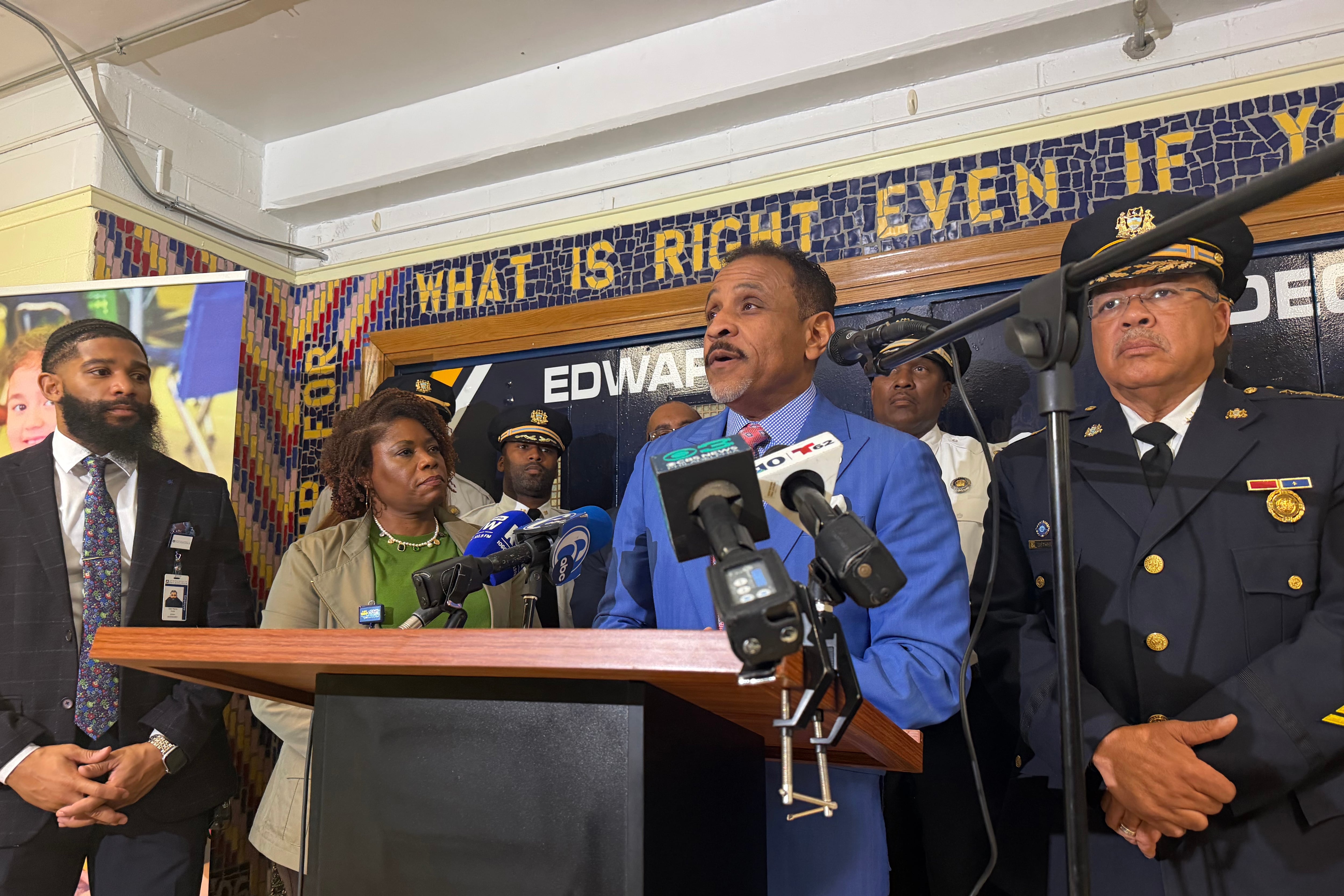
Whether police refer a student to Handle With Care is ultimately up to the responding police officer. Philadelphia Police Commissioner Kevin Bethel said his officers are trained to use this program for gun violence, domestic violence, fires and other incidents.
“We’re gonna run the gamut as it relates to what our men and women identify as traumatic,” said Bethel, a former chief of school safety. “Just having a parent arrested in front of a child can be very traumatic.”
Handle With Care initially launched with $1 million in federal money, and the expansion is funded by a $200,000 grant from the Pennsylvania Commission on Crime and Delinquency. District representatives said the grant will cover a staffer and the initial training and other costs associated with the expansion, and that ongoing costs will be “very low.”
This story is part of a collaboration between Chalkbeat Philadelphia and The New York Times’s Headway Initiative, supported by the Stavros Niarchos Foundation (SNF) via the Local Media Foundation.
Sammy Caiola covers solutions to gun violence in and around Philadelphia schools. Have ideas for her? Get in touch at scaiola@chalkbeat.org.