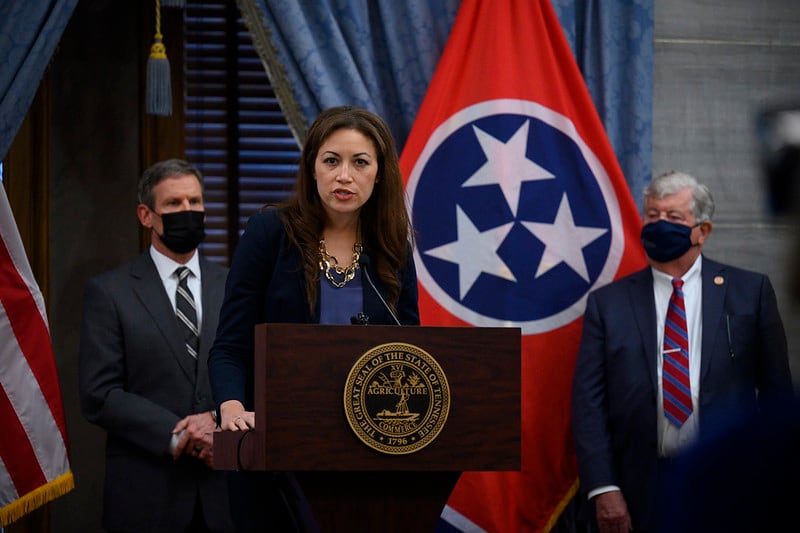
Tennessee could receive up to $2.6 billion more to spend on K-12 education if Congress approves a third coronavirus stimulus package, Education Commissioner Penny Schwinn said Tuesday.
That funding, which is part of President Joe Biden’s massive American Rescue proposal to deal with the pandemic, would add to the $1.5 billion the state already has received for education from the first two stimulus plans.
The total of about $4 billion in a single year would mark an unprecedented federal investment in Tennessee education. It would dwarf the $500 million in federal money received beginning in 2010 to overhaul the state’s education system over five years.
“It’s a stunning amount of money,” Schwinn told Chalkbeat of the combined stimulus packages. “In some ways, it’s overwhelming, but it’s also a great opportunity if we invest it wisely.”
Although the latest stimulus package is still working its way through Congress, Schwinn expects the amount for education funding to remain intact. She estimates Tennessee’s share at between $2.3 billion and $2.6 billion, which should arrive by April.
“I’m encouraging districts to make their plans now for 3.0 now,” she said. “We really want districts to have cohesive plans so they make sense for communities and kids.”
School systems have yet to spend most of the money from the first two stimulus packages, which were distributed based on their number of students from low-income families.
Last summer, Tennessee received about $260 million from the first package and $59 million through another federal education fund that the governor has discretion over.
The second package, which was approved by Congress in December, brought $1.1 billion to Tennessee. About $990 million of that goes to local school systems, and districts must submit their spending plans to the state by March 15. The governor’s discretionary education fund, meanwhile, got another $100 million boost from the second round of money.
In presentations Tuesday before the Senate and House finance panels, Schwinn outlined plans for spending the 10% of stimulus funds allocated to the state education department. Most of that $110 million portion from the second package will go toward students’ long-term needs, while the first round primarily helped with the immediate costs of reopening schools safely during the pandemic.
About $47 million will help pay for a new tutoring program approved by lawmakers last month to catch students up because of learning disruptions since last March. Another $20 million will go toward programs and grants to add more teachers, since about a third of them are eligible for retirement. And $20 million is needed, Schwinn said, to make Tennessee’s digital systems, including for the state’s comprehensive new literacy initiative, easier for districts, educators, and families to use.
Another $10.5 million will bolster work that began from the first stimulus package to provide more literacy resources, expand rural access to advanced courses, and continue the state’s partnership with PBS television stations to serve families without internet service.
As for the latest stimulus money going to school systems, Schwinn said Congress was clear that it should be spent on stemming learning loss and making school facilities safer for students. Ultimately, though, districts have discretion on spending the money, as long as it’s aligned with the intent of the legislation to provide relief from the pandemic.
All funding from the first two packages must be spent by Sept. 30, 2023.
“That is a tight timeline to spend this amount of funding,” Schwinn told the Senate panel, noting districts have to seek reimbursement from the state for their spending. “There is not a mechanism right now where we would be able to ask for a further extension, so it is a hard and fast deadline under which we are operating.”
Schwinn said up to $72 million out of the latest $100 million allocation to the governor’s discretionary fund must be offered to Tennessee’s 525 eligible private schools. The state is working through that process now, and any money that’s not sought by private schools will be reallocated to public schools.
“What we have seen is that the majority of our private schools are choosing not to participate,” Schwinn said, “either because the reporting requirements are too high, they’re participating in the paycheck recovery program, or they don’t want to submit the information to federal entities.”
The next round of federal money proposed for the governor’s discretionary fund is to go to higher education.