Sign up for Chalkbeat’s free weekly newsletter to keep up with how education is changing across the U.S.
Iowa will have more flexibility in how it uses federal funds after the U.S. Department of Education signed off Wednesday on a first-of-its-kind waiver request that could be a blueprint for other states.
Offering states relief from red tape has been a key component of the Trump administration’s promise to “return education to the states” and one that state schools chiefs from Republican-led states in particular have called for.
But it’s been unclear exactly what that might look like. States already control most aspects of education. Federal funding makes up about 10% of overall education spending, and those dollars do come with restrictions and reporting requirements that aim to ensure money is spent appropriately.
Supporters of the idea say states deserve more flexibility and can use it effectively, but critics worry that broad waivers might leave vulnerable students with fewer resources. While Iowa’s approved waiver request ended up being relatively narrow, a pending waiver request from Indiana could demonstrate just how much new authority the Trump administration is willing to give some states at the expense of federal rules and oversight.
The waiver allows Iowa to consolidate multiple federal funding streams used at the state level into a single block grant. State officials estimated this will free up an additional $8 million in reduced compliance costs over a four-year period. Iowa spends about $7 billion annually on education.
Iowa plans to use the block grant to continue teacher training in effective literacy instruction and launch a new training program that aims to help teachers better support English learners. Iowa’s English learner population has increased 40% over the last decade, state officials said.
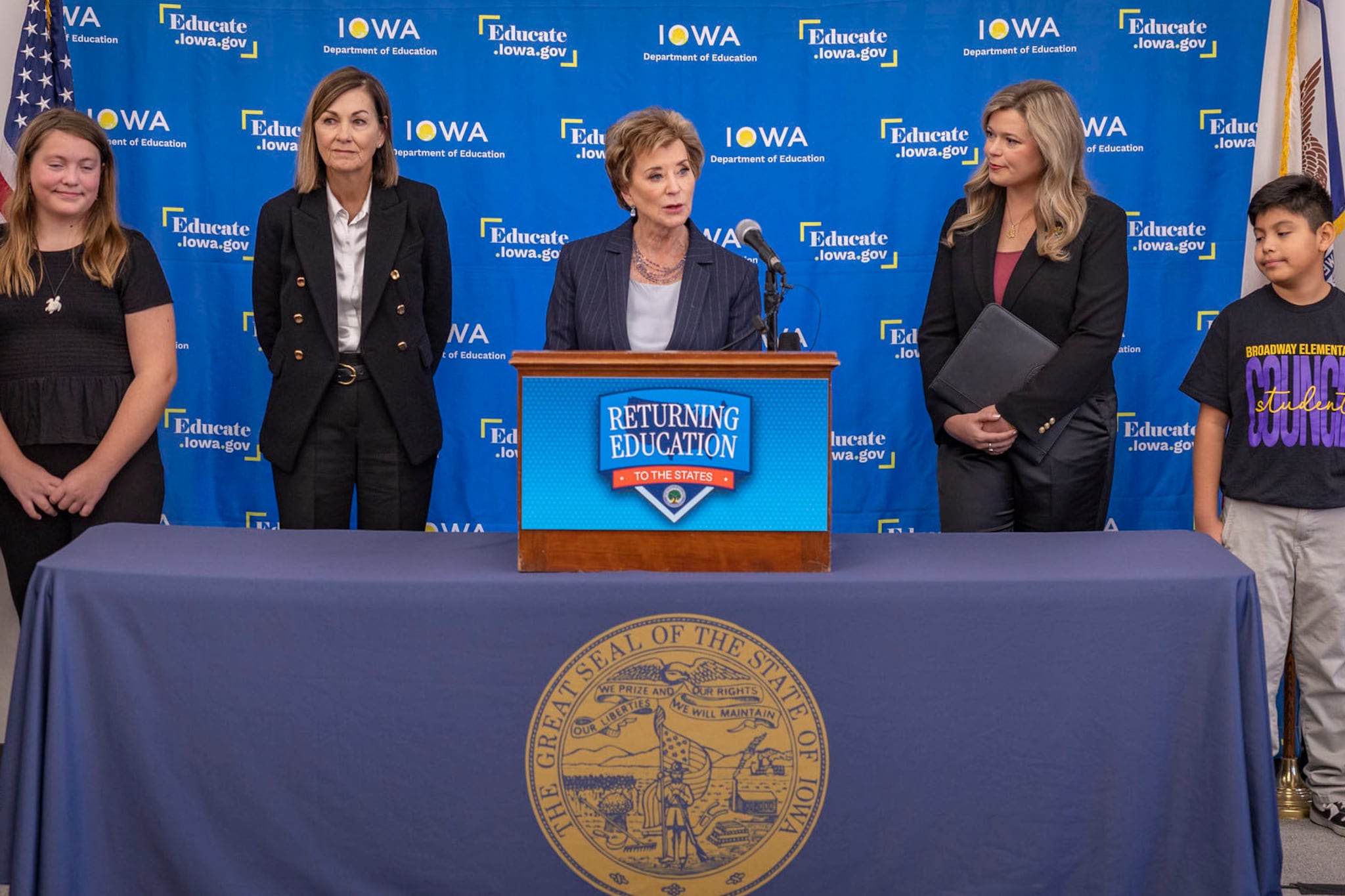
Flanked by Iowa Gov. Kim Reynolds, state Education Department Director McKenzie Snow, and attentive students, Education Secretary Linda McMahon announced the approval of the state’s request at Broadway Elementary School in Denison. McMahon praised the school’s bilingual programming and improvements in reading scores as examples of innovation that the administration wants to support.
Iowa can now reduce paperwork and “invest in proven strategies to build a world class teacher pipeline, close achievement gaps, and open post secondary opportunities to prepare for a great career,” McMahon said.
Iowa’s waiver doesn’t allow districts to consolidate most of their federal funding, which would have represented a much larger pot of money. But it does allow Iowa school districts to take advantage of a 1999 federal provision called Ed-Flex to roll over more money year over year to make it easier to invest in big-ticket items and longer-term strategies like new curriculum or ongoing teacher training.
Districts will also have more flexibility in how they spend federal funds intended for enrichment, technology, and school safety.
The approved waiver request, submitted in September, was significantly more modest than an earlier request Iowa submitted in March.
Anne Hyslop, director of policy development for the advocacy group All4Ed, said it was a good sign that federal officials told Iowa to scale back its request and appropriate that Iowa then did so.
“The things that Iowa was asking for originally, the secretary has no authority to waive,” she said. “They had gone so far beyond the realm of what the secretary had the authority to do.”
Now the state to watch, she said, is Indiana. That state’s waiver request includes state- and district-level consolidation of federal funding streams and changes to the accountability system.
The initial waivers approved by the Education Department likely will shape what other states request.
McMahon invited states to apply for waivers to certain federal requirements back in July. A proposal in Kansas seeks to pause federal school accountability requirements but does not ask for funding flexibility, while Oklahoma’s waiver request is on hold after leadership turnover there. Other states are expected to follow.
Iowa education officials said funding flexibility will allow more money to support teacher training and student achievement, and the public should see results in higher test scores, higher graduation rates, and reduced absenteeism.
Hyslop said there could be some benefits to more flexibility. More leeway for districts could allow schools to invest in, for example, an arts program or a new technology initiative.
But the Education Department still needs to ensure money is being appropriately spent, which is more challenging after massive layoffs.
“I do worry that the US Department of Education right now lacks the capacity to do meaningful oversight of how this program is being implemented or the waiver process in general,” Hyslop said.
Progressive education advocates also fear that money that federal lawmakers intended to support specific student groups won’t reach them.
“I think of red tape equaling protections for students,” said Nicholas Munyan-Penney, assistant director for P-12 policy at The Education Trust. “We want to make sure that students have access to the protections and resources they need to be successful.”
Advocates are particularly concerned that Iowa’s new block grant consolidates Title III funds that are required to go to English learners with other funding streams. The Trump administration laid off most of the staff at the Education Department who support those students, and rescinded a guidance document considered to be the “bible” in that field.
Iowa officials said the teacher training they are planning will benefit more students than the limited programs supported by state Title III dollars.
Iowa officials still will have to tell the federal government how they spent the money, along with estimates of how much time and money they saved compared with the previous system.
In her approval letter, McMahon said the Education Department is open to further streamlining data reporting requirements as well, but that will be an ongoing conversation with Iowa and other states.
But so far, Hyslop said, the administration’s rhetoric on giving states more authority “doesn’t match the impact.”
“The things that would be the most transformative still require congressional approval,” she said.
Erica Meltzer is Chalkbeat’s national editor covering education policy and politics. Contact Erica at emeltzer@chalkbeat.org.