Chalkbeat Ideas is a new section featuring reported columns on the big ideas and debates shaping American schools. Sign up for the Ideas newsletter to follow our work.
Rahm Emanuel — who once said, “you never want a serious crisis to go to waste” — sees two crises at the moment.
One is the well-documented learning decline plaguing American students. The other is the similarly declining favorability of the Democratic Party with voters. Emanuel has an answer to both: Democrats need to embrace reform-minded education policies to boost achievement, while pivoting away from what he sees as an overemphasis on race- and gender-related topics.
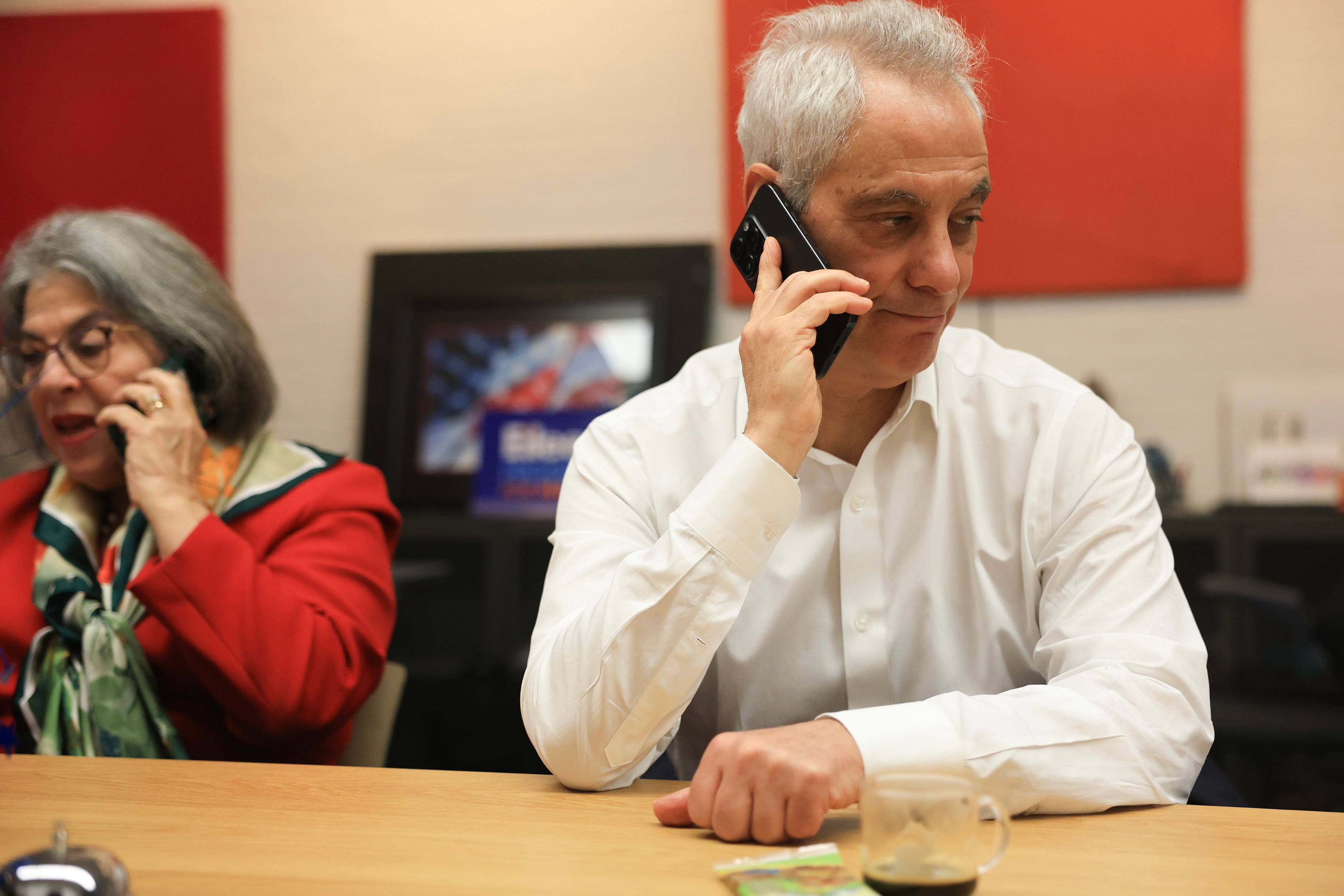
“We weren’t worried about what was going on in the classroom or the corridor,” Emanuel, the former Chicago mayor and White House chief of staff, said in an interview. “We were worried about a bunch of ancillary issues.” He was fresh off of a high-profile trip down to Mississippi, where improvements in fourth-grade test scores have drawn national accolades.
Emanuel is openly considering a run for president. If he takes the plunge, education will be core to his campaign, he says.
Already, though, his media blitz has reshaped the conversation about schools. Most other prominent Democrats have consigned education to the veritable kids’ table of issues. Although some of Emanuel’s pronouncements are up for dispute, he’s stepped in to fill a large void within his party. “I’ll say this: He’s talking about schools. That’s a good thing,” said Joshua Cowen, an education professor at Michigan State University, who briefly ran for Congress as a Democrat.
Emanuel cut his teeth in a different political era when leading Democrats were eager to talk about overhauling public schools. As Barack Obama’s chief of staff, he helped design Race to the Top, which promoted charter schools and the use of test scores to judge teachers. Then as Chicago mayor he pushed for a longer school day and closed 50 schools amid declining enrollment.
Emanuel acknowledges the bitter disputes over these policies. Race to the Top helped spur a nationwide backlash to testing. School closures in Chicago unleashed widespread anger from teachers and parents in the city, imperiling Emanuel’s reelection, although he ultimately won a second term. “My life would have been a hell of a lot easier had I left those schools open, even though parents were fleeing,” he said, after rattling off statistics about improvement in the city school system.
Whatever the flaws of the prior reform era, Emanuel says, at least Democrats had a clear agenda. Now he dings his party for extended virtual schooling during the pandemic and for allowing Republicans to own education issues. “You know that the Republicans are for vouchers. You can’t tell me what the Democratic calling card is,” said Emanuel, who served as ambassador to Japan under Joe Biden.
Indeed, while Trump campaigned on a far-reaching education platform, including closing the Education Department and getting “wokeness” out of schools, Biden and later Kamala Harris didn’t emphasize the issue. The Biden administration also quietly dropped an early proposal to create a Race to the Top-style innovation fund for schools.
Emanuel is alarmed that relatively few leaders from either party have made recovering from historic test scores declines a major priority. “Nobody’s going to break a sweat trying to solve it,” he said.
Some of Emanuel’s other claims are questionable, though. One of his key talking points is that Democrats have lost their edge on education with voters. This isn’t backed up by most recent polling. Well, he counters, the Democratic advantage is smaller than it used to be.
One long-running survey shows Democrats with a 10 to 15 point edge on education, which is smaller than the high points of 2007 and 2008, but comparable to many other times in recent decades.
As for COVID school closures, it’s not at all clear this is dragging Democrats down. Most voters say that, looking back, these closures were “largely necessary,” according to one recent poll.
And although Emanuel refers to identity issues as distractions, they’re quite resonant with students who are transgender or conservative parents critical of policies to accommodate trans students. (For voters particularly concerned about this issue, Emanuel is blunt: “If I run for office, I’m not your guy.”)
Yet Emanuel’s strategy of using education to try to redefine the party brand has historical precedent. George W. Bush campaigned as a “compassionate conservative” who would improve schools for disadvantaged children. Before him, Bill Clinton promised to be a “New Democrat” who would reform failing schools and stand up to “special interests,” including labor unions and gay rights advocates. Both men were elected in part thanks to their approach.
Today, even if Democrats still have an edge on education, they do have a problem with voters who see them, fairly or not, as too focused on social issues. To address this, Emanuel is trying to rerun the New Democrat playbook that worked in the ‘90s. “It’s a sense of deja vu,” said Patrick McGuinn, a Drew University political scientist who has studied how education plays out in national politics.
Asked about specific policies, Emanuel ticks through ways he’d like schools to improve. He wants more to adopt the Mississippi model — which includes phonics-based instruction and holding back struggling readers — and he wants high schools to require students to have a clear plan for when they graduate. He also suggests addressing low attendance rates by cutting funding to schools where too many students are absent.
The president doesn’t control schools like a mayor or a school board. They can leverage federal money to push schools to make changes, though doing this effectively is not easy. Emanuel has floated the idea of a new Race to the Top-style program.
If he does run for president, Emanuel will face skepticism and perhaps outright opposition from public school interests and teachers unions, which are major Democratic funders.
Randi Weingarten, president of the American Federation of Teachers whose local Chicago chapter frequently clashed with Emanuel, agrees Democrats need to lean in on education again. “There are pieces of Rahm’s agenda — such as boosting literacy and investing in Pre-K — that are foundational, but so are neighborhood public schools, which Rahm closed en masse as mayor of Chicago,” she said in a statement.
Cowen, the Michigan State professor, who is a leading critic of school vouchers, says that aside from Emanuel, though, national Democrats have largely failed to sketch out a clear vision on education. “Improving public schools is part of defending public schools and vice versa,” he said.
Matt Barnum is Chalkbeat’s ideas editor. Reach him at mbarnum@chalkbeat.org.