Sign up for Chalkbeat Chicago’s free daily newsletter to keep up with the latest news on Chicago Public Schools.
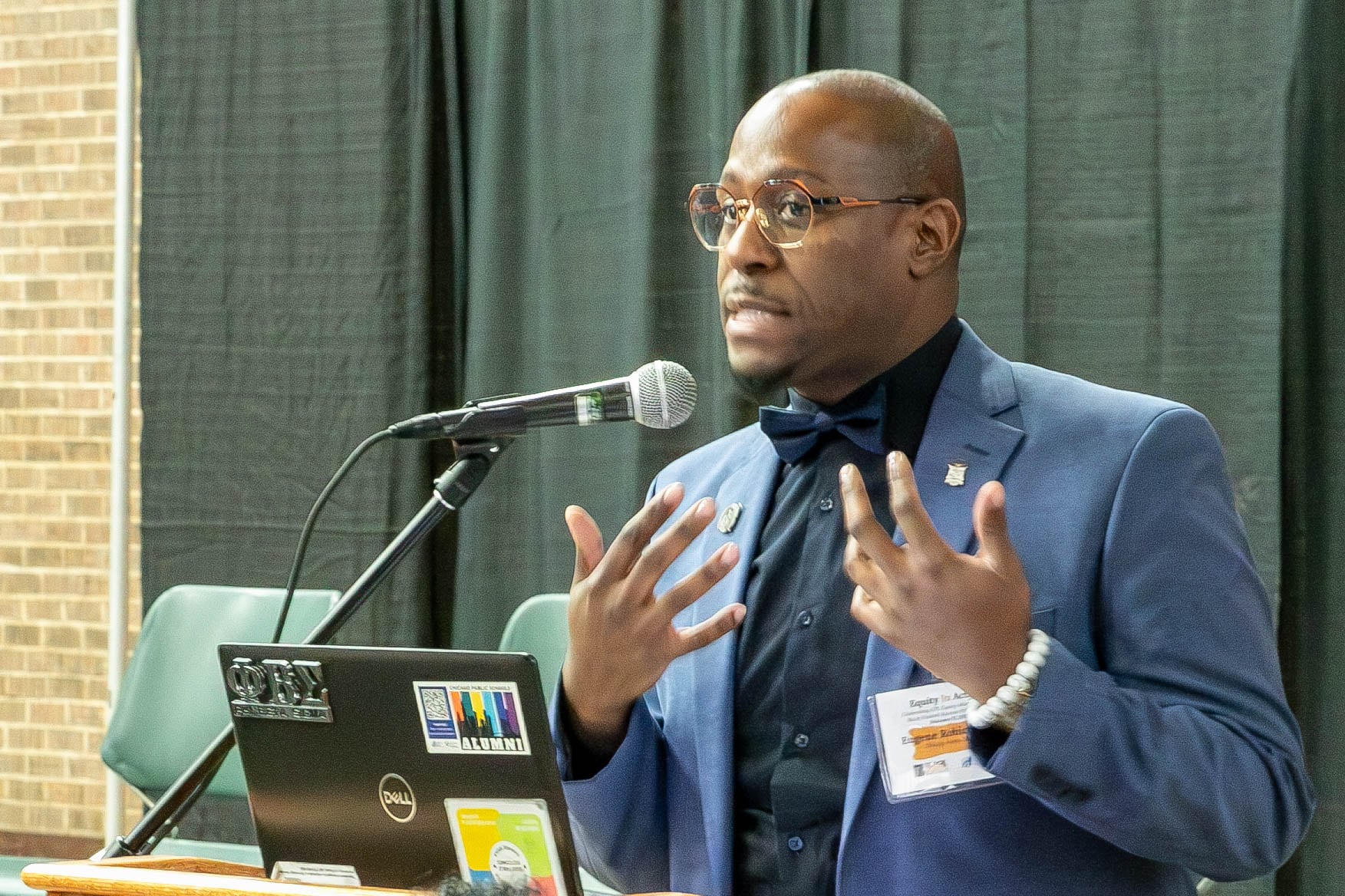
Eugene Robinson Jr., Chicago Public Schools’ first director of Black student success, has faced a tricky balancing act over the past year.
Community advocates called for decisive, visible progress on the district’s Black Student Success Plan, the five-year initiative they had championed for years and helped enshrine in state law. Meanwhile, the Trump administration argued the plan discriminates against non-Black students and withheld federal funding over it — a standoff that’s now playing out in the courts.
Against that backdrop, Robinson set out to implement the plan he helped write in 2024. A University of Chicago graduate with a master’s degree in social work, he previously worked as the district’s director of student engagement and led the University of Chicago Charter School’s Woodlawn campus.
The rollout’s first year was decidedly low-key, with lots of public attention focused on delays in naming a new board committee that will help guide the work. The board named most, but not all, of the Black Student Achievement Committee’s members this week.
Chalkbeat spoke with Robinson about what he was able to accomplish this past year and what comes next for the plan, at a time when the district is contending with major budget pressures.
This conversation was edited for length and clarity.
You became the inaugural director of Black student success in June 2024, charged with rolling out a plan that involved a lot of input — and high expectations — from community members. What drew you to this role, and did you have some trepidation?
I’m a product of Chicago Public Schools. I went to Lindblom High School in Englewood. My family has a story that’s connected to why we’re doing this work and to the Great Migration. I am also an uncle of several nieces and nephews who are products of Chicago Public Schools. I’ve worked in higher education, and I’ve participated in a program called Great Expectation Mentoring. In my professional career, I’ve looked at other cities and states doing work focused on Black boys or Black girls. This opportunity allowed me to connect being a product of CPS, growing up in Englewood and Auburn Gresham, coming back to work in schools, working in nonprofits, and as a Black man in general.
Your first task was to write the plan, drawing on recommendations that came through community engagement. The plan sets some concrete goals, but it doesn’t go into detail about how the district will get there. How much work has the district done to figure out the “how,” and how much still remains?
The one thing I like to say is that the Black Student Success Plan is not the work. It is the vision and the aspiration. It is also the item to hold us as a district accountable, and it was written to align with the district’s five-year strategic plan, and with state statute that requires the school board to establish a Black Student Achievement Committee. The goals are very high-level and ambitious. There’s a lot of research and data that talks about certain powerful practices, and there was historical data that we looked at as a district.
But the plan is not the work. Some of this work started at the school level before the plan was actually taking shape. One example is Black student unions — one of the recommendations from the community working group. How do we create these culturally centered leadership and voice spaces for young people?
You led the plan’s first year of implementation in a national climate of intense scrutiny of race-based initiatives. How much were you able to accomplish this year?
The first year was about socializing the plan, letting everyone know that, “Hey, we have a Black Student Success Plan,” and activating that ecosystem for philanthropy with higher ed and community-based partners.
The Black Student Success Working Group didn’t go away. We reconstituted that to look different and to engage differently. We call it the Black Student Success Champion and Stakeholder Alliance Group so we are moving beyond recommendations to how this shows up in schools.
We also were able to establish what’s called the Black Student Success Convening and Collaboration, where we brought together various offices connected to certain goals. For example, we have a goal to increase Black male teachers and Black teacher retention. That’s our talent office.
We walked on a journey of establishing a Black student union framework, so we actually did some focus groups with schools that had Black student unions and schools that did not have them.
Using the two examples you mentioned, did the district’s talent office take some steps this year to make it easier to recruit and retain Black male teachers? Did schools foster new Black student unions?
I would say this is [work that will take place] in Year 3 of the plan. We have never had a Black student union resource and toolkit. We also looked at the history of Black student unions nationally and in CPS, and we actually went into the CPS archives and pulled out photos of Black student unions to understand and make those connections for young people.
We received a small grant opportunity that supports both the Black male educator strategy work and our very first Black student union conference. We are launching a Black male educator wellness cohort with some of this funding. We are working to establish other partnerships to offer professional learning for Black male educators. We’re supporting our grow-your-own work to ensure that Black males in non-teacher roles move up into teaching roles.
How did the Trump administration’s push to get the district to scrap the plan affect your work?
One of the things I would say related to is that we still have that open investigation [by the U.S. Department of Education]. But the district will continue to ground ourselves in the research and the data and our equity framework, which is all about targeted universalism. Targeted universalism is not about taking from one group to support and elevate another group. It is the system recognizing that groups may need differentiated support to achieve the same north star.
We are no different than any other school district having to navigate this climate, like my colleagues that I’m in close connection with in Denver and Los Angeles, who have similar Black student success plans.
Did the fact that the board’s Black Student Achievement Committee wasn’t named earlier this year affect your work on the plan, given the central role it is supposed to play in guiding the initiative?
Even though the committee has not been launched, there is collaboration and communication between the Office of Equity, the CEO’s office, Black Student Success Plan, and the two chairs of that committee. This is all new for us, but there is open communication. The way I will explain it is that the Black Student Success Plan is the work of the district in alignment with the state statute and our five-year strategic plan. The Black Student Achievement Committee will serve as the accountability structure for the district to be able to do this work.
You mentioned the philanthropic funding you lined up. Do you see this work being largely funded through philanthropic contributions going forward, or will the district attach some local or state dollars to the initiative?
There is an overall commitment that the CPS budget process is driven by equity. We are in a budget season now, so I wouldn’t answer that particular question. What I will share with you is that there is momentum to support this work in the philanthropic community, and we’re also looking at other ways of supporting this work.
But I think about the district’s commitment to having an Office of Equity, the positions that come along with that, including my position that never existed before, and also a project manager who works alongside me. Having different offices looking at their data and aligning to the Black Student Success Plan will take people, time, and money. Those offices will identify the resources that will potentially be attached to this work.
What’s high on your to-do list for next year?
I know I talked about Black student unions a lot, but I’m really excited because when we center ourselves on student voice and those who are most impacted and allow them to have a seat at the table, it can make for powerful practice and ignite opportunities for young people.
I am excited that we will be able to host the very first Black Student Union Conference at Malcolm X College on Oct. 21. We have some young people through the Mayor’s Office Youth Works program interning with us to help us plan the conference, and we have collaborated with different partners like Mikva Challenge over the year.
Mila Koumpilova is Chalkbeat Chicago’s senior reporter covering Chicago Public Schools. Contact Mila at mkoumpilova@chalkbeat.org.