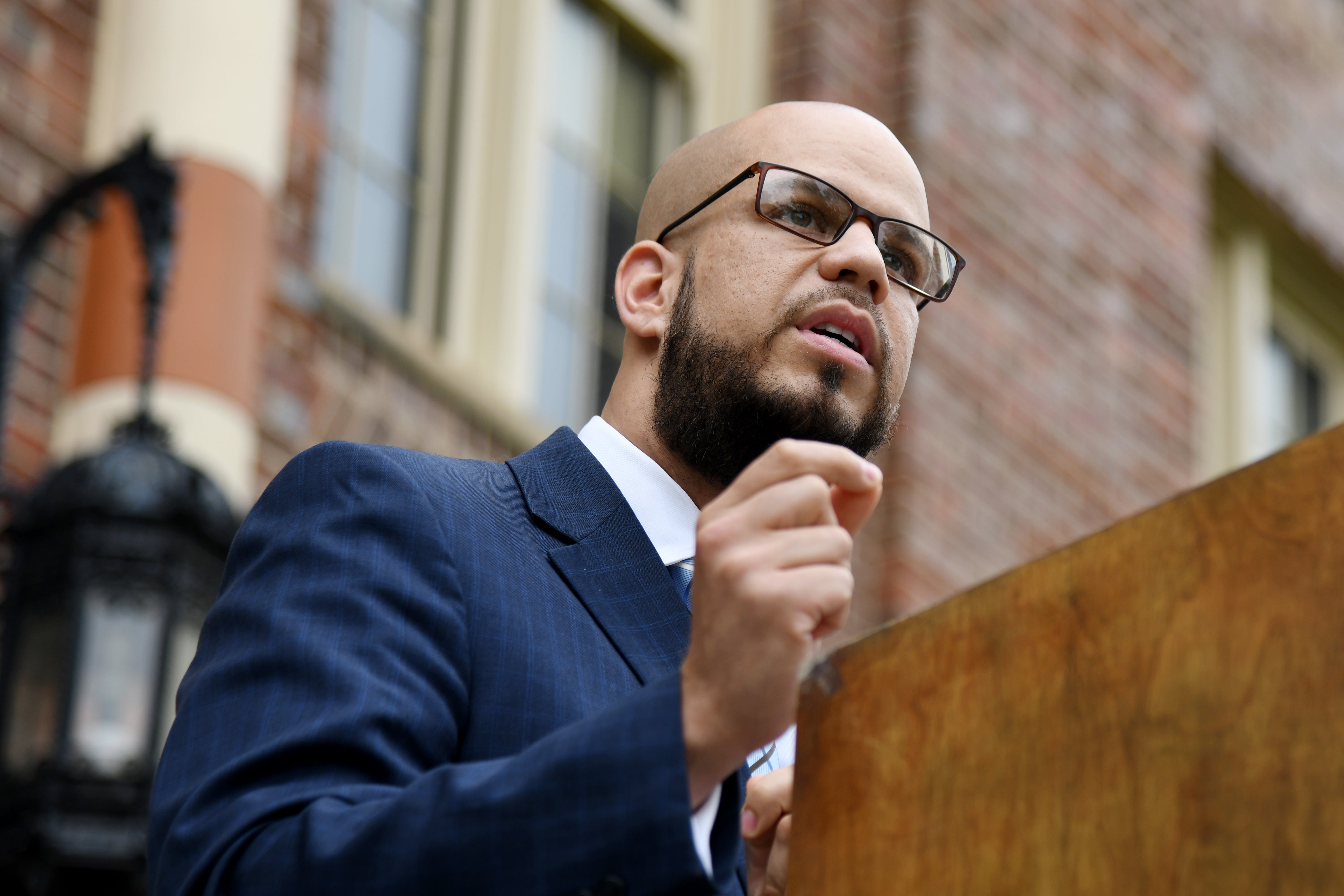
Five months into Denver Superintendent Alex Marrero’s tenure, the school board extended his contract Thursday from two to four years with an automatic one-year extension. Marrero is now contracted to lead the 90,000-student district until June 2026.
“Having that positive impact on a district the size of Denver Public Schools requires more than two years,” said board President Xóchitl “Sochi” Gaytán.
“We’re moving boldly,” said board member Michelle Quattlebaum. “When you ask someone to put a strategic plan together for an organization of this size, we must give them time to do that. When you throw in a pandemic, we must give them time to do that.”
The vote was 5-2, with school board members Brad Laurvick and Scott Baldermann voting no. Both said they supported Marrero but took issue with the timing of the vote.
Laurvick said it would have been more appropriate to extend Marrero’s contract after his first performance evaluation, which has not yet occurred. “My ‘no’ is not directed at Dr. Marrero. It’s solely about the length of the contract at this specific time.”
The school board hired Marrero as superintendent in June, and he started in July. An election last month ushered in three new school board members and resulted in a leadership shakeup. New President Gaytán and Vice President Tay Anderson announced the board’s intention to vote on extending Marrero’s contract Wednesday, one day before the vote.
Some community groups, including the Colorado Black Roundtable, praised the decision, saying in a statement that they have “full faith” in Marrero, whom they said has consistently shown up for the Black community. Other groups expressed disappointment not in Marrero’s performance but in what they said was a hasty decision by the board.
“The lack of transparency and community involvement is not how this new school board has committed itself to operate,” the Latino Education Coalition said in a statement. “Given the unique challenges currently faced by our students and teachers, extending the contract of Dr. Marrero should not be the first order of business.”
Board member Scott Esserman said he disagrees. “We have heard loud and clear, even from people who want to grouse about not having had enough voice, that Dr. Marrero is currently doing the things we expect him and want him to do,” he said.
Marrero spent his first 100 days as superintendent conducting a listening tour throughout the district that will help shape Denver Public Schools’ next strategic plan.
The contract extension does not change Marrero’s salary. He earns $260,000 per year. That’s the same salary earned by the previous superintendent, Susana Cordova, and more than the $242,125 previous district leader Tom Boasberg made when he left in 2018.
Cordova’s last contract was for 3½ years with an automatic one-year renewal. Boasberg’s first contract was for four years, but his last contract was for two.
Per his four-year contract, Marrero will receive a performance evaluation each year by Oct. 31.