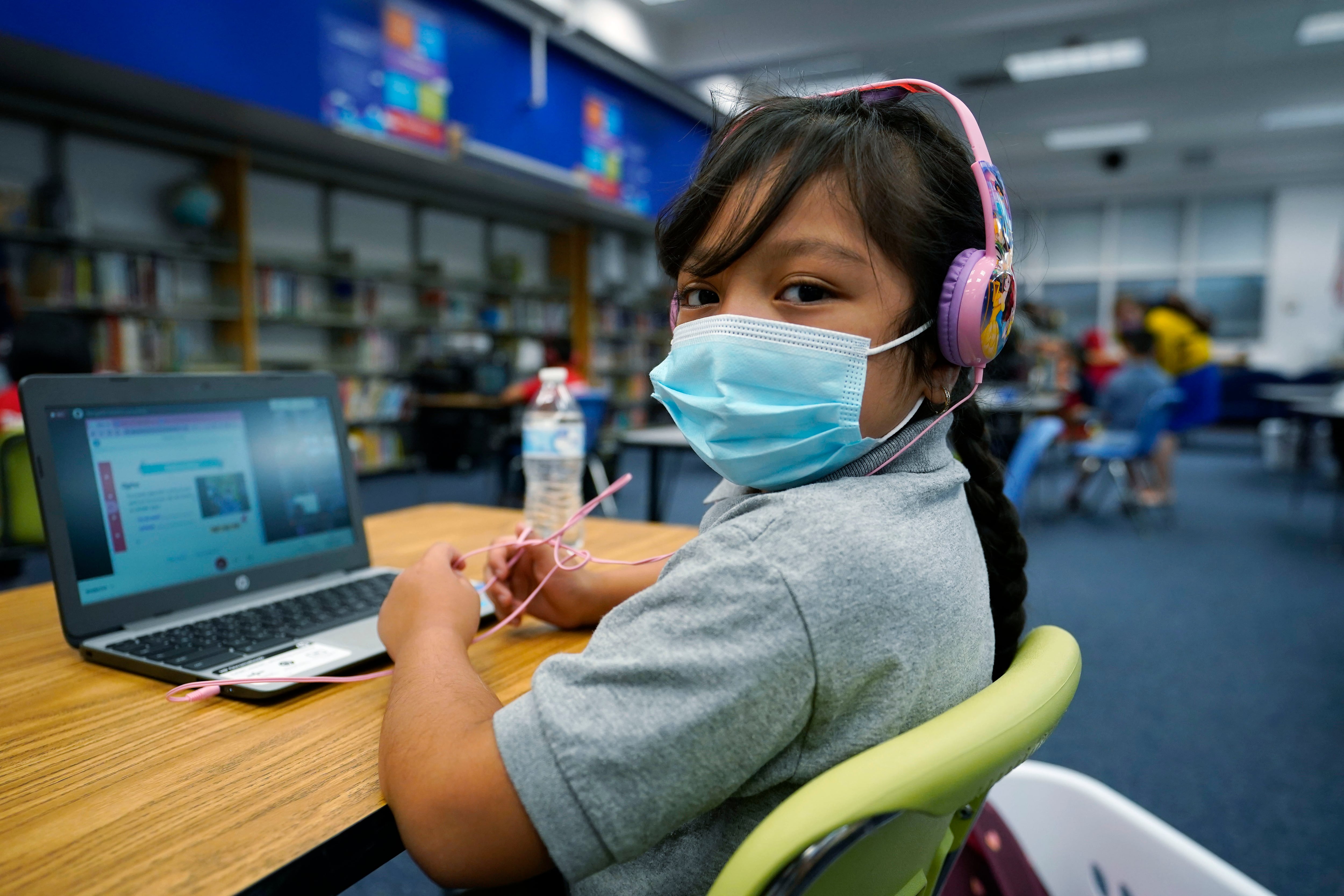
Face masks will be required inside school buildings for all Denver students, staff, and visitors, whether they’re vaccinated or not.
Denver Public Schools announced the policy first in an email to staff obtained by Chalkbeat and then in an email to parents later Tuesday afternoon.
In the email to district staff, Denver Superintendent Alex Marrero cited a rise in COVID rates in the community and noted that even vaccinated people can contract and spread the virus, though their infections are much less likely to be severe. He said district leaders consulted with local public health officials on the decision to require masks.
“Given the current conditions and vaccination rates, and the advice of our partners at Denver Health, this masking requirement is the right thing to do for the health and safety of our students and staff,” he wrote. Marrero added that he is hopeful COVID conditions will improve “and that we will be able to relax health restrictions soon.”
Masks will not be required outdoors, the email says, nor will they be required for vaccinated staff members who are working alone in their offices or workspaces.
Denver Public Schools is the largest school district in the state with more than 90,000 students. The district’s mask rules are stricter than state guidance released Friday, which recommends — but does not require — that everyone in a school setting wear a mask.
However, Denver’s policy is in line with guidance from the federal Centers for Disease Control and Prevention, which said last week that all students and staff should wear masks regardless of vaccination status. A new order from Denver Mayor Michael Hancock also requires that teachers and other school personnel be fully vaccinated by Sept. 30.
The mask rules go into effect Monday. The first day of school for most Denver students is Aug. 23.
Denver Public Schools’ rules are stricter than several other Colorado school districts. The state’s second-largest district, Jeffco Public Schools, is mandating masks for students ages 11 and under who are too young to be vaccinated, as well as for unvaccinated staff. But masks will be optional for vaccinated staff in Jeffco, as well as for students aged 12 and older.
The state’s third-largest district, Douglas County, won’t require masks for anyone.
Marrero, who started his job in July, said last week that he’d heard pleas from parents on both sides of the mask debate.
“I have folks who have said, ‘You’d better listen to the guidance. You’re a doctor but you’re not that type of doctor,’” Marrero said. “In a matter of hours, if not immediately, when I check my emails or when I get to interact with someone in the community saying, ‘I’m not sending my child in if you force them to put on their mask. My child is vaccinated.’”
“I’m engaging with both,” he said. “So no one can say that I only heard one side.”
More than 75% of Denver residents ages 12 and older have received at least one dose of a COVID vaccine and about 70% are fully vaccinated, according to data released Friday by the Denver Department of Public Health and Environment.
But the seven-day average of new daily cases and the percentage of people testing positive for coronavirus ticked up over last week, as did the number of confirmed cases of the more contagious delta variant, health officials said.