Sign up for Chalkbeat Colorado’s free daily newsletter to get the latest reporting from us, plus curated news from other Colorado outlets, delivered to your inbox.
Abraham Lincoln High School needed to track down 13 graduates.
That’s how many it would take to boost the southwest Denver school’s rating to a middle-tier yellow grade after years at the bottom. If Lincoln could prove to the Colorado Department of Education that at least 13 more graduates were enrolled in college, career training, or the military, the school could earn enough rating points to take a step toward exiting the state’s watchlist for low performance — a feat it hadn’t accomplished in more than a decade.
“It has always been a struggle for our school to (be) a place where the community is proud of, in terms of academic achievement,” said Principal Néstor Bravo. “I want to work really hard on making Lincoln a positive point of reference for the southwest.”
Lincoln has been on Colorado’s watchlist for low performance longer than any school in Denver. Located in a largely Hispanic, working-class neighborhood, Lincoln has a vibrant history, display cases full of athletic trophies, and notable alumni including Colorado Education Commissioner Susana Córdova and Denver school board President Xóchitl Gaytán.
But enrollment has fallen from 1,900 students a decade and a half ago to about 830 students today. Lincoln has struggled academically for at least as long. And recent immigration enforcement actions by the Trump administration have made matters worse.
In the four days after President Donald Trump was inaugurated last January, Lincoln lost 100 students, many of them new immigrants from Venezuela and other countries, Bravo said.
“They disappeared,” Bravo said. “We couldn’t find a trace of them. They just didn’t show up.”
And attendance is spotty for many of the students who remain. More than 6 in 10 Lincoln students were chronically absent last school year, meaning they missed 10% or more of their school days. Bravo said it doesn’t help that federal Immigration and Customs Enforcement agents regularly park their vehicles at the car wash across the street and at a strip mall where students walk to buy lunch, though he said he hasn’t seen them this month.
As far as he knows, none of his students or their family members have been arrested by ICE, Bravo said. But as a Venezuelan immigrant himself who came to Denver to get a graduate degree and was hired to teach Advanced Placement Spanish classes at Lincoln before becoming a principal, Bravo said he understands the fear.
“They are gambling with their future in a sense,” Bravo said. “If I stay in school, if I keep coming here, I might be captured or they’re going to take me, so what am I going to do?
“The most important thing is to give kids a reason to be here and feel safe,” he said.
How Abraham Lincoln H.S. improved academic growth
Even under those difficult circumstances, Lincoln made academic progress. While the percentage of students meeting the state’s bar on PSAT and SAT tests remained low, Lincoln’s academic growth — a measure of how much students improved year over year — was the highest it’s been since before the pandemic.
Bravo credits a series of changes he made when he became principal last school year. They include twice-weekly SAT prep classes using the online platform Khan Academy, which has an AI assistant that can chat with students in Spanish.
He also prioritized improving the way teachers deliver their lessons, both by cutting administrators without that skillset and training teachers in a method meant to get students collaborating and talking in class, which he said can be intimidating for English learners.
“As a second language learner myself, if I don’t have to talk, I won’t,” said Bravo, who said he spoke Spanish and Portuguese, but not as much English, when he took a teaching job at Lincoln more than 15 years ago.
“We have a high percentage of multilingual learners,” he said. “We have kids who need to practice English, who need to speak in their native language, so let’s get them to talk.”
Bravo is trying to improve the culture at Lincoln, too. A competitive athlete, Bravo warms up with the soccer team and shoots arrows with JROTC students at the school’s indoor range. He added big screen TVs to the main hallway to broadcast the students’ achievements, such as the boys baseball team winning the city league championship last spring. Posters advertising Lincoln’s upcoming school play, “Shrek the Musical,” hang near the TVs.
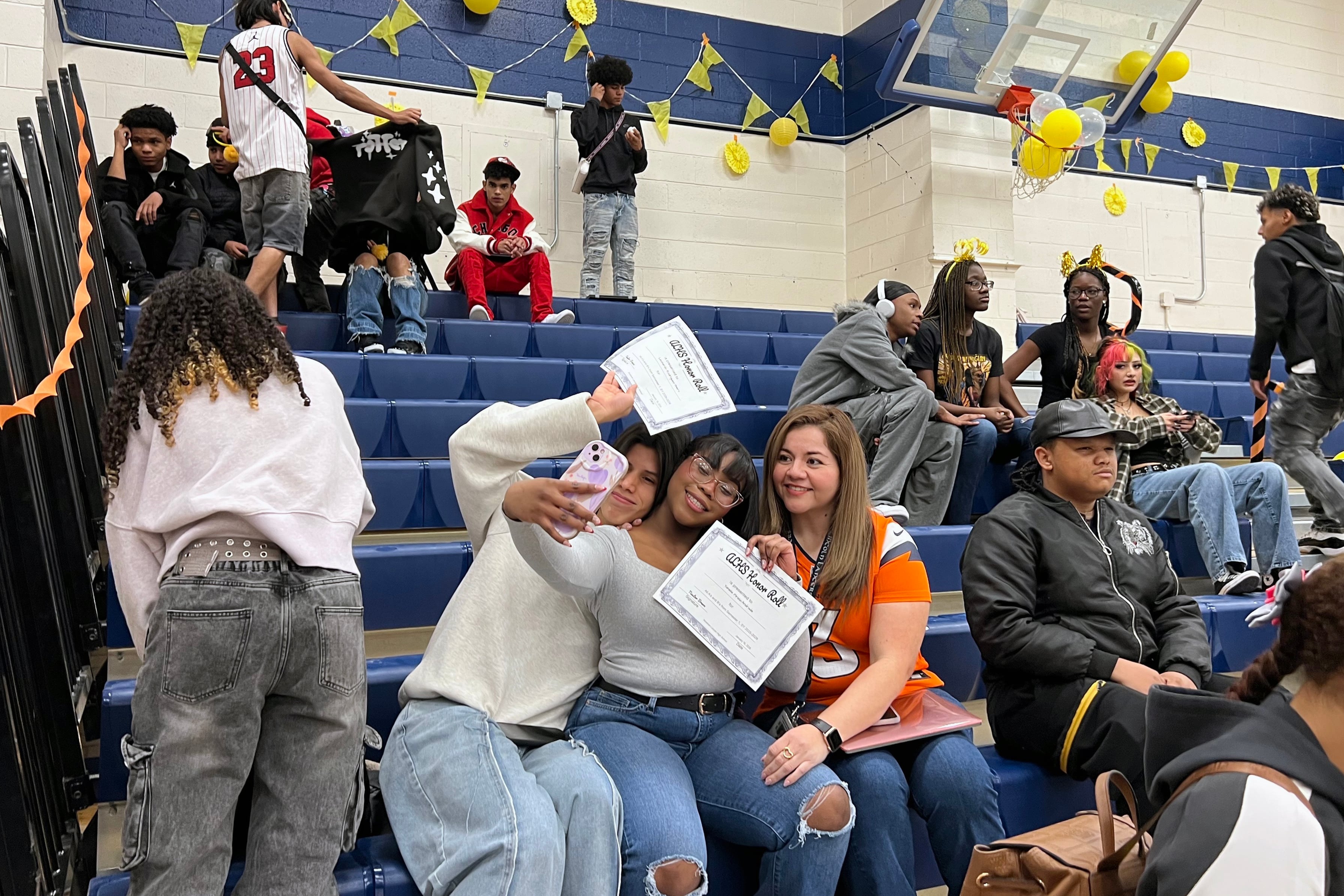
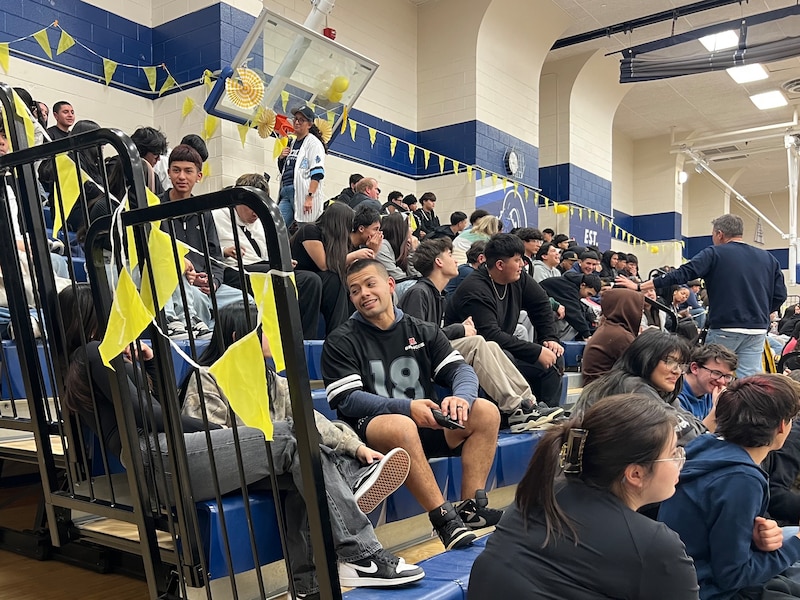
Last Friday, the school celebrated its academic progress. Staff decorated the gymnasium with yellow streamers. Bravo gave a pep talk. Guitar students played a cover of Radiohead’s “Creep.” The robotics team, wearing matching sweatshirts, showed off a robot. And students who had earned all A’s and B’s in the first semester were called up to get awards.
“I used to not really focus on my grades at all,” a senior named Gabe said, taking the microphone and addressing his fellow students sitting in the bleachers. “I used to try to just get past high school, you know? But that limited my opportunities.
“I would say just try your hardest, even if you don’t know what you’re going to do after high school, just so you have opportunities,” Gabe said. “Just don’t close any doors.”
Moving from orange to yellow
The data shows that more Lincoln students are following that advice. When the Colorado Department of Education released its preliminary school ratings this fall, Lincoln had earned the second-lowest rating, signified by the color orange.
But Bravo suspected he could get Lincoln’s score up to yellow. High schools are rated based on their PSAT and SAT scores, graduation rates, and how many of their students go on to college, the military, or a career training program.
It was in that last category where Bravo knew Lincoln could move the needle. The state’s data seemed incomplete, he said. Lincoln staff and the advisers who work at the Denver Scholarship Foundation’s in-house college and career planning center at Lincoln knew anecdotally of more graduates who had continued their education.
So the staff began contacting former students one by one to collect the proof they’d need, like a college class schedule, to show state officials that the graduates had matriculated. In some cases, it became a game of social media telephone: They could see that one graduate was connected with another who had gone to a small community college in the mountains. Could that graduate get in touch with their friend and tell them to call the staff at Lincoln?
In the end, Lincoln staff found more than the 13 students they needed to bump up the school’s rating. And the state officially upgraded Lincoln’s rating to yellow in December.
Now Bravo is focused on keeping it there, even in this challenging time.
“I was very proud to see that last year, we were able to show that we can grow,” Bravo said. “It’s overwhelming for a public school with the limited resources we have, trying to address a societal friction, where people have strong opinions about what to do or what not to do with immigrants.
“But we don’t back down.”
Melanie Asmar is the bureau chief for Chalkbeat Colorado. Contact Melanie at masmar@chalkbeat.org.