
Sign up for Chalkbeat Colorado’s free daily newsletter to get the latest reporting from us, plus curated news from other Colorado outlets, delivered to your inbox.
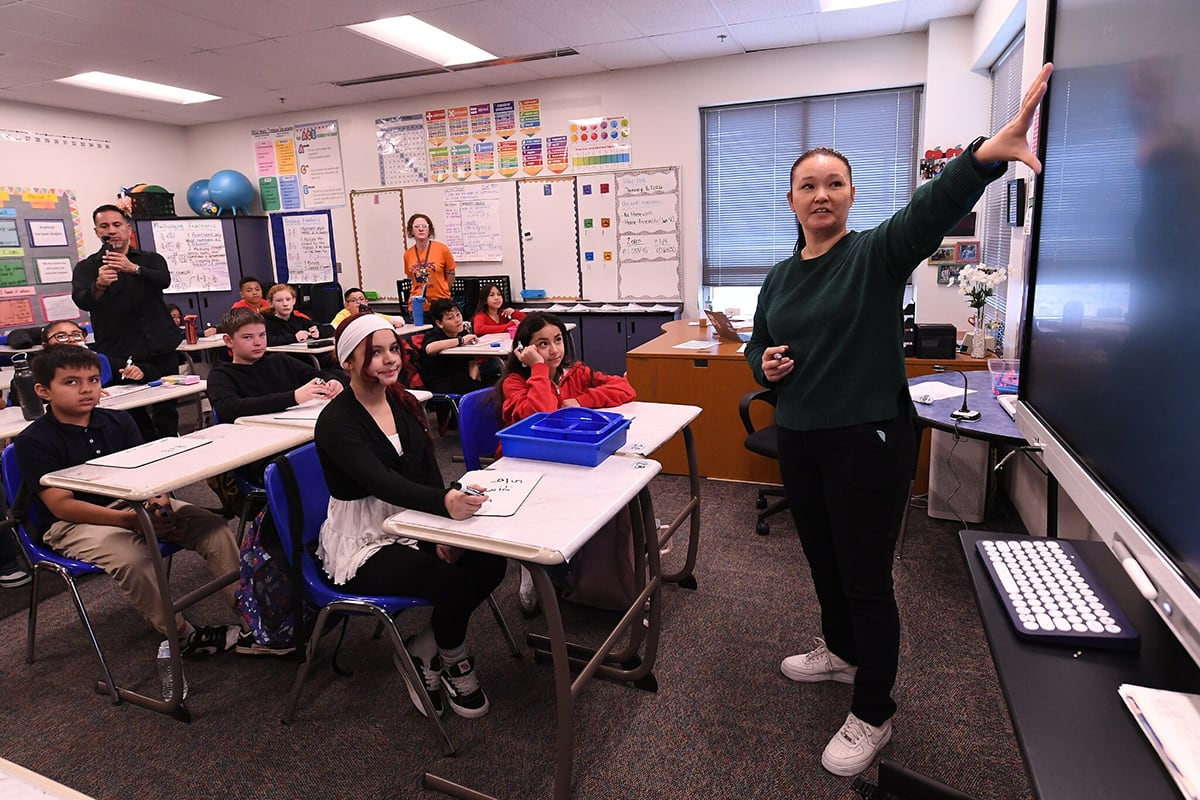
On a Thursday in January, Shana Engel and the rest of the teachers at Mountain Vista Community School in Colorado Springs gathered with their students for a special assembly. No one knew what it was for.
Engel, a sixth grade math teacher, figured one of her colleagues was being recognized.
But suddenly the cameras were trained on her, with students screaming and clapping as she picked her way through the packed bleachers to the gym floor, where Colorado’s education chief was waiting to give her a hug.
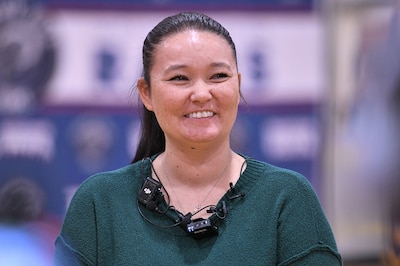
Engel had won the Milken Educator Award, often referred to as the “Oscars of teaching.” The award is for early or mid-career teachers and comes with an unrestricted $25,000 prize.
“I was beyond surprised when my name was called,” she said.
Engel, who is one of 30 Milken award recipients nationwide this year, talked to Chalkbeat about how her fourth grade teacher calmed her “new student” nerves, what she learned from her mother’s struggle to learn English, and how she helps struggling students solve math problems.
Was there a moment when you decided to become a teacher?
I’ve wanted to be a teacher since I was a student at Mesa Ridge High School in Colorado Springs. We had an elementary education elective class at school, which allowed us to visit the surrounding elementary schools and volunteer. I loved being in the school environment as someone the students looked up to and sought help from.
How did your own experience in school influence your approach to teaching?
When I was in fourth grade, we moved schools. I was nervous about moving to a new school and have always been a shy person. Somehow, my new fourth grade teacher, Mrs. Russel, sensed that. She brought me outside and introduced me to a group of students who would become some of my best friends at that school for the next couple of years.
I always remember the warmth I felt when I first spoke with her, and the satisfaction I felt when she introduced me to some new friends. It reminds me that all students are different and experience things that aren’t always pleasant, and that teachers have the power to help students adjust.
What other experiences shaped you as an educator?
My mother was born in Korea and moved to the United States after marrying my father, who was in the army. She spoke Korean at home. Throughout my life, I witnessed people’s reactions to my mom when they thought she could not understand them. It embarrassed her and made her feel ashamed that she did not read English and could not communicate very well.
She has gotten better at English over the years, but I always think of how hard it must have been for her.
This has helped me relate to students who aren’t English-speaking and those who have a challenging time understanding an educational world where terminology is so complicated.
Tell us about a favorite math lesson to teach.
My favorite math lessons are those on expressions or equations and those involving geometry. For example, students in sixth grade need to understand equivalent expressions, so knowing that 6(x + 5) is equivalent to 6x+30.
When my students struggle, I find the challenge of helping them understand enjoyable. By working in small groups, having students display their learning on white boards, and encouraging productive conversations with math vocabulary, students start to get better at concepts they once feared.
How do you help students who feel they are “bad” at math?
When students feel they are bad at math, I help them by asking questions. For example, if students need to calculate the surface area of a solid figure, I would ask them, “What is the first thing you need to do?” Many times, they think out loud and figure out where they are stuck.
For students who are very stuck, I ask them, “What shapes do you see?” “What do you know about the area of a triangle?” “If you are trying to find the total area of this figure, what would you need to do?”
Effective questioning helps students find the answer with minor prompting. When they realize they did the work, you can see their pride.
You also encourage “essential conversations” among students. Tell us how it works.
I have learned that students can help one another better than I can when given the opportunity to discuss things together. I provide sentence stems and give students specific topics to discuss. For example, I might say, “The partner with a higher number on their desk, tell your partner what shapes you see and how many of them there are. Lower number partner, agree or disagree, tell your partner why, and then identify the base and height of each shape.” I will then go to the group I notice is struggling or not talking, and ask questions.
Struggling students are paired with proficient students and students who are almost proficient are grouped with advanced students. So, there is always a partner who is stronger in math. However, students are required to speak back and forth through structured conversations so that the stronger math student isn’t just rambling to their partner.
The greatest secret for peer collaboration is building comfort with being incorrect. I often tell students, “Wrong answers are still great answers, because through fixing our mistakes, we develop a greater understanding.”
Tell us about a memorable time — good or bad — when contact with a student’s family changed your perspective or approach.
Last year, I showed a parent how much growth her daughter achieved from the beginning of the year to the middle of the year.
She just smiled and said, “I hope you know how much she likes your class … She never used to like math. Her sister has always been better, but this year they help each other. It’s because of you.”
What is something going on in the community that affects the students you teach? How do you address it?
The district I work in has many single-parent households and many families are economically disadvantaged. Our school has many programs to support those who need food or clothing, and we have many bilingual employees to assist families who do not speak English.
I work hard to help students build their confidence and realize they can do hard things. I have provided after-school tutoring and led clubs, such as robotics and STEM, to build interest in different fields.
What are you reading for enjoyment?
I work with an enjoyable group of teachers, and we have a book club this year. We are on our third book, “Happy Place” by Emily Henry. The other book that I read for enjoyment every night is the Bible, which reminds me regularly to love and cherish others, and more importantly, to lend a helping hand.
Ann Schimke is a senior reporter at Chalkbeat covering early childhood issues and early literacy. Contact Ann at aschimke@chalkbeat.org.