Sign up for Chalkbeat Indiana’s free daily newsletter to keep up with Indianapolis Public Schools, Marion County’s township districts, and statewide education news.
The Indianapolis Public Education Corporation has chosen a new leader with an extensive background in charter schools both in Indianapolis and nationwide as the board’s work ramps up on creating a new accountability system for schools.
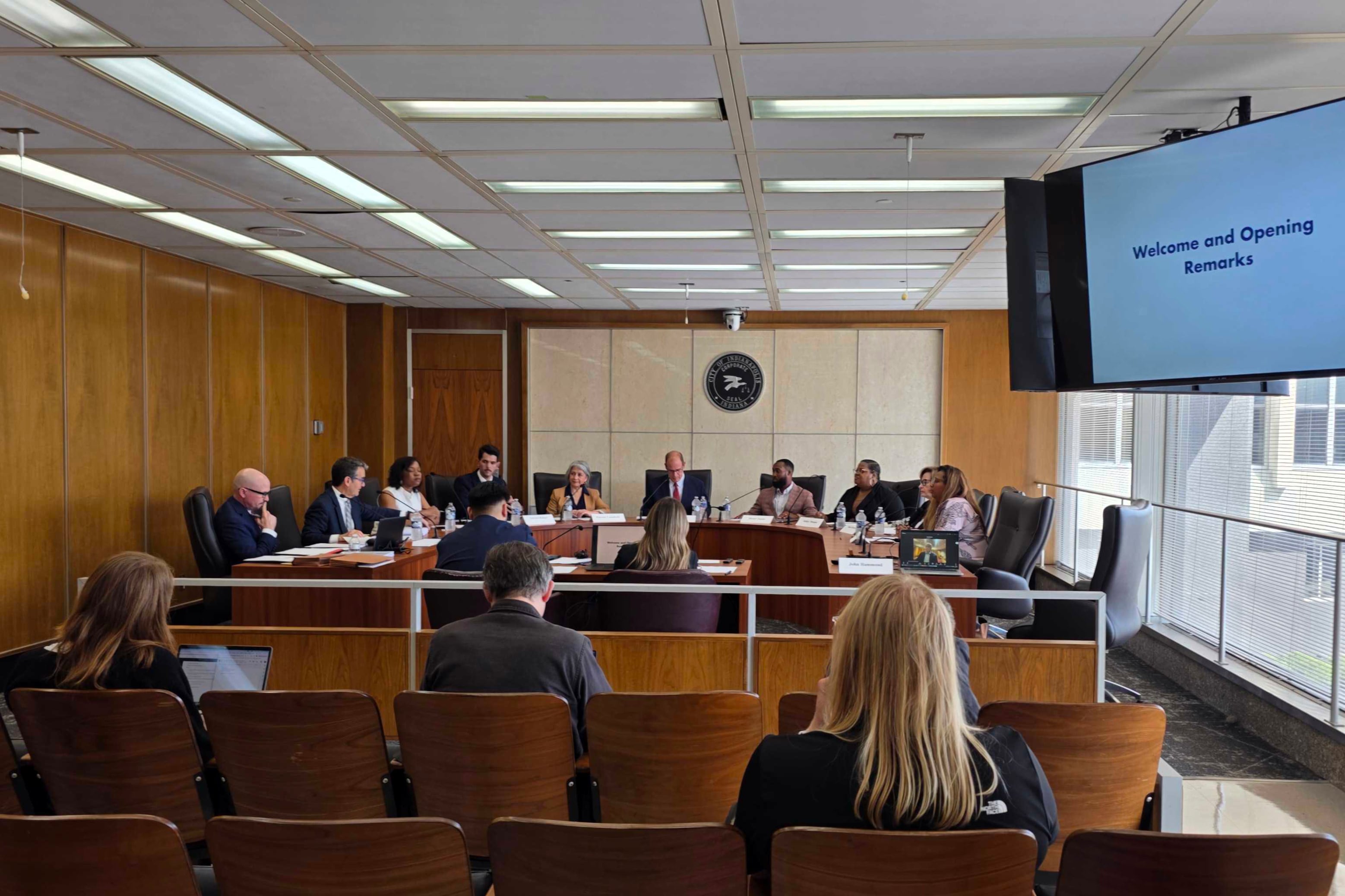
The board on Wednesday unanimously approved Karega Rausch as executive director following a recommendation from Indianapolis Mayor Joe Hogsett.
Rausch has spent the last decade as president and CEO of the National Association of Charter School Authorizers. He will lead IPEC’s work as the board drafts an accountability system for Indianapolis Public Schools and city charter schools and works to pass a property tax referendum that will be shared between IPS and charters this year. IPEC also has key powers over transportation and buildings for schools.
Rausch was chosen from a pool of 36 candidates and a list of six finalists that included school district leaders, charter school policymakers, and elected officials. His hiring further tips the balance of experience of IPEC members — which includes charter school and district leaders — toward charter schools.
He served as the education and charter schools director under Indianapolis Mayors Bart Peterson and Greg Ballard, chaired the Indiana Charter Schools Board and led Stand for Children, a nonprofit education advocacy group, in Indiana. Rausch also led a push for IPS to offer preschool, IPEC chairman David Harris said.
In comments at the meeting, Rausch characterized himself as a bridge builder.
“I’ve sought to listen carefully, communicate clearly, and build consensus around meaningful outcomes for kids and families,” Rausch said.
The board also extended its contract with acting executive director Michael O’Connor to Sept. 1.
Neither a start date nor a salary have yet been determined for Rausch, according to O’Connor, because the board first needed to approve the hire. Those details will be negotiated by board chair Harris — and posted — in the coming weeks, O’Connor said.
The salary range for the executive director position was listed as $235,000 to $325,000.
How a new accountability system informs school closures
During Wednesday’s meeting, the board also heard an update from the group developing a draft of the new accountability framework for schools.
The framework will apply to both types of schools under IPEC’s purview — IPS and charter — and will be based on factors such as academic results, student growth, enrollment, and finance and governance.
The system will enable IPS and charter authorizers to address chronic low performance, according to the group’s presentation.
IPEC board member Edward Rangel, who led the group, emphasized that only those entities — not IPEC — will decide if a school can continue to operate. But the accountability framework will allow IPEC to reassign underenrolled school buildings.
“A school’s existence is not our discretion,” Rangel said. “Resource allocation does lie with IPEC.”
Rangel said the board expects to lean on external experts as it considers which buildings are underenrolled.
The law that created IPEC — HEA 1423 — allows it to appeal to the State Board of Education if a school operator chooses not to close an underperforming school.
There will be no summative score on the framework, in part because that could be confused with the state’s new school accountability system, Rangel said.
An update on this system is due to lawmakers on Aug. 1, with a final draft due in November 2027. The board expects to host stakeholder engagement meetings throughout August. The system is expected to take effect in the 2028-29 school year.
IPEC meets again on Aug. 12.
Correction: A previous version of this story misstated the date that IPEC must submit a final performance framework to lawmakers.
Aleksandra Appleton covers Indiana education policy and writes about K-12 schools across the state. Contact her at aappleton@chalkbeat.org.