Sign up for Chalkbeat New York’s free daily newsletter to get essential news about NYC’s public schools delivered to your inbox.
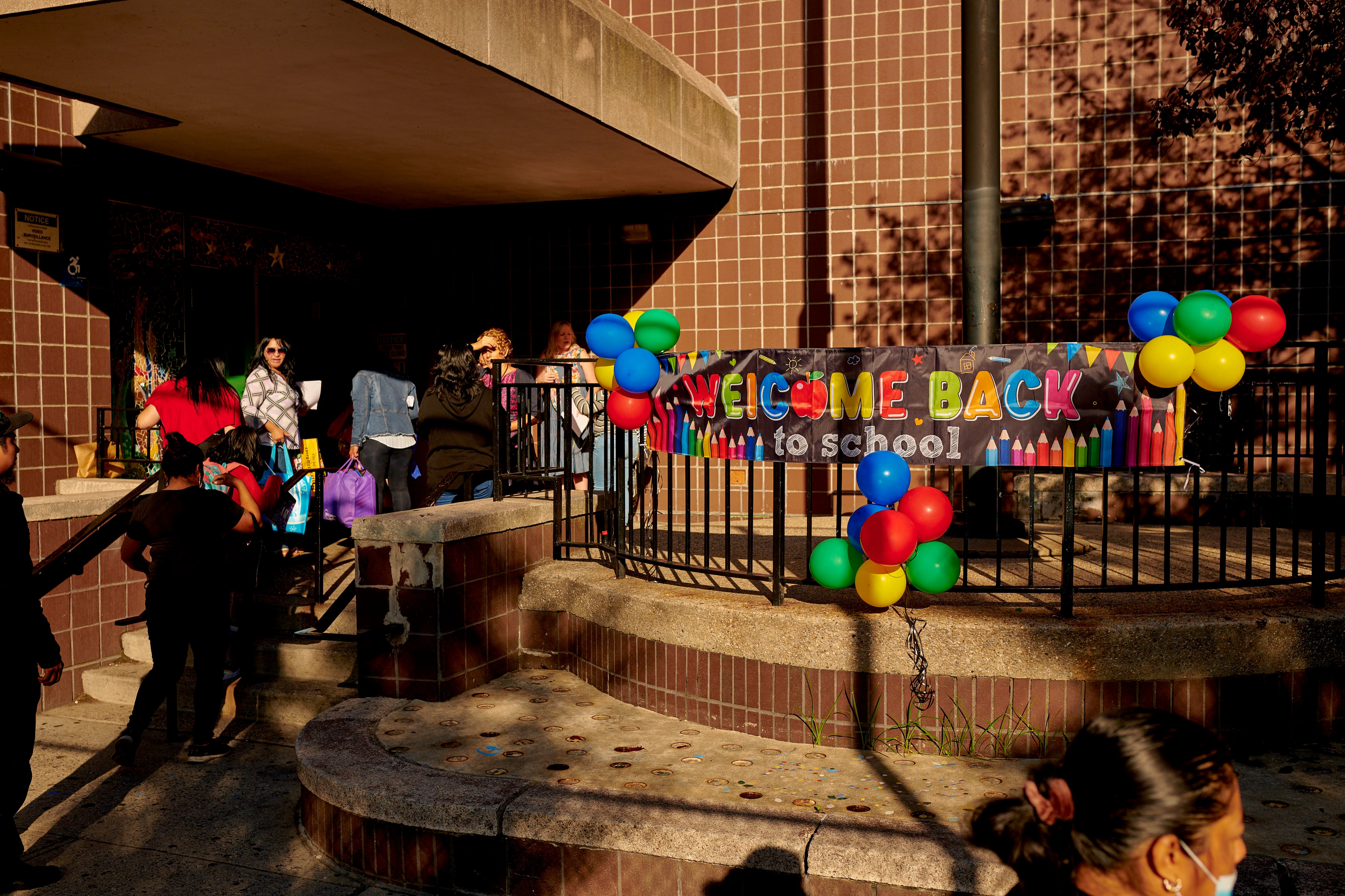
On Thursday, New York City’s public schools will begin the first full school year under Mayor Zohran Mamdani.
His signature initiative will provide free childcare to about 2,000 2-year-olds — the initial phase of his ambitious promise to create a universal program. New York City is also implementing a year-long policy with strict limits on student-facing AI use and screen time for the city’s youngest students.
But much of the mayor’s K-12 agenda still remains murky. Here are five questions we’ll be asking this school year.
When will Mamdani’s education agenda come into focus?
The city’s schools are grappling with immense challenges. Significant learning disparities continue to fall along race and class lines. Recent test score results raise fresh questions about whether student achievement, particularly in reading, is heading in the wrong direction. Chronic absenteeism, which spiked during the pandemic, remains elevated.
More than eight months in, neither Mamdani nor schools Chancellor Kamar Samuels have laid out detailed plans to tackle those challenges nor have they sketched out clear goals for the nation’s largest school system. And on several key issues — ending mayoral control of the school system, reducing class sizes, and boosting pay for paraprofessionals — the mayor has backtracked from campaign promises.
How will a new administration grapple with big enrollment declines?
The influx of tens of thousands of migrant students starting in 2022 temporarily slowed the enrollment losses that have been hollowing out New York City schools for a decade. But that migration came crashing to a halt last year when President Donald Trump took office, and the enrollment losses resumed. The city’s K-12 public school enrollment fell to about 790,000 last year, a drop of nearly 150,000 students since the 2017-18 school year. That’s a loss of 16%. The latest enrollment projections predict the decline will continue over the next decade.
There are now nearly 340 schools with fewer than 250 students. Such small schools have a hard time providing a robust education, and they’re more expensive for the city to operate. Samuels has said that consolidating underenrolled schools is a priority, but he has yet to lay out any citywide plans. And school mergers and closures are always contentious, provoking strong reactions and blowback. We’ll be watching to see how Samuels approaches the enrollment challenge and whether officials try to pick up the pace of school mergers and closures.
Can Mamdani’s free childcare rollout overcome early payment snafus?
While Mamdani hasn’t yet staked out a clear agenda on K-12 education, it’s a different story in the early childhood education arena.
Just days into his administration, Mamdani sketched out plans to begin delivering on his promise to expand free childcare — starting with 2,000 free 2-K seats for 2-year-olds in select districts this fall. Officials got more than enough applicants to fill those seats. But long-running challenges in the childcare sector — from bureaucratic delays in approving contracts, to low rates of pay for many childcare providers, to thousands of unfilled seats in the city’s 3-K and prekindergarten programs — continue to hang over Mamdani’s efforts.
With a new deputy chancellor for early childhood education taking the helm, we’ll keep an eye on how the city tries to chip away at those longstanding challenges, while also laying the groundwork to expand the 2-K program to reach 12,000 kids next year.
How will big changes in school technology policies affect students and educators?
Shortly before students returned to classrooms, Mamdani announced a ban on generative AI tools from preschool through eighth grade and restrictions on individual devices for the city’s youngest students.
Those changes come on the heels of outcry from many families and educators and represent an early test of how reducing technology and screen time in schools affects student learning. In some cases, schools will be required to ditch student-facing tools they’ve been using to aid their teaching. Other major school systems will be watching closely, as AI-fueled technology tools continue to proliferate, and New York City’s technology policy is among the most aggressive in the country.
Will Mamdani make good on his vow to improve special education?
As city officials warn of potential yellow bus shortages this school year, Mamdani will face an early test of his pledge to prioritize students with disabilities, who represent about 43% of the 150,000 children who depend on school buses. Roughly 24% of the city’s public school students have a disability.
Samuels has vowed to tackle the longstanding dysfunction in the school bus system “once and for all” in part by renegotiating contracts that are nearly a half century old. Doing so will be a complicated task that requires action from Albany.
The mayor has also pledged to reduce the cost of private school services and tuition for students with disabilities, which now represents more than $1 out of every $40 the Education Department spends. So far, officials have announced plans to add capacity to the city’s own special education programs, though it remains to be seen whether it’s enough to make a dent.
Alex Zimmerman is a senior reporter for Chalkbeat New York, covering NYC public schools. Contact Alex at azimmerman@chalkbeat.org.
Michael Elsen-Rooney is a reporter for Chalkbeat New York, covering NYC public schools. Contact Michael at melsen-rooney@chalkbeat.org