Sign up for Chalkbeat New York’s free daily newsletter to get essential news about NYC’s public schools delivered to your inbox.
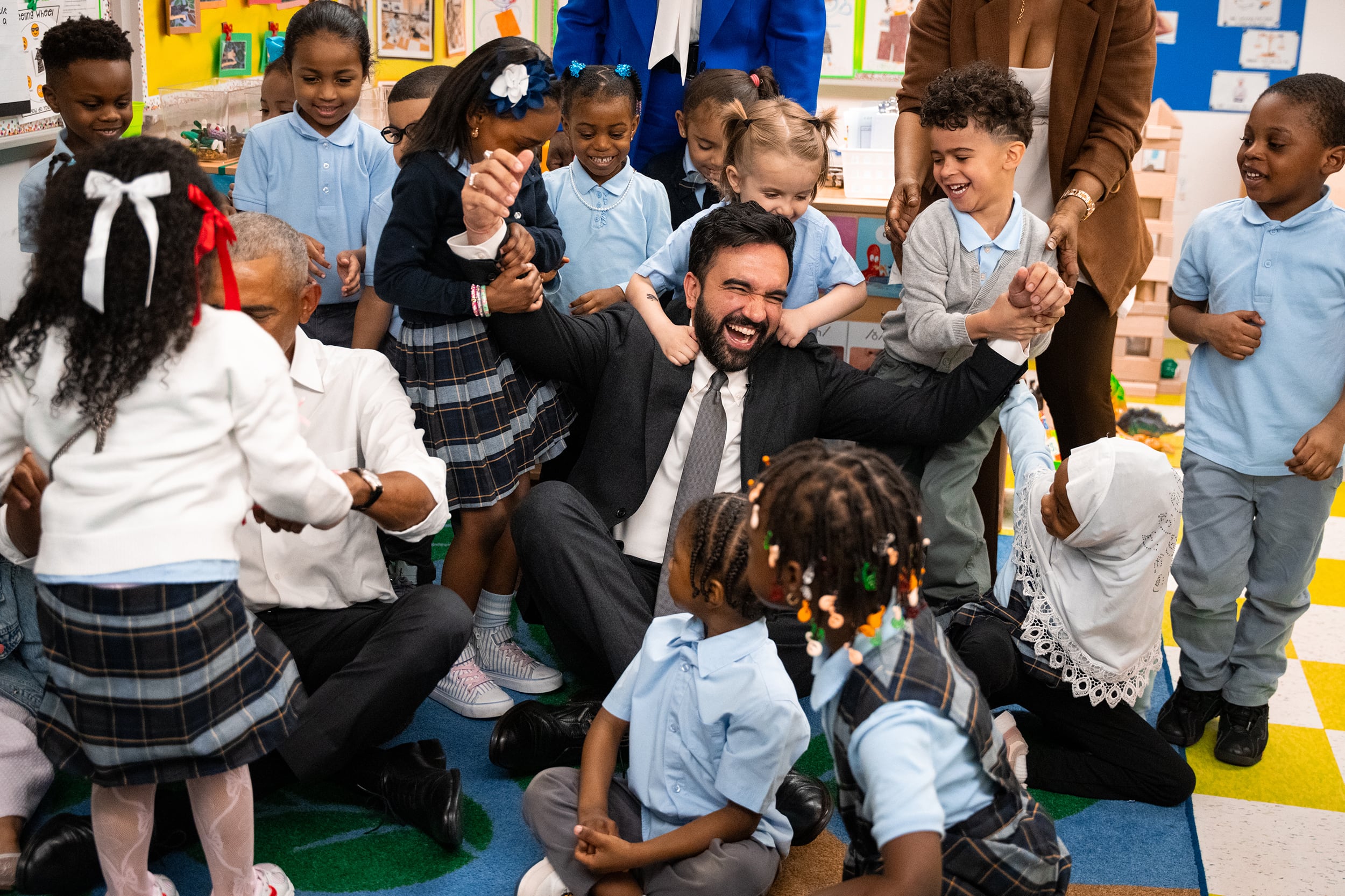
Roughly 2,000 families received offers for a spot in the inaugural year of 2-K, New York City’s new free childcare program for 2-year-olds, officials announced Tuesday.
Around 5,700 families applied for the initial 2,000 seats, which were restricted to priority neighborhoods in Manhattan, Brooklyn, Queens, and the Bronx.
“Today represents a monumental step on the path to universal childcare here in New York City,” Mayor Zohran Mamdani said at a press conference Tuesday morning in the Bronx. Mamdani made expanding free childcare a key campaign pledge.
“We are writing a better chapter for … the generations of New Yorkers many years from now who will start families here in our city and who will not need to worry about leaving their job or moving out of the neighborhood they love to make it all work,” he said.
The release of the offers comes after city officials spent months spreading the word about the new program with events such as a “2K for 2-K” road race in Manhattan’s Fort Tryon Park and a jingle contest judged by Cardi B and Lin-Manuel Miranda.
The initial interest in 2-K comes as welcome news for Mamdani after his administration’s efforts to boost publicity for the city’s 3-K and prekindergarten programs didn’t lead to an increase in applications. Those programs, while wildly popular and oversubscribed in some neighborhoods, have struggled with thousands of empty seats in other parts of the city.
Officials didn’t share any details about how the initial round of applications and offers were distributed between the priority neighborhoods: Washington Heights and Inwood in Manhattan, Canarsie and Brownsville in Brooklyn, Ozone Park and the Rockaways in Queens, and Fordham, Belmont, Riverdale and other nearby neighborhoods in the Bronx.
Emmy Liss, the executive director of the mayor’s Office for Childcare and Early Childhood Education, said the “majority” of the children who received offers live in the priority districts. Officials prioritized applicants who have siblings at the program they applied to, or were already attending that program, and those who live in the same district, Liss said.
More than 80% of applicants got into one of their top three choices, and more than half got into their first choice, officials said. Families that applied and didn’t get an offer will automatically be added to waitlists.
In a press release Tuesday morning, officials said that the application results from this year would help guide the expansion of the program next year. Mamdani has pledged that the program will grow to 12,000 seats next year and expand citywide by the end of his first term, though Gov. Kathy Hochul has only committed funding for the first two years. A report released Monday by the Center for New York City Affairs found that it will likely cost around $9 billion to provide free universal childcare for all children under age 5, about $5 billion more than the city is currently spending,
Officials haven’t yet shared where the additional 10,000 2-K seats for next year will be located, except that they will likely add seats in the priority neighborhoods and some of the new seats will be in Staten Island, the only borough not a part of this year’s 2-K rollout.v
Seats are split between center and home-based programs. Unlike 3-K and pre-K, which mostly follow the K-12 school calendar, most 2-K seats are free from 8 a.m. to 6 p.m., year-round.
Michael Elsen-Rooney is a reporter for Chalkbeat New York, covering NYC public schools. Contact Michael at melsen-rooney@chalkbeat.org