Sign up for Chalkbeat New York’s free daily newsletter to get essential news about NYC’s public schools delivered to your inbox.
A coalition of union officials and civil rights leaders urged New York Gov. Kathy Hochul on Wednesday to reverse her plans to opt into a federal tax-credit scholarship program passed by Republicans in Congress and signed by President Donald Trump.
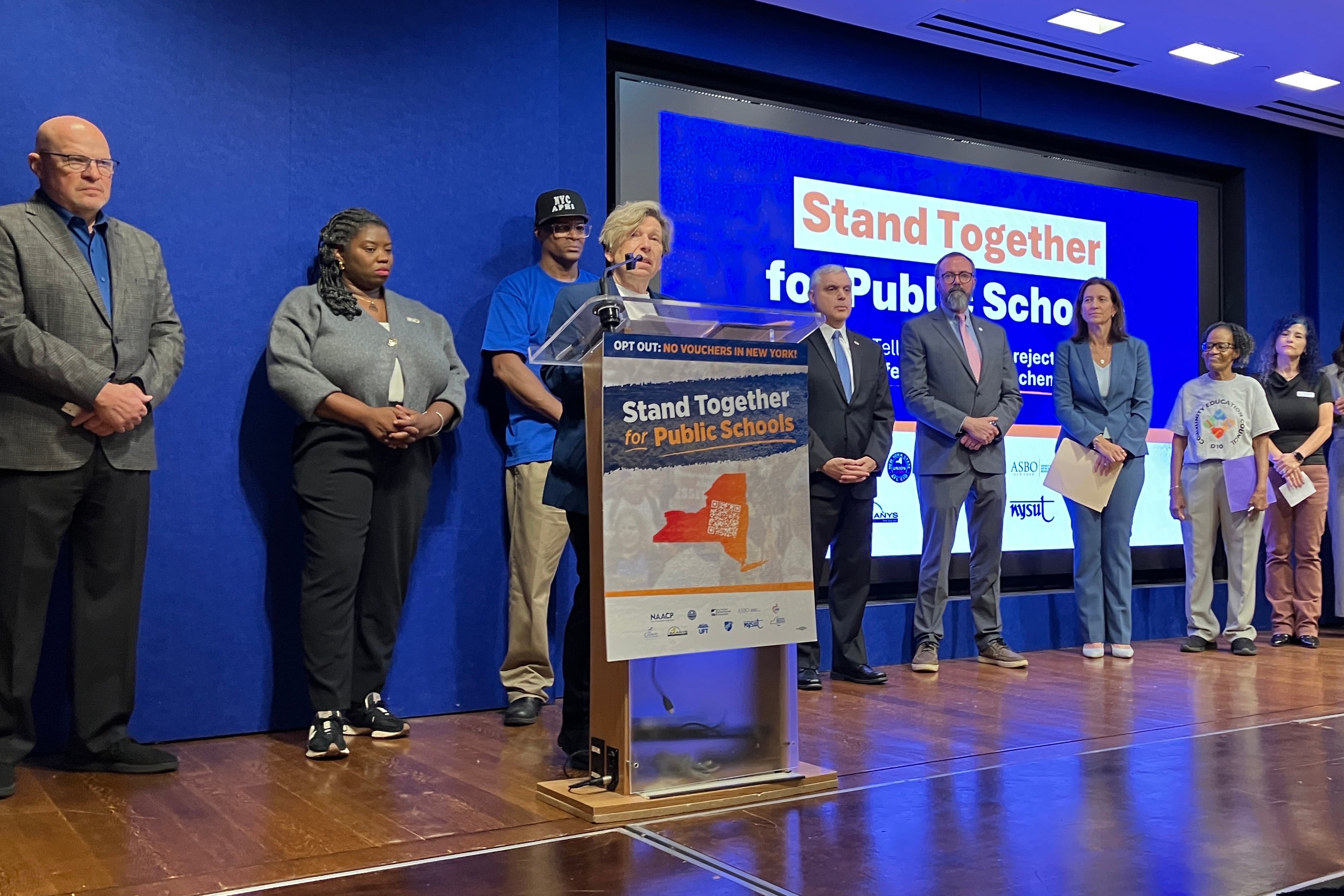
During a gathering at the Lower Manhattan headquarters of the United Federation of Teachers, top officials argued that the voucher-like program represents a threat to public education. They said it would allow public funding to flow to private schools that may refuse to admit higher-need children. They were flanked by several lawmakers and representatives from advocacy groups, including the NAACP.
“Vouchers are about allowing private schools to pick and choose who they admit, leaving the most vulnerable children behind,” said Randi Weingarten, president of the American Federation of Teachers. She offered a blunt message to the governor: “Opt out right now.”
The press conference is one of the most visible efforts so far to persuade Hochul, who is facing reelection in November, to change her position on the federal program. Many of the groups support Hochul’s reelection bid and are hopeful she will be receptive to their arguments, even as she indicated in May that she plans to opt the state in.
In a statement, Hochul’s office reiterated its support for the program and emphasized that public school students can benefit from it.
“Governor Hochul’s priority is making sure every student receives an education that best meets their needs, which is why she wants the federal scholarship tax credit to benefit all New York students,” Hochul spokesperson Jonah Allon said. He noted the governor has increased funding for public schools and that the tax credit program would not divert funding from local and state budgets.
The tax credit program, approved last year through the Republican-backed One Big Beautiful Bill Act, will take effect in January 2027. It allows taxpayers who donate up to $1,700 to an eligible scholarship-granting organization to receive an equivalent reduction in their federal taxes. Those organizations can give students money for private school tuition, tutoring, and other education-related costs.
Governors must opt their states in for students to benefit from the program. Hochul’s office has previously said she’s waiting for regulations from the Treasury Department, expected later this month, to see if there are any “poison pills” that would change her decision to participate.
Union officials said they still believe there’s time to get their message across to the governor.
“We’re just hoping that she continues to have an open mind and hears us,” United Federation of Teachers President Michael Mulgrew told reporters on Wednesday.
Thirty states have formally opted in, according to a list maintained by the Internal Revenue Service. Most are Republican-led, and many already have state voucher or education savings account programs.
So far, Colorado Gov. Jared Polis is the only Democrat to officially opt into the program and enthusiastically embrace it. In Kentucky, Kansas, and North Carolina, Republican-controlled legislatures overrode Democratic governors’ vetoes to opt their states into the program. Some Democratic governors, including Oregon Gov. Tina Kotek and Wisconsin Gov. Tony Evers, have firmly rejected the program. Most are taking a wait-and-see approach, prompting furious lobbying from all sides.
The federal program would represent a dramatic expansion of private school choice in blue states that have resisted vouchers. But some public education advocates have argued that it would be a mistake to pass up the opportunity to raise money for tutoring or after-school programs — even if they think the credit is bad policy.
Teachers unions have generally taken the opposite tack, arguing the program will undermine public schools by luring away students and directing more taxpayer dollars to private schools.
Still, enrollment and funding are not necessarily directly linked: State funding for New York school districts has increased in recent years even as there are fewer students in public schools. Funding for the federal tax credit comes from federal, not state, coffers. Advocates have pitched the effort as essentially free federal money.
Union leaders raised a host of other concerns. They argued that scholarship-granting organizations could spend money in ways that don’t benefit students and that public funding could flow to schools that may not welcome students with disabilities or other needs. They also noted that relatively affluent families could benefit from scholarships to private schools because families earning up to 300% of their area’s median income are eligible.
“The fundamental difference between public and private schools is this: we educate everyone,” said Melinda Person, president of New York State United Teachers.
Others are pressuring Hochul to move forward with her plans to opt in. A coalition of 37 anti-poverty groups, community-based organizations, and charter school leaders argued in a Sept. 10 letter to Hochul that the program could benefit public school students.
“This program offers a source of funding, at no cost to the state education budget, that can expand access to tutoring, afterschool programming, special education services, and other supports that are too often out of reach for lower-income families,” the letter states. “We believe New York can shape its participation in ways that meaningfully benefit public school students.”
Jim Blew, who advises a coalition of groups backing the tax credit, praised Hochul’s plan to participate.
“We are very impressed that she has stood up to the unfounded arguments from the unions,” said Blew, who worked in the Education Department during Trump’s first term. “This takes no money from the state budget for public education.”
Ideas editor Matt Barnum and national editor Erica Meltzer contributed.
Alex Zimmerman is a senior reporter for Chalkbeat New York, covering NYC public schools. Contact Alex at azimmerman@chalkbeat.org.