Did you know search engines like Google are changing the way you see news? Keep Chalkbeat’s valuable education coverage at the top of your feeds by clicking here and checking the box next to our name.
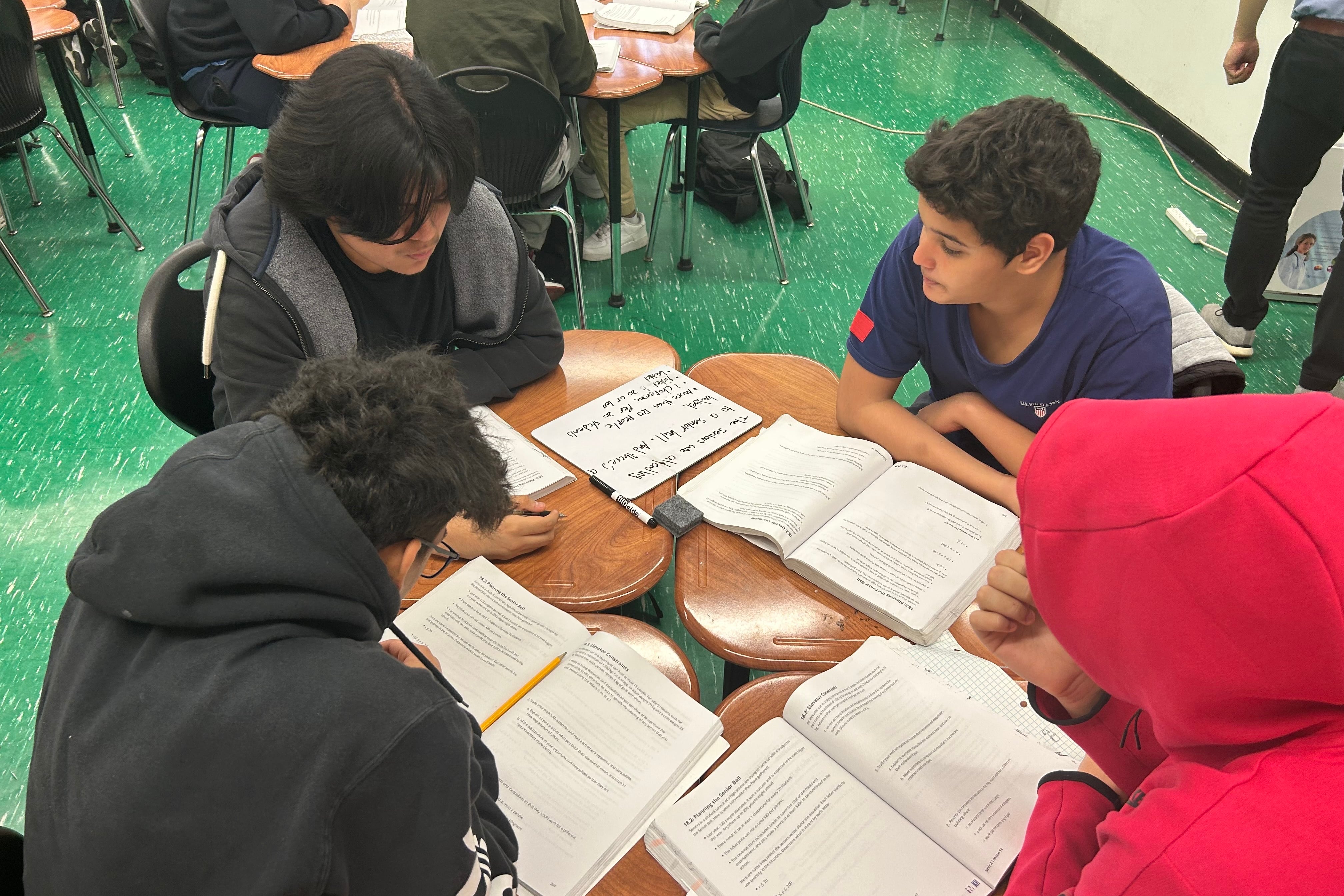
New York City has made a big bet that math instruction should prioritize open-ended problem solving and student discussion rather than more rote methods. But some educators worry the new curriculum is challenging to implement and could be counterproductive for students who haven’t mastered the basics.
Gabe Rosenberg, veteran math teacher at Bard High School Early College in Manhattan, knows the debate well. He helped develop portions of the Illustrative Mathematics high school curriculum. New York City mandates the problem-based curriculum for high school Algebra 1 and requires the elementary school version in some schools. Philadelphia and Denver are increasingly adopting it, too.
Asked about his approach to designing curriculum, Rosenberg said a guiding principle was focusing on knowledge and skills students will retain five or 10 years from now.
“Memorizing a few things they will forget by next Fall is unimportant,” he said in an email. “Every student should see themselves as capable doers of mathematics.”
Rosenberg’s career initially focused on studying pure mathematics as a university researcher, earning a doctorate from Columbia University before teaching at Yale. He ultimately gravitated toward math education, which he felt could reach far more people than specialized research. In 2004 he joined Bard High School Early College, a selective program that offers students a chance to graduate high school with an associate’s degree.
More recently, Rosenberg won Math for America’s Muller Award for Professional Influence in Education, which comes with $20,000 in prize money. (An additional $5,000 will go to Illustrative Mathematics, which nominated him.)
Chalkbeat caught up with Rosenberg to learn more about how he approached crafting an influential math curriculum as part of a larger team, what he makes of the critiques of the curriculum’s more open-ended approach, and how he works with students who struggle with math.
This interview has been edited for length and clarity.
You teach at Bard High School Early College Manhattan, which has a selective admissions process. How did you approach writing a curriculum for a broader range of students?
I have had the great fortune of working with mathematics teachers from across New York City in Math for America and across the U.S. and Canada through the Park City Mathematics Institute. Those experiences have led me to believe that all students are capable of learning mathematics. They just need to be given the opportunity to explore it themselves.
What’s your favorite Illustrative Mathematics lesson to teach? Walk me through what students do and why you like it.
My favorite lesson is a geometry lesson in the unit on congruence called “Points, Segments, and Zigzags.” Students are first asked to prove or disprove the claim that all points are congruent. They next move on to prove or disprove the claim that all segments are congruent. After disproving that claim, they modify the claim to one that can be proven: All segments of the same length are congruent.

There is so much I love about this lesson. First of all, it highlights an incredibly important and broad concept in mathematics, the importance of precise definitions. I also love that, as is often the case in mathematics, there are several different avenues to prove the claims presented. And after disproving a claim, students immediately have the opportunity to do what mathematicians would often do in such a situation, revise the claim. Finally, we get a glimpse of one of the reasons WHY we prove things in mathematics.
One criticism of Illustrative Math is its conceptual approach assumes students have some of the nuts and bolts down, when many students don’t. Do you think that’s a fair criticism? How should a teacher handle that?
I don’t really agree. The curriculum doesn’t make assumptions. It is filled with opportunities for formative assessment, where teachers can get a better sense of where their students are coming from and opportunities to use that information to make adjustments. In the case of Algebra I there are whole “extra support lessons.”
The key is that all students should have the opportunity to engage with grade level mathematics. When a student comes in with some gap, there is some evidence that what was being done before wasn’t working. Repeating it is unlikely to help. Provide only enough support so that students may genuinely engage in the math at hand. Sometimes that opportunity to see a concept used in a new and interesting context can provide students more motivation to learn it.
When a student is really struggling to understand a mathematical concept, what do you do? Can you give me an example?
The first step should be to try to figure out what the precise obstacle is. Only then can you plan a strategy to remove the obstacle.
For example, if all I knew was that a student was having difficulty completing the square, I wouldn’t have any idea where to begin. If, however, I can get them to make their thinking visible and I see that they are confusing the idea of finding the square root of a number with the idea of halving a number, I am in a much better place to help.
There’s been a backlash to ed tech in schools at the same time teachers are figuring out what to do with AI. What role do you think technology should — and shouldn’t — play in a math classroom? Do you use AI?
I do not use AI in my teaching and do not want students using it either. Partly that is for environmental and ethical reasons but also for pedagogical reasons.
My favorite book is “Mathematics for Human Flourishing” by Francis Su, which reveals how mathematics is a critical human endeavor. The core value of mathematics is lost if it is not humans engaging with it. Technology works best when it leads to more human engagement. So, for example, using dynamic software to explore a great variety of examples, can lead to students making interesting conjectures that they may then try to prove or disprove.
Are there any particular math gaps you’ve noticed among high schoolers in recent years?
I have been particularly concerned with students’ lack of a strong understanding of the concept of fractions. It’s not really a recent problem, but has continued to intensify recently. I find that some students come into high school without being able to add or multiply two fractions. The rest are able to do so because they’ve memorized some rules, but can’t tell you why those rules should be true.
A student that understands why two-thirds plus five-thirds is seven-thirds, but two-thirds times five-thirds is ten-ninths will also be able to understand why 2x plus 5x is 7x, but 2x times 5x is 10x-squared and why 2 root 3 plus 5 root 3 is 7 root 3, but 2 root 3 times 5 root 3 is 30.
Tell us about your own experience with school and how it affects your work today.
I remember being pulled out of regular math classes so that I could work on more interesting mathematics. Those meetings and summer math programs were the only opportunities to see the more broad world of mathematics. I’ve strived in my work today to provide opportunities for all students inside a math classroom to explore and discover more interesting mathematics.
Alex Zimmerman is a senior reporter for Chalkbeat New York, covering NYC public schools. Contact Alex at azimmerman@chalkbeat.org.