Did you know search engines like Google are changing the way you see news? Keep Chalkbeat’s valuable education coverage at the top of your feeds by clicking here and checking the box next to our name.
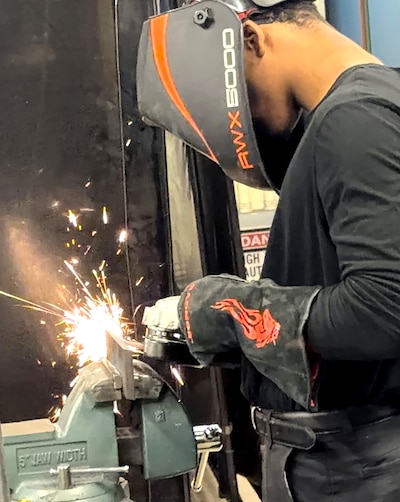
Kristopher Purnell, 17, wants to be an underwater welder when he graduates high school. But he acknowledges that “it’s a little risky.”
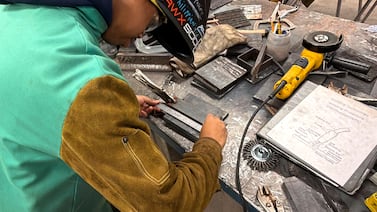
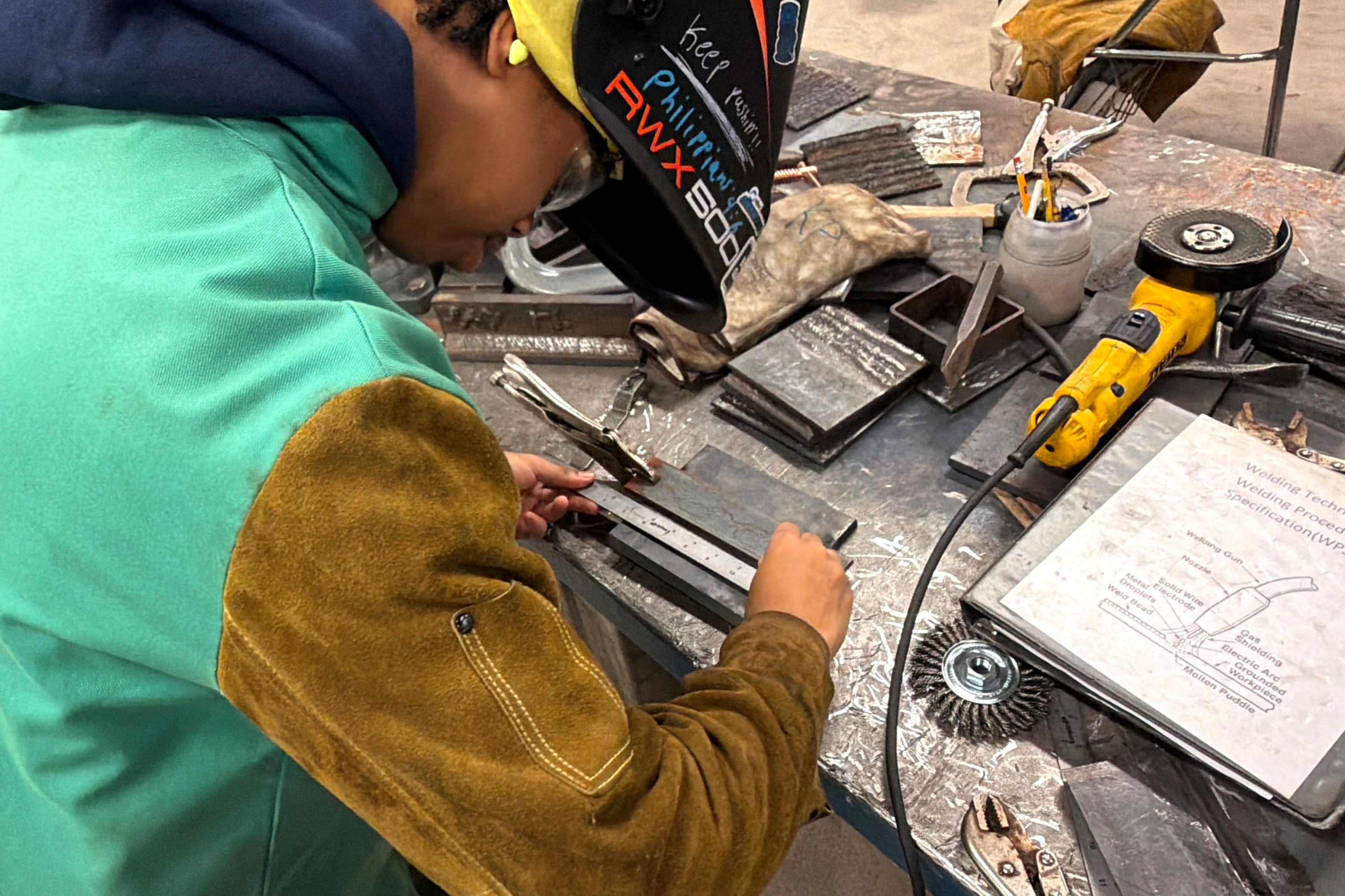
Wearing a welding jacket and helmet during a recent morning in his Philadelphia high school’s welding room, he said he had been “arc flashed” — a kind of severe sunburn on the cornea from not having his helmet on correctly. He’d also gotten a few minor skin burns since joining his school’s welding program in 10th grade.
But Purnell, now an 11th grader, isn’t put off by the physical toll of the trade. He scrawled “keep pushin’!!” on the side of his helmet.
“What motivates me, I gotta say, it’s the pay stub,” he said.
Philadelphia has been brimming with welding and machinist jobs ever since President Donald Trump set his sights on bringing shipbuilding back to the United States in 2025. Backed by a $2 billion investment from the White House, one company plans to increase the city’s shipyard’s annual production from less than two vessels to up to 20 and create more than 7,000 jobs over the next five years. Most of those positions have a starting pay of more than $20 an hour — nearly three times the state’s minimum wage of $7.25 per hour.
They’re exactly the kind of jobs that local and national officials say are a great fit for all the high school graduates who don’t go to college: good pay, on-the-job training, no debt, and seemingly AI-proof. But the reality in Philly shows how difficult the path to the industry can be.
Many teens are behind in crucial math skills they need to pass job placement tests. Some balk at the physical toll and risk. Most have never even heard of shipbuilding.
Schools, community colleges, and workforce training groups are trying to provide support. But it’s expensive, and there aren’t enough training programs yet to reach all teens who may be interested.
Experts and instructors say it’s true that American shipbuilding’s revitalization offers an economic boon to young workers. But that’s only if they can — and want to — get their foot in the door. Purnell only chose the welding program because his friend put him onto it, and though he’s motivated, he said it’s tricky to balance the work with his other high school classes.
“Obviously employers can pull talent from the entire region,” said Gianna Grossmann, deputy commerce director in the city’s Office of Workforce Solutions. “We really have that focus on making sure that Philadelphia residents are equipped for that opportunity and can get it, hopefully, first.”
If Philly succeeds at launching more youth into shipbuilding jobs, it could help the rest of the country. Trump’s plan to bring back American shipbuilding will require, by some estimates, training up to 250,000 new workers nationally. Cities like Baltimore, Maryland, and Mobile, Alabama are also hoping young people can get in on the jobs.
“The question becomes, how do you create interest, and then house and upskill that interest in a way that is actually truly accessible to anyone across the city?” said Maya Heiland, director of apprenticeships at the Community College of Philadelphia.
Right now, she said, “I don’t think that that’s happening.”
Shipbuilding offers good pay to students who make it
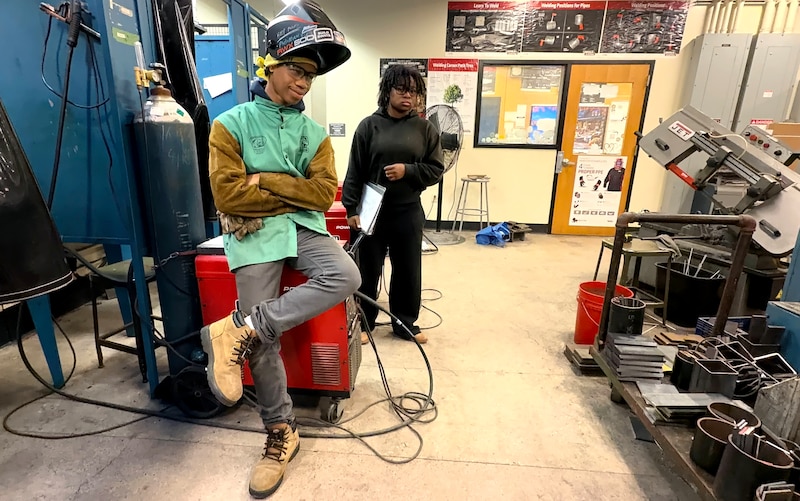
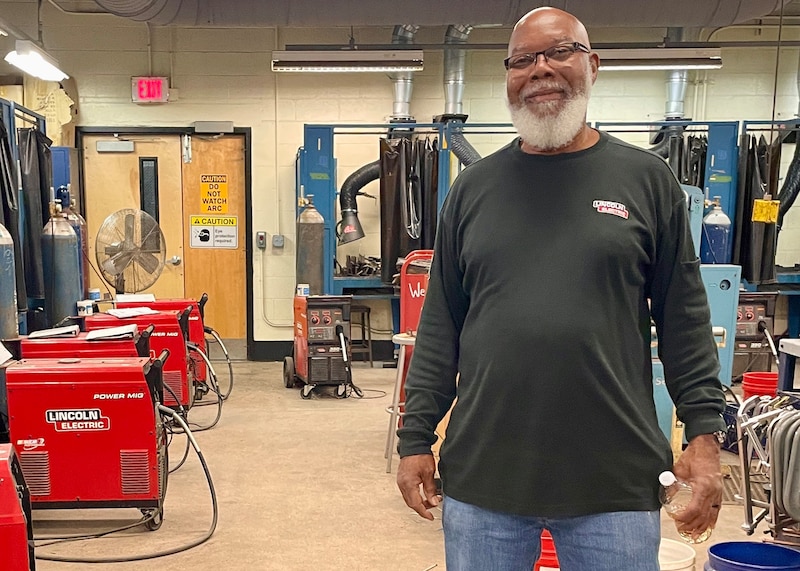
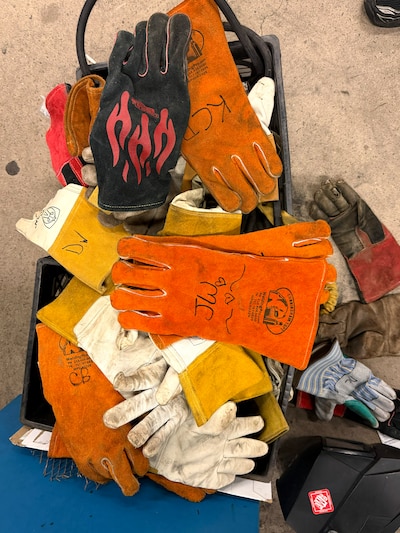
In the basement of Ben Franklin High School, retired ironworker Harry Graham runs welding classes three periods a day, where 24 students regularly share 16 practice booths.
“They’ve got incentives to graduate,” he said. “They want the high paying job.”
Research shows career and technical education training programs do help students reach graduation. But getting a related job is an additional challenge. Survey data of Philadelphia district students in career training programs released last year shows that less than a third who were working the year after they graduated were in jobs closely related to the trade they studied.
Shipbuilding is predominantly male, and historically, its jobs have come through family connections. There’s also a history of racism against Black workers in several of Philly’s trade unions.
Graham, who is Black, said he tries to help the city’s students, who are mostly Black and Latino, see a place for themselves in the trades. More women have also joined his program in recent years, he said.
But building interest is only the first challenge. Students also need to pass certification and placement tests that can be particularly difficult, instructors said. Last school year, only about half of high school seniors in the district’s construction and manufacturing training programs scored competent or advanced on their state-required assessment, called the NOCTI, according to district data.
Some students join Graham’s program in 10th grade unable to add fractions, he said, which is a middle school skill. Others are still learning to read a ruler. Most rely on calculators, which is of little use to them to pass most trade union tests. Only a quarter of district high school students scored proficient on the state math test last year.
Adam Ring’s classroom, also at Ben Franklin High School, holds several $50,000 CNC machines, which can cut metal. Students who learn to use them have a decent shot at high-paying machinist jobs.
But Ring, who teaches the school district’s only precision machining program, said he spends much of his class time teaching students math — even basic addition.
To him, those struggles show that framing these jobs as a great option for students who aren’t on a college track doesn’t always make sense.
“It’s all technical language and jargon,” Ring said. “Tons of machining jobs are related to college-level skills.”
Introducing students to the trades early is key
Still, those in Graham’s and Ring’s classrooms have more access to training than most. Only four out of the district’s roughly 55 high schools offer welding. A few local charter and private schools also offer welding training programs, as do some nonprofit workforce training organizations.
That leaves many young people out of the loop, said Carol de Fries, executive director of the city-run City College for Municipal Employment. “We need to build the pipelines for them to get access to these opportunities,” she said.
The city is working with the school district and other local groups to expand middle school programs that introduce the trades to 12- and 13-year olds. The hope, de Fries said, is that more students will choose high schools that offer those programs.
For those who don’t, landing one of these high-paying jobs can feel impossible.
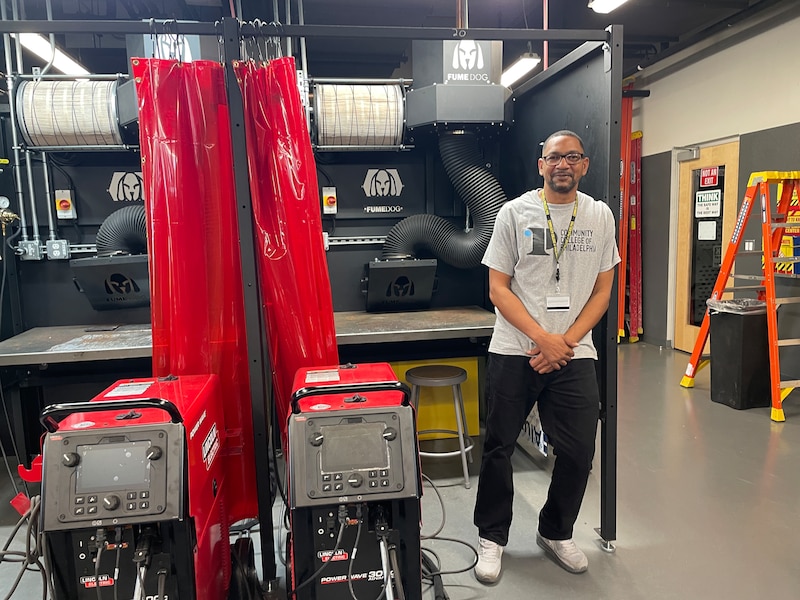
“It’s just too many barriers out here for these students coming out of high school,” said Ron Sizer, who directs the advanced manufacturing program at the Community College of Philadelphia.
Many of the college’s advanced manufacturing programs are free, with funding from the U.S. Navy. But those who join are often juggling childcare, other work demands, and family responsibilities, Sizer said.
He offers mentorship, professional connections, and technical training. But what he needs, he said, is the ability to expand the program’s reach and convince more experienced welders and machinists to teach, even though they could earn far more in the industry.
“I have more job opportunities than seats,” Sizer said. “We’re just trying to do more to fill that gap.”
Companies at the Navy Yard are using high salaries to try to entice workers. Some say young people entering apprenticeships in particularly dangerous parts of the industry, like underwater welding, can earn more than $100,000 annually by the time they’re 25 if they progress quickly through certification tests. Rhoads Industries, which builds submarines, offers apprentices a starting salary of $25 per hour.
But focusing on the high end of pay scales might downplay the fact that not everyone achieves that kind of salary. And the potentially generous pay doesn’t sway everyone.
After almost three years of training in welding at Ben Franklin High School, 17-year-old Aahayla Capers reached a decision: “I couldn’t take it up as a full career.”
She felt supported in her program, but she doesn’t like the long-term physical toll and tight quarters the jobs require. “If I can’t move around and move my body, I don’t want to do it,” she said.
While training, she got arc flashed multiple times, and now she often has to wear glasses. She blames herself for not properly following safety protocol.
“That’s the one downside that I’m really upset about,” said Capers, who plans to go into the military after high school. “That I did blow my eyes over something like this.”
Rebecca Redelmeier is a reporter at Chalkbeat Philadelphia. She writes about public schools, early childhood education, and issues that affect students, families, and educators across Philadelphia. Contact Rebecca at rredelmeier@chalkbeat.org.