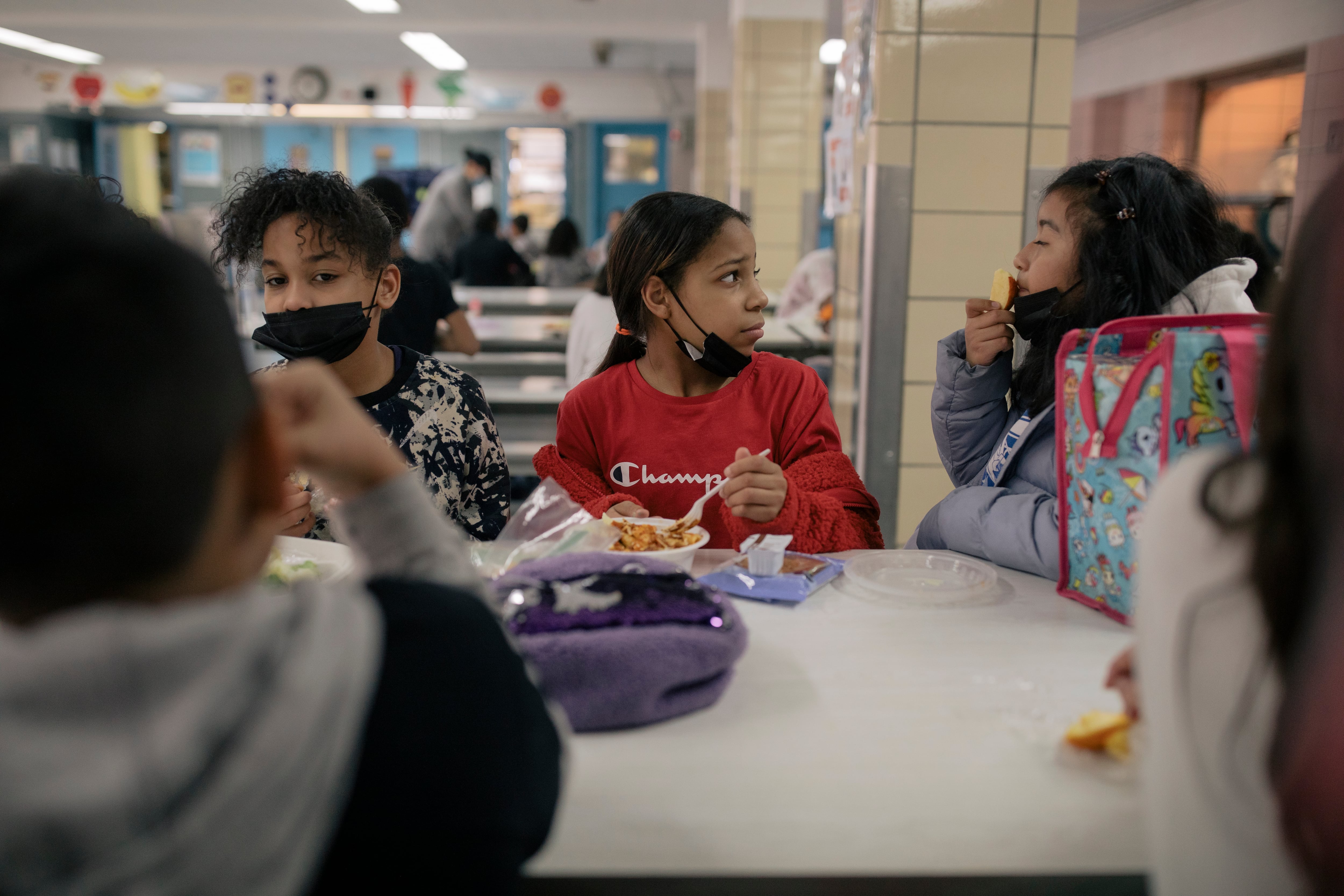
A new national survey suggests that many schools and families are struggling with this year’s changes to the federal school lunch program.
For two years, school lunches were free for all students at U.S. public schools under a pandemic-era provision that waived income eligibility requirements. But now, months into the first school year since the expiration of those rules, the share of schools with more than half of students using the program has dropped from 84% to 69%, according to survey data released Tuesday by the National Center for Education Statistics.
Across the nearly 1,000 public schools surveyed in October, more than a third said convincing parents to submit free and reduced-price meal applications was a challenge, making it the most common concern. Others cited staffing shortages and increased costs among issues facing their meal programs, according to the survey.
“For two years, there were no charges, there were no letters — none of that was happening,” said Shani Hall, who oversees student nutrition services for schools in Hillsborough County in Florida. Every week, her office sends about 3,000 text messages to parents, urging them to apply for free and reduced-price meals, she said.
“There’s a lot of confusion among parents. They just don’t understand: If they were free before, why are they not free now?” she said.
Districts across the nation are struggling to communicate the change to parents, said Diane Pratt-Heavner of the School Nutrition Association. She noted families of young children may have never seen the application form before, while other families who have come to rely on the meals might now find themselves ineligible.
Language barriers, outdated contact information, unresponsive families, and general confusion can stifle outreach efforts, too.
“The free and reduced-price meal application form was always a barrier for getting eligible kids the meals that they really rely on,” Pratt-Heavner said, noting questions about Social Security numbers have long raised concerns for some immigrant families.
Overall, about 27% of schools said administering the program was more difficult this year than last year, while 22% said it was easier and half reported it was the same.
The survey also suggests fewer public schools are taking part in the federal program. Last March, 94% of public schools reported participating in the federal program — a rate not far from the 96% participation rate in the 2017-18 school year, said Rachel Hansen, the project director for the NCES survey. But by October, that had fallen to 88%.
Hansen called that a “significant drop” and said NCES researchers were still working to understand what had caused the decline. The U.S. Department of Agriculture, which operates the federal meals program, did not immediately respond to a request for comment, and official participation rates for the school lunch program aren’t yet available for this year.
Pratt-Heavner, though, cautioned against drawing conclusions from the survey data on school participation — noting some affluent schools might opt out of the federal program if few students were eligible, but that those cases were unlikely to disrupt participation rates nationwide.
“That number does fluctuate a little bit from year to year based on school consolidation and other things like that,” she said. “But it would surprise me if a large percentage of schools dropped out of the program.”
Despite the challenges, free meals remain widely available at many schools. Hall said the majority of schools in her district qualified under the community eligibility provision — meaning the school can offer free meals to all students without collecting household applications because a high percentage of students are eligible based on participation in other programs, like SNAP.
But for students at the other 56 schools in her district, the situation is tougher, as families reeling from the economic hardships of the pandemic and rising costs face additional expenses at school.
Hall said the school district is still looking to donors to help families pay off lunch debt.
“Coming up with either the money to pay for a school meal or to pack a lunch is just so much harder right now,” she said.
Julian Shen-Berro is a reporter covering national issues. Contact him at jshen-berro@chalkbeat.org.