Sign up for Chalkbeat Chicago’s free daily newsletter to keep up with the latest news on Chicago Public Schools.
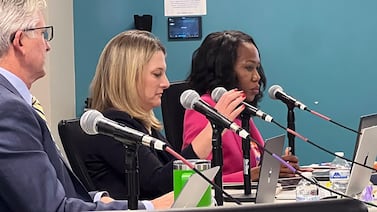
When the Chicago school board announced three finalists for the role of district CEO last week, there was a notable absence: Latino frontrunners.
Some Latino advocacy groups and community leaders have since voiced disappointment, pointing out that almost half of the district’s students are Latino. Making the matter more politically delicate is that Chicago Public Schools is seeking a replacement for its first Latino schools chief, Pedro Martinez, who was fired without cause over the objections of some prominent community advocates.
Some say the lack of Latino finalists is fresh evidence that the district must work to build a pipeline to top leadership posts for strong Latino contenders, within and outside the district.
“What we see is a disconnect between whom we serve as a district and who is making the highest-level decisions,” said Yesenia Lopez, an elected school board member representing a district on the city’s Southwest Side.
On Friday, the board said interim CEO Macquline King, former New York City schools chancellor Meisha Porter, and former East Baton Rouge superintendent Sito Narcisse — who are all Black — would vie for the district’s top role. They will meet with Mayor Brandon Johnson and a community panel next.
The board did have a Latino frontrunner, Denver Public Schools Superintendent Alex Marrero, back in November, when the district appeared to be near the finish line with the search. But when his name was leaked to the media along with Porter’s, Marrero distanced himself from the process, insisting he was committed to his current district.
It’s not clear if other Latino contenders were in the running for finalist slots more recently. School board members signed nondisclosure agreements barring them from discussing the CEO search. It is possible that candidates currently in leadership roles elsewhere might have been discouraged from continuing on when the board decided to make finalist names public last week.
In response to a request for comment from school board President Sean Harden, the board office released a statement saying that search has focused on finding candidates with “the core competencies” needed to lead CPS in partnership with the board.
“The robust recruitment and nationwide interest in the role resulted in an applicant pool, from screening to finalists, that is diverse across several metrics, including but not limited to race, ethnicity, and gender,” the statement said.
The search, which involved extensive community engagement through surveys, focus groups, student panels, and other events, yielded more than 100 applications.
Some Latino leaders decried Martinez departure
Miguel del Valle, Illinois’ first Latino state senator, who served as school board president during former Mayor Lori Lightfoot’s term, said he is reluctant to criticize the current board without knowing more about the level of interest from strong Latino candidates and any efforts to encourage such candidates to apply.
Still, he said, “Having been very much involved in selecting the first Latino CEO of CPS, I have to say I was disappointed.”
Martinez’s dismissal by a Johnson-appointed board in late 2024 drew condemnation from some community leaders. Illinois Latino Agenda, a coalition of leaders advocating for representation in positions of power, called the move “an affront” to the Latino community, arguing he had brought academic gains and stability to a school system long plagued by frequent leadership turnover.
Lopez, the school board member, said that after last Friday’s finalist announcement, she’s heard from some community leaders and elected officials on the Southwest Side, where Martinez — the son of Mexican immigrants who attended CPS — enjoyed a lot of support.
“He was seen as a person with a lived experience, bringing that cultural lens and speaking the language,” she said.
She said she worries that Martinez’ ouster and its aftermath might have discouraged some Latino candidates from pursuing the CPS top job. And she stressed the district faces a larger issue. Latinos make up fewer than a fifth of school leaders in CPS.
Lopez said a lack of community roots in top leadership can translate into policies that fail to fully consider the experience of many families. As an example, Lopez said she supports offering access to online learning for some immigrant families fearful of stepped-up immigration enforcement. But she also said extended online learning during the pandemic strained Southwest Side families, where many parents are frontline workers, and some lacked access to technology.
Latino advocates push for a leadership pipeline
Linda Xóchitl Tortolero, the president and CEO of the advocacy group Latino Policy Forum, who has since joined Illinois Latino Agenda as a member, noted in a statement that the CPS search is playing out at a time when the local Latino community feels under duress amid the Trump administration’s enforcement push, which has affected attendance for the district’s growing number of English learners and for some of its other students. She urged the district to choose a new leader with extensive experience serving Latino, immigrant, and English learner students and a record of improving their outcomes and school experience.
“Children and families deserve to see themselves in their leaders,” she said. “They also deserve leaders who see them, know them, and fight for them.”
A 2025 study by the Council of the Great City Schools, which advocates for urban school districts, showed that among 77 member districts, about 20% of superintendents were Latino in 2023. About 45% were Black, and roughly 30% were white. Only 4% were Latina women.
The report found a major increase in Latino representation in top district jobs since the start of the pandemic and a dip in the number of Black leaders. These trends coincided with a steady increase in the portion of Latino students in large urban districts and a marked decrease in the number of Black and white students.
Lopez said the board is unlikely to go hunting for a Latino finalist after a year-long search process and given a goal of selecting a new permanent CEO in April. But she said the district must do more to cultivate the next generation of Latino leaders — and saying they aren’t out there or won’t apply for key CPS posts isn’t good enough.
“That’s just an easy scapegoat answer,” she said.
Mila Koumpilova is Chalkbeat Chicago’s senior reporter covering Chicago Public Schools. Contact Mila at mkoumpilova@chalkbeat.org.