Sign up for Chalkbeat Chicago’s free daily newsletter to keep up with the latest news on Chicago Public Schools.
The Chicago school board formally voted Thursday to shutter two high schools in the troubled ASPIRA charter network, as hundreds of students have moved to new campuses months before the end of the school year.
In a unanimous vote without any discussion, the board revoked ASPIRA’s charter after months of district cash advances to the network and escalating demands for financial information Chicago Public Schools said the charter’s leadership never provided.
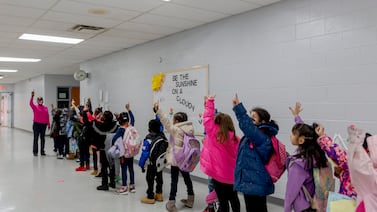
About 500 ASPIRA students have migrated to some 20 district and charter high schools. The largest group transferred to Carl Schurz High School in Irving Park, which this week held an in-person event to introduce some of the 235 new students and their families to clubs and other activities.
In addition to Schurz, about 70 students transferred to Roosevelt and 50 went to Kelvyn Park, a CPS spokesperson said. Charters have accepted about 10 ASPIRA students.
At the board’s Thursday meeting, interim CEO Macquline King praised Schurz efforts to welcome students — and decried what she described as an ongoing lack of cooperation from ASPIRA leaders in transferring student records and other issues, a charge an ASPIRA official strongly disputed.
In an unprecedented move earlier this month, the district started moving students out of the network’s Early College and Business and Finance campuses after concluding that the school could not furnish the money needed to complete the year. ASPIRA’s leaders at first struck a defiant posture, arguing the district was undermining the schools midyear, but they eventually moved to lay off all their employees at the two campuses, though the layoff notices indicated the closures could be temporary.
The vote at Thursday’s board meeting made the closure permanent.
Edgar Lopez, the head of ASPIRA, said in an interview that he is exploring legal actions against the board’s vote.
The district’s charter sector has faced a turbulent stretch, with a string of schools closing or turning to CPS for help with making payroll. Citywide enrollment declines hit charters especially hard last fall, putting a strain on campuses whose funding is largely based on the number of pupils they serve. Charter advocates have also blamed a district practice of withholding thousands of dollars per pupil for CPS’ massive debt and pension obligations.
But critics of the industry have held up the case of ASPIRA to argue that financial missteps and insufficient transparency have at least contributed to the crisis.
District officials have said ASPIRA leaders wildly overestimated projected enrollments in budgeting and failed to come up with a feasible plan to finish out the school year, despite $2.5 million in advances from CPS.
On Thursday, King said the district is backing proposals at the state legislature that would empower CPS to monitor charters more closely and intervene more quickly if it has concerns about their finances. She spoke of the “traumatic” disruption to students, families, and staff when charters flounder without much notice.
“We cannot allow this to be the status quo,” she said.
ASPIRA students scattered to other campuses in recent weeks
King said 75% of ASPIRA students have transferred to district schools, and officials are working to ensure the rest have found a new campus. The district has waived all student fees for them and is providing Ventra cards, mentoring, and mental health services, she said. Making sure seniors can transfer all credits and stay on track for graduation is “top priority,” King said.
She said Alfonso Carmona, the district’s acting chief education officer, met with ASPIRA’s board this week, “imploring them to do the right thing” and help students transition smoothly to new schools.
Jennifer Conant, the charter division chair of the Chicago Teachers Union, which represents educators at ASPIRA, said about 50 students remain enrolled in the two network campuses, though few are coming to school.
Lopez called the district’s claims that ASPIRA hasn’t been cooperative a “fat lie.” Lopez said the network held a fair with about a dozen other schools in the area to help kids decide where to transfer. He also claimed district officials have only visited the school once in recent weeks.
In response to Lopez’s claims, a CPS spokesperson said the district and ASPIRA had partnered to host two fairs for students, and CPS staff had made multiple visits to ASPIRA schools over the last two weeks.
Lopez said he was disappointed but not surprised by Thursday’s outcome. He doubled down on his claims that the district has worked against charters, including not providing enough funding to the network, and that a longtime deficit was made worse by ASPIRA’s overprojections of enrollment. He added that high salaries for teachers unionized by the CTU put pressure on finances. Lopez said he approved of pay raises in the last teacher’s contract, in part to avoid talk of a strike, but he ultimately could not afford them.
Asked what his message is for students and families who left ASPIRA, he said, “I’m sorry, even though it’s not my fault, but I’m sorry.”
There is no immediate impact to ASPIRA’s alternative school, which is officially managed by Youth Connection Charter School. A CPS spokesperson said Youth Connection “expressed its commitment” to keeping the school open for the rest of this academic year. But the Youth Connection board would have to decide if it wants to continue its partnership with ASPIRA, and CPS is discussing the matter with the school, according to the spokesperson.
Schurz principal Heidy Moran said ASPIRA students began enrolling on March 6, just a couple of days after she found out through staff that they may receive an influx of kids. That same week, the 1,120-student school received more than 100 calls from parents with questions about the school, prompting her to hold a virtual welcoming event for families.
Schurz High School has stepped up to welcome students
At Wednesday’s event to introduce new students to activities, the school’s staff and students manned booths in a small gymnasium, where families could sign up and ask questions about activities such as sports, craft club, and Gender and Sexuality Alliance, known as GSA. A panel of current Schurz parents and students shared tips with an audience of roughly 50 people in the school’s auditorium about getting acclimated at the school.
Jonathan Escobar, 18, a senior who attended Wednesday’s event with his mother, said his experience so far at Schurz has been “strange.” He didn’t want to leave ASPIRA Business and Finance, but he and his family agreed he had to transfer after hearing repeatedly that ASPIRA did not have money.
He said many of his friends joined him at Schurz, but he still misses his teachers and his old classes. He’s also waiting for confirmation from Schurz officials that he’s on track to graduate. If it was up to him, Escobar would graduate in a small ceremony with just his fellow ASPIRA classmates.
“It’s still sad for me, but we have to move on,” he said.

Schurz has enrolled 150 transfer students since September who come from other local schools, other states, or even other countries, so to receive 235 more students in a short period of time is “unprecedented,” Moran said. She’s also sensed a feeling of grief among students who miss their old teachers and building and described the transition process for them as “very challenging.”
The school created a “welcoming team” made up of staffers charged with organizing events and initiatives to make the new kids feel more comfortable, Moran said. One of their initiatives was to pair each new student with a more veteran Schurz student, who helps them find classes.
“It’s nice — you see them greeting each other in the hallway afterward,” Moran said.
Moran said that for the most part, credit requirements at Schurz have been “a perfect match” for most ASPIRA seniors, meaning they should be on track to graduate. There are some remaining wrinkles, including ensuring ASPIRA kids who were taking dual enrollment classes can still do so virtually at Schurz. Some students may also need to take credit recovery classes in order to graduate, but Moran did not know an exact number of students.
The Thursday vote left uncertainty for employees at the two ASPIRA schools. Conant, the CTU charter chair, urged the district to hire educators and staff at campuses welcoming ASPIRA students, which she argued would ease their transition.
Cindy Camacho, who has worked at ASPIRA Business and Finance High School for eight years, said she was aware that ASPIRA was grappling with declining enrollment but the impending closure came as a “big shock.”
Camacho, who is still at the high school, said she’s unsure how she’ll manage her finances once she’s laid off, especially since she’s currently enrolled in a master’s program. She said she’s worried about the students — especially seniors — and how they’ll navigate a new environment this late in the school year.
“I think that all of the actions that [CPS] started taking a few weeks ago should have been taking place last semester,” she said in a recent interview.
Mila Koumpilova is Chalkbeat Chicago’s senior reporter covering Chicago Public Schools. Contact Mila at mkoumpilova@chalkbeat.org.
Reema Amin is a reporter covering Chicago Public Schools. Contact Reema at ramin@chalkbeat.org.