Colorado Gov. Jared Polis is steering $44 million in additional federal coronavirus relief money to efforts to close academic and economic gaps that widened during the pandemic and to improve the quality of online instruction, especially in rural areas.
Polis announced Thursday how he plans to distribute the money from a discretionary fund that’s a small share of the federal CARES Act relief bill. The largest share, $33 million, will go toward an innovation grant fund that will address learning gaps that have widened while schools were closed and improve students’ economic prospects.
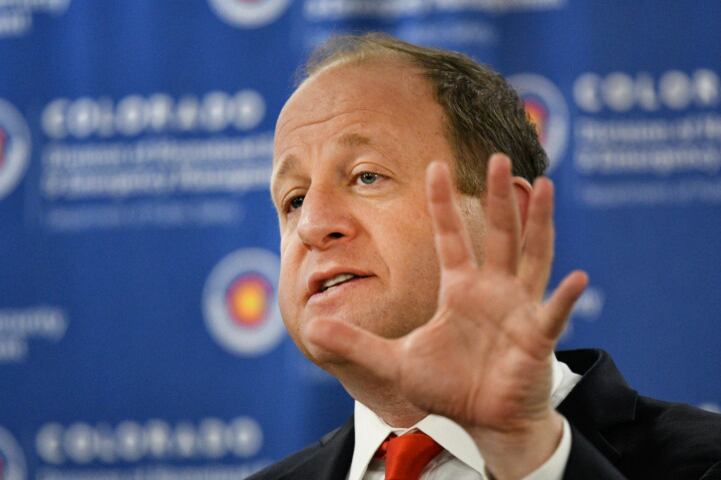
“Even before the coronavirus, we knew our education system was plagued by inequality,” he said at a press conference. “Those inequalities have been worsened by the coronavirus.”
The rapid switch to online learning and the challenges and opportunities that came with it have renewed calls in some quarters to “reimagine” education, and proposals that could make long-lasting impact will receive priority. The goal of this fund is to help students who already faced challenges, such as those living in poverty, those with disabilities, students learning English, and students in the foster care system or experiencing homelessness.
Proposals that serve geographically diverse regions and proposals from schools that have struggled to raise test scores will be prioritized. The governor’s office will also be looking for proposals that strengthen relationships between high schools, colleges, and industry, such as apprenticeships and work-based learning, and proposals that help college students stay in school and graduate faster.
Colorado separately is looking for research funding to study how successful these efforts are.
Another $5 million to $6 million will go toward increasing the capacity of Colorado Empowered Learning, the state’s supplemental online learning platform. Colorado schools expect to toggle between online and in-person instruction for at least the next school year as the coronavirus lingers.
Colorado Empowered Learning provides ready-made online courses and teacher training to work in both online and hybrid models. The goal is to train many more educators in how to be effective when they aren’t in the same classroom as their students and to improve the quality of online instruction.
The governor also plans to give $1 million to higher education institutions to help students whom previous grants excluded, including undocumented students and those whose financial situation changed significantly in recent months.
Lastly, $3 million will go to a state teacher recruitment program that was set to lose most of its funding in the state budget.
This money is in addition to federal money dedicated to education providers. Colorado’s early childhood providers got $41 million through the CARES Act, while K-12 schools will share $121 million, and higher ed institutions will share $144 million, with about half of that going to direct assistance to students.
Separately, Polis gave $510 million of the state’s $1.67 billion general relief allotment to K-12 schools and another $450 million to higher education institutions, mitigating the impact of state budget cuts.