Sign up for Chalkbeat Colorado’s free daily newsletter to get the latest reporting from us, plus curated news from other Colorado outlets, delivered to your inbox.
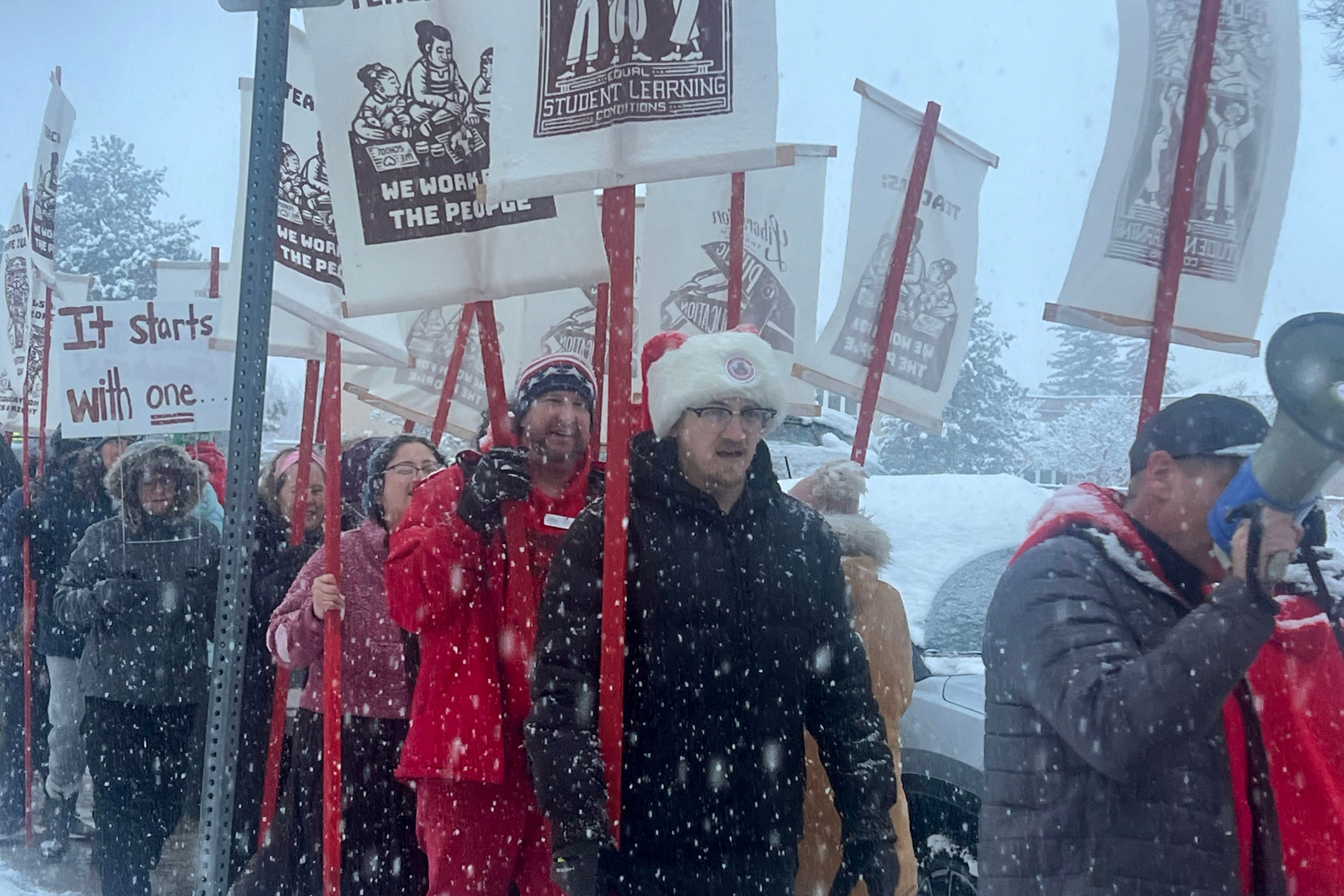
Twenty-five teachers in Colorado Springs District 11 received warnings or were penalized by district officials because of actions during the run-up to a one-day strike by the teachers union in early October, according to union officials.
Union leaders say the district’s sanctions are part of a broader union-busting effort that could push teachers out of the classroom.
Angel Givler-Viers, a fifth grade teacher who is active in the teachers union and has a large social media following, faces the most severe punishment. The district superintendent recommended at the Dec. 3 school board meeting that she be fired for insubordination and neglect of duty.
Jessica Wise, a spokesperson for the 22,000-student District 11, said by email that “a number of staff received appropriate communications” following events surrounding the strike on Oct. 8. She couldn’t confirm whether the number was 25.
The flurry of warnings and discipline measures handed out to teachers involved in the strike comes after more than a year of growing tensions between school district leaders and the Colorado Springs Education Association teachers union. The school board voted a year ago to let the union’s master agreement with the district lapse at the end of last school year, a move that enraged many teachers and helped spark the strike.
David Graf, a union official, said in addition to Givler-Viers a second teacher is on paid leave now for actions prior to the strike. A third teacher was on paid leave earlier this fall for materials distributed during the strike but has returned to the classroom, he said.
Givler-Viers has been on paid administrative leave since Oct. 6. Wise said it could be weeks or months before the school board votes on whether she should be fired.
District 11 has about 1,650 teachers. Last year, about two-thirds were in the union, but that number has gone down, partly because many teachers left the district last year, Graf said.
Besides objecting to the end of the master agreement, teachers union members have cited general concerns, such as low morale and lack of teacher voice in district decisionmaking, and specific ones, including a new policy banning most flags, including pride flags, from district classrooms and a recent decision to cut several pages on gender identity out of a high school health textbook supplement.
Wise confirmed that the district’s curriculum department removed the textbook pages in August because they weren’t aligned with the district’s approved curriculum and standards, according to an October Rocky Mountain PBS story.
Wise said the district has made big investments in teachers in recent years, including this year giving licensed teachers a 4% recurring raise and a 6% onetime bonus. The district has also launched a districtwide teacher coaching program and eliminated central office jobs in order to preserve classroom positions, she said.
Givler-Viers, who taught literacy at McAuliffe Elementary and often goes by Dr. G., believes the district’s effort to terminate her is part of a broader effort to silence and scare educators.
“It’s just way bigger than me,” she said. “It impacts all of us. And if they get away with it now, they’re going to continue doing it.”
Social media posts lead to district investigation
Givler-Viers received a letter that outlined four allegations against her on Nov. 21, about seven weeks after being put on administrative leave, said Graf, who’s been involved in the case.
One allegation in the Nov. 21 letter cites unprofessional conduct stemming from inappropriate social media posts. The other three allegations cite issues that arose after she was placed on leave, including that she set foot on district property and talked to district staff in violation of the leave conditions and that she didn’t answer questions fully and truthfully during the district’s investigation.
Givler-Viers said she stood on a step leading to the district administration building to make a speech to union members during a censorship vigil while she was on leave.
Graf and Givler-Viers said the district hasn’t specified what social media post or posts prompted the first allegation.
Wise said the district can’t comment on individual cases or timelines, but said “employees recommended for termination are provided information regarding allegations and findings at the appropriate stage of the process, consistent with those legal requirements, prior to any Board of Education consideration.”
Givler-Viers, who’s taught in District 11 for eight years, has more than 18,000 followers on TikTok. Many of her posts are short videos in which she speaks directly to the camera about issues ranging from the unpaid work teachers do to the challenge of taking sick time as a teacher.
About a week before the strike, she posted a video in which she suggested that parents seeking to support the union keep their children home on the day of the strike. She cautioned that children attending school that day could end up in large classes staffed by central office employees with no teaching experience.
“ … that means your kids could be in a classroom with however many other kids show up, with an accountant," she said in the post, which has nearly 90,000 views.
A week after the Sept. 28 TikTok post, Givler-Viers said she was going over Latin and Greek roots with her students when she was asked by her school principal to come to the office. A district human resources official told her she was being put on administrative leave while she was investigated for her social media posts. She went back to her classroom to gather her personal items and was escorted to her car.
“I just took my cell phone and my car keys and I left, and the kids … they’re like, ‘Are you OK? Where are you going? What’s happening?’” she said.
‘I can’t do it anymore’
Graf said 22 teachers received either a conference memo or a letter of reprimand because they referenced the strike in messages or in plans for substitute teachers who worked on the day of the strike.
A conference memo is one of the district’s mildest responses to an infraction and warns employees about a violation of board policy but isn’t placed in their personnel file. A letter of reprimand is a more serious penalty.
Jim Dobyns, who goes by the first name Talsen, is a physical education teacher at Rogers Elementary School. He received a conference memo around the time of the strike. He said it was the last straw that prompted him to resign. His last day is Dec. 19.
“It’s a terrible working environment to be in when you’re constantly under duress and afraid,” he said. “I just can’t do it anymore.”
The conference memo Dobyns received cited a message he left prior to the strike in the online system for lining up substitute teachers. He wrote, “This leave was posted without the consent of the teacher. You will be required to cross a picket line to accept it.”
Dobyns said district administrators, not him, posted the request for a sub to cover his classroom during the strike.
The conference memo, which was reviewed by Chalkbeat, said, “This unsatisfactory inappropriate conduct negatively impacted the operations of the school and caused harm amongst the Guest Staff and/or District Staff that were covering your classroom on that day.”
Dobyns said he wrote the message in the online system because he didn’t want his sub to be surprised by the strike.
“A lot of subs didn’t know [about the strike]” he said. “A lot of people don’t watch the news these days.”
Dobyns expects more District 11 teachers to quit in the coming months.
“I know from the talk around the water cooler that there is going to be an exodus of educators from D11 come March when hiring season starts,” he said.
Dobyns has a job lined up in home remodeling sales once he leaves the district.
Ann Schimke is a senior reporter at Chalkbeat. Contact Ann at aschimke@chalkbeat.org.