Sign up for Chalkbeat Colorado’s free daily newsletter to get the latest reporting from us, plus curated news from other Colorado outlets, delivered to your inbox.
Teacher Dez Baldonado began her remarks with an apology.
“First, allow me to apologize for speaking this rapidly,” she told the Denver school board at its meeting last week, leaning into the microphone so close that the board members could hear her gasp for breath between every sentence. “However, the limit of two minutes to address you makes it necessary, in order to share everything I would like.”
It’s been more than two years since the Denver school board put time limits on public comment at its meetings. The goal was to curtail the marathon sessions that occasionally lasted until midnight or later, when more than 100 people would sign up to speak about a controversial topic.
But now some board members are questioning whether the limits have shortened public comment too much. Board Vice President Monica Hunter, a former Denver teacher who was elected in November, said at last week’s meeting that she’d like to reconsider the time limits. Several other board members signaled that they agreed.
“People are just not signing up for public comment,” board member Kimberlee Sia said. “I think there’s this perceived notion that they’re not going to get on the list.”
Baldonado, who teaches science at Morey Middle School, was at last week’s board meeting to talk about health insurance for teachers. But she also said the board’s public comment policy “erodes whatever trust the community has that DPS wants to listen to its diverse community.”
Far fewer people sign up to speak
The Denver school board has long been criticized for not listening to the public, and most board candidates say they want to improve community engagement. At a forum this fall, no candidate said they agreed with the public comment limits — not even the incumbents who’d voted to put the rules in place.
By Chalkbeat’s count, the number of people who signed up to speak during the board’s regular monthly public comment sessions dropped drastically after limits were put in place.
In 2022, before the limits, 653 people signed up for the 11 meetings. (The board meets every month except July.) In 2025, after the limits, the total was 145, a 77% decrease. Those counts don’t include the special public comment sessions the board occasionally holds on topics such as school closures or charter school renewals.
The board first curtailed public comment in September 2023 under then-board President Xóchitl Gaytán, who enacted a two-hour limit for the comment period. Gaytán said it was a “temporary solution” that would stay in place until the board agreed on new rules.
“There’s been times where we’ve stayed until midnight or 1 in the morning to hear every single constituent and parent that was coming in to share any comments or concerns,” Gaytán said in 2023. The two-hour cap was meant to respect the time of board members and district staff, she said.
After that, the number of speaker signups began to decrease, from 510 in 2023 to 339 in 2024, by Chalkbeat’s count.
In December 2024, the board voted to adopt new public comment rules. Instead of a blanket two-hour limit, the new rules restrict public comment based on topic. The board allows 30 minutes of comment on each proposed policy or item on its agenda, plus 30 minutes of unrestricted comment in which speakers can talk about almost anything.
The new rules also shorten each speaker’s time from three minutes to two, and restrict who can comment: A speaker has to have “an established relationship” with Denver Public Schools, as a parent or teacher, for example.
The new rules went into effect in January 2025, and the number of speakers dropped even more. In January and again in June, just one person signed up for public comment.
Schedule and venue pose more hurdles
Rob Gould, president of the Denver teachers union, frequently speaks during the public comment period. He has sat through meetings that stretched into the wee hours. But he said the board has gone “from one extreme to the other, and it’s better to find something in the middle.”
Cody Ostenson, the director of external affairs for an advocacy group called Denver Families for Public Schools that sometimes disagrees with the union, agrees with Gould on this.
“What we’ve heard from families and folks we’ve worked with is it seems like there’s more confusion about what families can talk to the board about, given the topic restrictions,” Ostenson said, “and that two minutes isn’t enough time to express their views.”
Advocates said speakers are also confused about when to sign up. In 2022, the board held public comment at its monthly voting meeting on Thursdays. In 2023 and 2024, the board moved public comment to its Monday work sessions, three days before the voting meeting. In 2025, it was moved back to Thursdays but two weeks prior to the voting meeting.
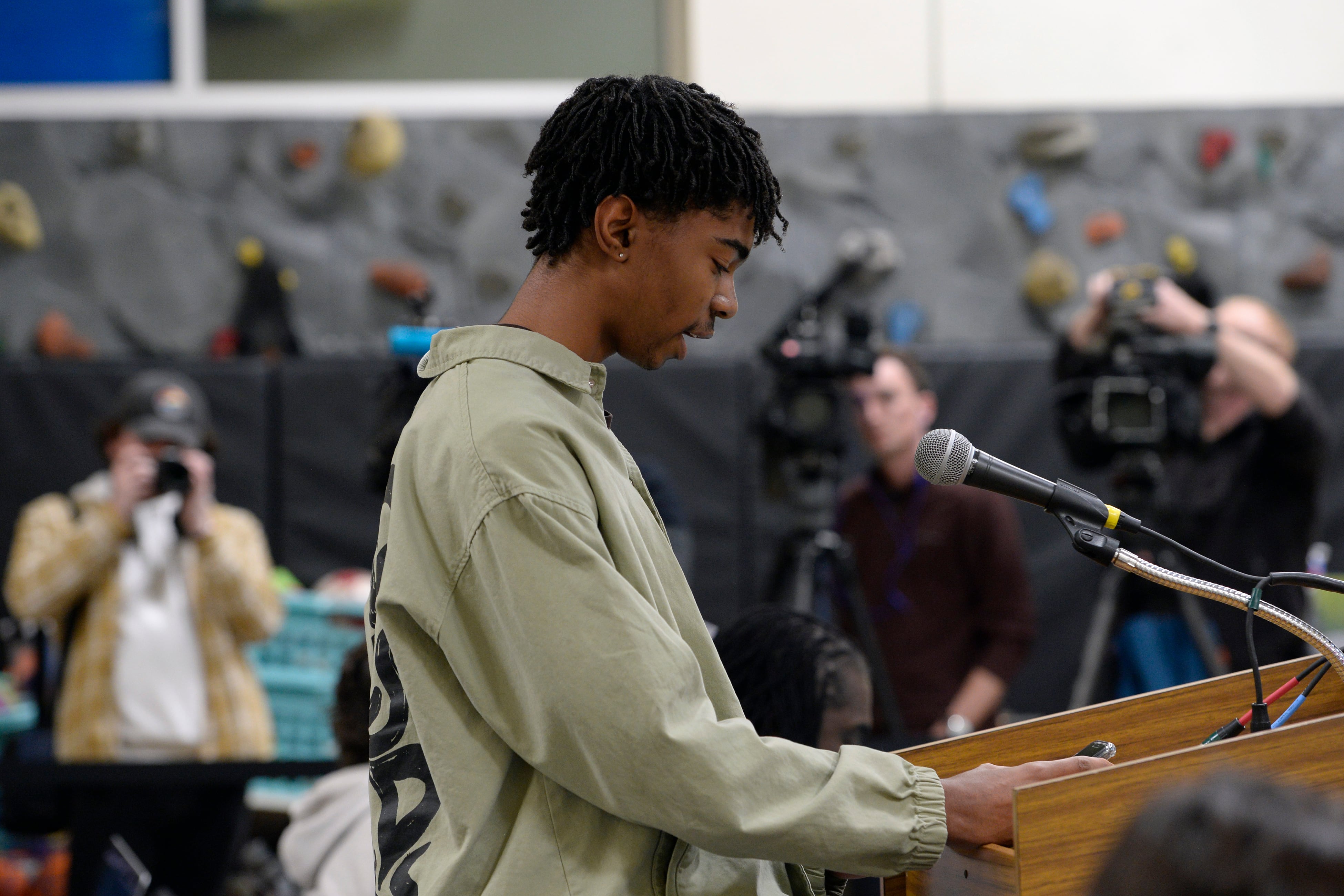
And then there’s the size of the room. Public comment was previously held in a large gymnasium on the ground floor of DPS headquarters. The gymnasium is primarily used by a charter school that shares the building. On days when the board held its meetings, the district would set up a dais, a speaker podium, and rows of black padded chairs.
But for the past year, the board has held all of its meetings in a much smaller conference room on the seventh floor. When the room fills up, would-be attendees are directed to an overflow room upstairs, where the meeting is livestreamed on a big screen.
“There’s hardly any seats,” Gould said of the seventh-floor conference room. “It makes the board more inaccessible.”
DPS spokesperson Scott Pribble said by email that the meetings were relocated because the gymnasium is managed by the Downtown Denver Expeditionary School and “it didn’t seem right to move the afternoon PE classes and after school care” for the school board meetings.
The seventh-floor conference room also has a better technology setup that allows board members to attend meetings virtually if necessary, Pribble said.
Gaytán is once again president of the school board. And although she enacted the first round of public comment limits back in 2023, she indicated last week that she’s heard the complaints and is open to revisions. It’s not clear when the board will next discuss it.
“I appreciate us being open to having that discussion and seeing where we make some language changes,” she said.
Melanie Asmar is the bureau chief for Chalkbeat Colorado. Contact Melanie at masmar@chalkbeat.org.