Did you know search engines like Google are changing the way you see news? Keep Chalkbeat’s valuable education coverage at the top of your feeds by clicking here and checking the box next to our name.
Just a few years after Illinois lawmakers ended tax credits for private school scholarships, the state is now debating another education rebate program — but this time, it’s backed by the Trump administration.
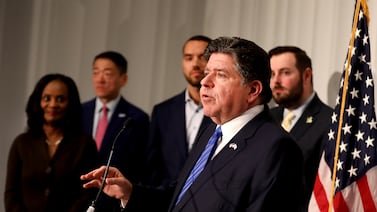
Gov. JB Pritzker has yet to decide whether to opt Illinois into the federal government’s tax-credit scholarship program, which allows taxpayers to donate to organizations supporting private or public schools. That’s in large part because the political landscape for Pritzker is complicated, as influential education groups disagree over which students will reap the benefits of the program.
Launching Jan. 1, the program allows individual taxpayers to donate up to $1,700 toward scholarship-granting programs that pay for tuition and other education services, and receive dollar-for-dollar tax credits. Anyone can donate, but students in states that haven’t opted in cannot benefit.
Since the Republicans’ One Big Beautiful Bill Act established the tax credits last year, some governors had been waiting for the federal government to issue regulations for it before deciding whether to opt in. The U.S. Treasury Department released those rules in early October, but they lack guardrails Democratic governors had hoped for, including provisions that might allow them to steer money toward students from low-income backgrounds or require certain standards for scholarship-granting organizations.
As a result, while 31 states have opted into the program so far, most Democratic governors either haven’t decided yet, like Pritzker, or have opted out, according to SGOlist, a site for scholarship-granting organizations. Only two, New York Gov. Kathy Hochul and Colorado Gov. Jared Polis, have chosen to opt their states in.
Unlike some of the undecided states, Illinois has a history with education tax credits for school choice.
Launched in 2017, Invest in Kids allowed taxpayers to receive a rebate of 75 cents for every dollar donated to scholarship-granting organizations for private schools, with a maximum of $1 million in credits per taxpayer annually. Nearly three-quarters of tax credits went to donors located in Cook County or northern Illinois in 2023, the program’s last year before lawmakers discontinued it, according to a 2024 report for the state.
Shortly after the federal government released rules for the tax credits earlier this month, Pritzker’s office said he would “carefully evaluate the proposed regulations and make a decision grounded in what best supports working families, students, and our public schools.”
As Pritzker weighs his decision, advocates are becoming increasingly vocal. Here’s where some of the most prominent groups stand on whether Illinois should opt into the federal tax-credit program.
Teachers unions worry about impact on public schools
The Illinois Education Association and Illinois Federation of Teachers staunchly oppose joining the program. Union leaders say it could further strain public schools that already lack adequate state funding.
In Illinois, enrollment plays a critical role in determining how much money schools receive from the state’s evidence-based funding formula. If the federal tax credit prompts a “mass exodus” of students to private schools, underfunded public schools could lose even more money, said IFT executive vice president Cyndi Oberle-Dahm.
“The teachers still have to teach. The students are still attending,” Oberle-Dahm said. “Yet they’re doing so with even fewer resources.”
Students with disabilities face significant barriers to private school admission, and in rural districts, there might not even be viable private school options, said Karl Goeke, IEA’s president. He said many of those students ultimately wouldn’t benefit from the federal tax credits.
“I really would like the governor to say no, so we can stop talking about vouchers. I don’t want to talk about it anymore,” he said.
Private schools hope to provide more to students
Many low-income families served by the Big Shoulders Fund, a scholarship-granting group that supports Chicago Catholic schools and received money from the Illinois tax credits, faced financial instability after Invest in Kids shuttered, said Josh Hale, the fund’s CEO. His organization lost a major source of funding, having received 25% of all donations in the state program’s final year.
“We really had to work hard to help those families,” Hale said. “Some of those families had to, you know, try to pay more, or some families had to change schools.”
In the 2022-23 school year, six scholarship-granting organizations received nearly $76 million in contributions. The average donation ranged from a little over $12,000 to nearly $24,000, depending on the organization.
At St. Francis de Sales High School on Chicago’s Southeast Side, families who live at or below the poverty line would be the primary beneficiaries from the new program, Principal Roni Facen said. Many of her students come from low-income families and experience food insecurity.
If Pritzker opts in, St. Francis de Sales could receive a bump in donations that would provide financial aid for students.
Beyond scholarships, Facen would use the additional money to help the surrounding community. She wants to establish a center at the school where teens could participate in weekend STEM activities. She also wants to expand test prep for college admissions exams to get her students accepted at high-quality universities.
Facen said the key question for her is: “How do we support our community as a whole and be a real resource and agent of change on the Southeast Side?”
Public school advocacy groups still mulling tax credits
Meanwhile, major public school advocacy groups are focused on deciphering whether Illinois can ensure that public schools receive meaningful benefits. Not all of them have reached the same conclusion.
Stand for Children, which supports policies benefiting public education, believes Illinois can maximize gains if school districts build up their nonprofit infrastructure.
To take advantage of the program, scholarship-granting organizations would need to partner with school districts to provide scholarships for eligible academic services. Districts could also incorporate the federal tax-credit scholarship program into payroll deductions for school staff or other local employers, in order to support programs such as summer learning or career and technical education, said Jessica Handy, the group’s executive director.
“I don’t mean to say that it will be easy, because every one of these steps will take a lot of work.” she said. “And the schools need to start now to wrap their mind around this and engage all of those local stakeholders to do it.”
Another advocacy group, Illinois Families for Public Schools, sees a different outcome. In a study with policy research center Institute for the Public Good, the organization concluded the program would heighten inequities in public schooling. Wealthier school districts have more taxpayers who could claim the credit and they might prefer to donate to local organizations, leaving poorer districts with less financial support, the study said.
Makiya Seminera is a reporter covering how the state and federal government affect education in Chicago and across Illinois. Contact Makiya at mseminera@chalkbeat.org.