Data analysis by Thomas Wilburn
Did you know search engines like Google are changing the way you see news? Keep Chalkbeat’s valuable education coverage at the top of your feeds by clicking here and checking the box next to our name.
Pastor Michael Neal was leading a church service at Price Elementary in Chicago’s Bronzeville neighborhood in late 2011 when word spread among his congregation that the school would close at the end of that school year.
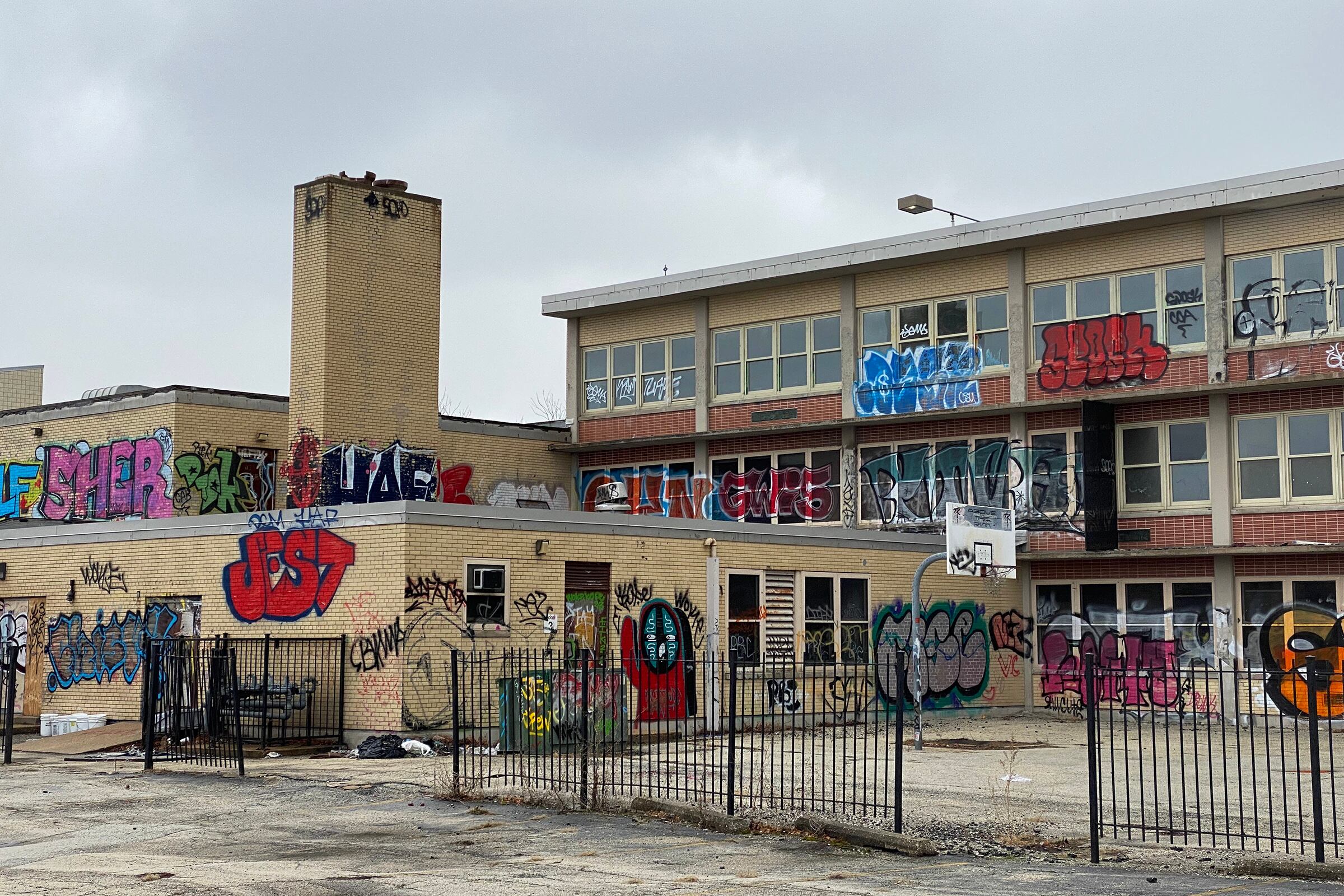
Neal’s church had just started using the shrinking school’s gym to host services. He remembers the following months as a frantic “funeral march.” Staff scrambled to secure other jobs and clear out, leaving behind piles of desks and chairs in the hallways.
“It created a big shadow — a pall over the whole building,” Neal said of the closure decision.
The following year, another 50 Chicago elementary schools closed, the largest mass closures in the country. The move helped make shuttering schools a politically toxic topic that Chicago officials have avoided.
But in this fall’s historic school board election, candidates are once again debating closures. About a dozen of the 45 candidates said they would support some closures as the district reckons with enrollment that has declined by 76,000 students over the past decade. Some have sought to reframe closures as an issue of student experience and outcomes rather than cost savings, arguing that schools with very low enrollment cannot offer rich academic, extracurricular, and social opportunities.
More than 140 of the district’s roughly 500 schools use less than half of their space, often in massive, aging buildings requiring millions in repairs. That includes 43 that are less than one-third full, according to Chicago Public Schools’ utilization measure, which critics have called imprecise, but the district continues to use. Most of these schools are concentrated in roughly a half dozen of the city’s 20 school board districts, making closures a more pressing issue for candidates in those areas.
Neal is now running in district 6b on the South Side, which stretches from the well-to-do Lakeshore East neighborhood downtown into the heart of the South Side. Of its 25 district-run schools for which CPS has utilization data, 15 operate at less than half capacity, including three at less than one-third.
Both he and his opponent said they would consider some school mergers in a candidate questionnaire from Chalkbeat, WBEZ, the Chicago Sun-Times, and Block Club Chicago. Earlier in October, Superintendent Macquline King tapped the Greater Bronzeville Community Action Council, which Neal helps lead, and other local groups to spearhead a “reimagining with community” push to address declining enrollment.
Other candidates — particularly those backed by the Chicago Teachers Union — have spoken forcefully against any closures and wielded the issue to attack their opponents.
They argue that another round of closures would destabilize predominantly Black neighborhoods, disrupt student learning, and increase gun violence. Instead, they propose filling vacant space in school buildings with outside facilities, such as health clinics, food pantries, or even grocery stores.
Candidates are speaking out about closures
For Neal, the closure debate comes down to the student experience. He said his grandson started prekindergarten in the district this fall, and Neal wants him to have access to challenging classes, sports teams, school plays, and friendships in the coming years. Students at severely underenrolled schools are often denied these opportunities, he said. Many of these campuses wrestle with high absenteeism.
At a recent candidate forum, he said he challenged anti-closure contenders: “If you’re not sending your kid to a school that’s severely underenrolled, why do you expect other families to do that?”
Still, Neal believes CPS should extend a closure moratorium that expires next summer to allow more time to address declining enrollment. He also supports a recent push to sell or repurpose school buildings left vacant since 2013 or earlier. Crumbling vacant buildings are “a visual to the community that they don’t care about us,” he said.
A nonprofit Neal leads, Timothy Community Corporation, recently moved from the former Price Elementary building to a nearby Catholic school after CPS said it owed about two years’ rent — a claim Neal denies.
Neal’s opponent, attorney Brittany Kimble, said in the candidate questionnaire that she would back closures as a “true last resort” after significant community engagement and thoughtful transition planning.
Some candidates who support closures represent districts with few, if any, schools that could face that possibility. One of the most outspoken, Ellen Rosenfeld, is running unopposed in the North Side’s district 4b, where only one of 15 district-run schools is considered underutilized, and two are overcrowded. She said the 2013 closures are a cautionary tale but cannot dominate the conversation 13 years later.
“We need to move on and do better,” she said. “What we’re doing, it’s not working. It’s insanity and it’s wasteful.”
Anti-closure candidates go on the offensive
Opposition to closures runs deep on the West Side, where 43 of the 67 district-run schools in districts 5a and 5b are less than half full. Those include Douglass High School, which has served fewer than 50 students for years and drawn criticism from right-leaning pundits.
All four candidates running in those districts oppose closures. One, LaPamela Williams, has even said she would consider opening more charter schools if there’s community demand.
District officials and experts have attributed enrollment loss primarily to plummeting birth rates that are reshaping urban districts across the country. But some candidates blame historic disinvestment on the South and West sides and argue that more resources could reverse the declines.
“When we talk about underenrolled schools, we should be clear we are talking about primarily Black and brown students in Black and brown neighborhoods that deserve more investment and not punishment,” Hilario Dominguez, the union’s favored candidate for school board president, said in an interview this summer.
He and other candidates have at times questioned whether the district actually faces an enrollment emergency. Dominguez described “supposed underutilized schools” as “a term thrown around to undermine the district.”
Chicago has tried investing more in high-poverty schools through its Sustainable Community Schools program, which partners 20 schools with nonprofits to expand services. Despite an extra $500,000 annually per school since 2018 and an influx of federal COVID aid, enrollment grew at just three schools. The other 17 lost students at a sharper rate than the district overall, including 13 that lost more than a quarter of their enrollment.
Still, Shannon Bennett, executive director of the Kenwood Oakland Community Organization, which joined a CTU call to extend the district’s closure moratorium, pointed to research on the academic disruption caused by the 2013 closures and an uptick in gun violence near vacant school buildings. He rejects the idea that closures could be handled better or that community engagement would elicit anything but impassioned opposition.
“They want to put lipstick on a pig and call it a beauty queen,” he said. “Closures are a nonstarter in these communities.”
David Stovall, a professor of Black studies at the University of Illinois Chicago, said school board candidates are still not talking enough about underenrollment, an issue central to the experiences and outcomes of the district’s Black students.
Stovall opposes large-scale closures, but he believes some campus mergers are necessary after years of failing to address the issue. He intrigued by bringing additional services into schools based on families’ needs, but said that won’t solve the academic and social limitations of severely underenrolled campuses. The district is not doing right by students by keeping some of these schools limping along, he said.
“The folks who are saying, ‘Is this really a crisis?’ are missing the point,” Stovall said. “This is not going to get any better.”
Danny Vesecky, a senior policy and research associate at the Chicago-based nonpartisan think tank Civic Federation, hopes the new, fully elected school board will tackle underenrollment at its first meeting in January 2027. He called the 2013 closures “shockingly rushed” and urged more thoughtful planning.
“I want to see the new board dig in on Day 1,” Vesecky said, “because it’s going to be a really long process.”
Mila Koumpilova is Chalkbeat Chicago’s senior reporter covering Chicago Public Schools. Contact Mila at mkoumpilova@chalkbeat.org.