Sign up for Chalkbeat Colorado’s free daily newsletter to get the latest reporting from us, plus curated news from other Colorado outlets, delivered to your inbox.
Seeking to reverse a recent decision by the Denver school board to close 10 schools, a group of parents sued Denver Public Schools this week, alleging district leaders had an “ulterior motive” for the school closures “of converting public resources to the private market.”
The 142-page lawsuit was filed Thursday by Mamas de DPS. According to the lawsuit, Mamas de DPS is a limited liability company made up of parents whose children attend DPS. The group registered as an LLC with the Colorado Secretary of State’s office on Dec. 12.
A group with a similar name, Mamás de DPS Peliando por Las Escuelas Públicas, rallied in 2022 in support of bilingual programming in DPS and against school closures, but it wasn’t immediately clear Friday whether the two groups are the same or affiliated.
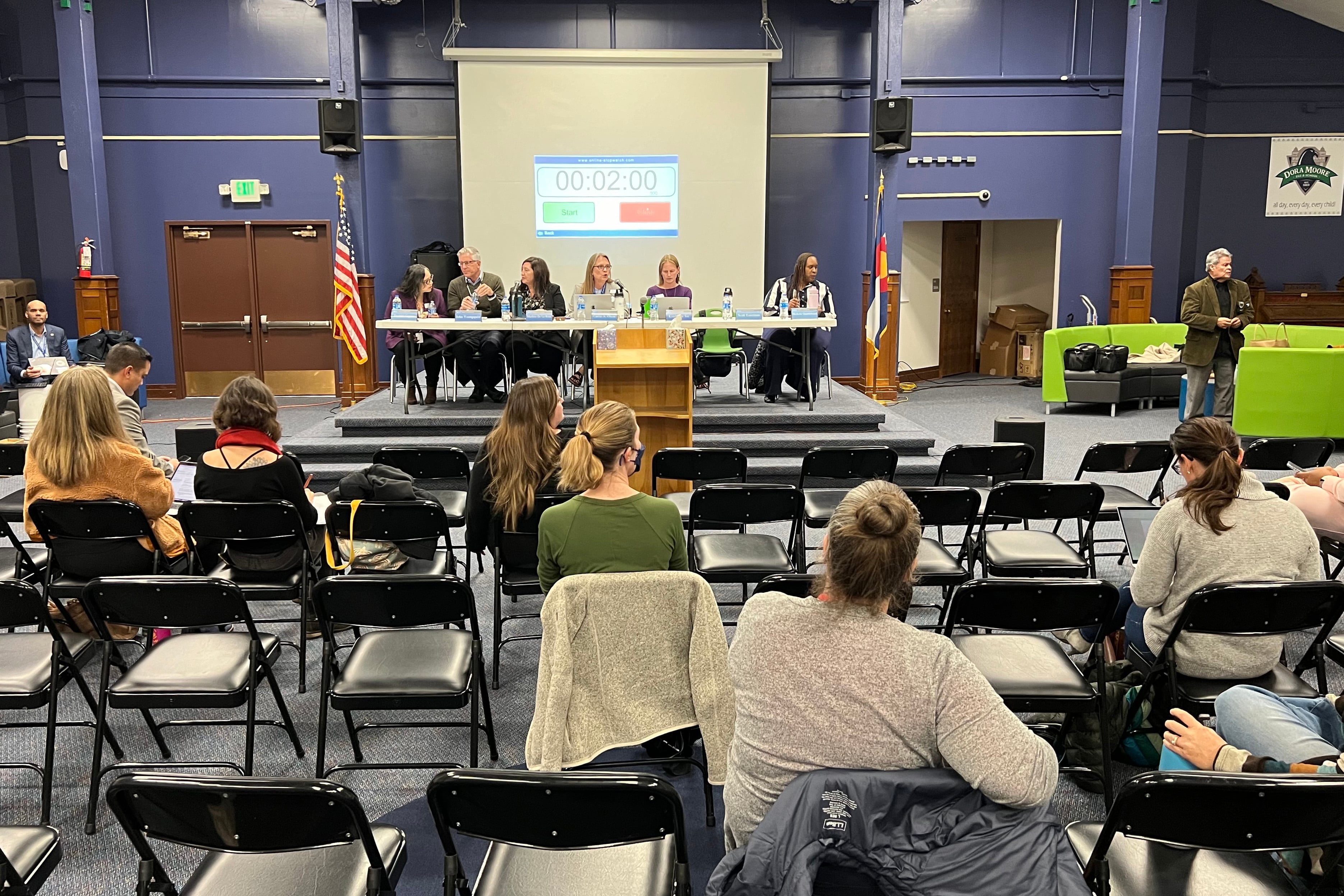
The Denver school board voted on Nov. 21 to close seven schools and partially close three more at the end of the school year. The closures were proposed by Superintendent Alex Marrero to address declining enrollment. Board members said the closures are necessary because of the financial strain of operating schools with low enrollment.
But the lawsuit alleges that DPS isn’t being transparent about its enrollment, that its claims about underutilized school buildings are dubious, and that it’s unclear how the $6.6 million the district said it will save by closing the 10 schools is enough to solve any financial problems.
The lawsuit names Marrero, all seven school board members, and a consultant that the district hired to advise the board on several topics, including its school closure policy.
A spokesperson for DPS said the district would not comment on the lawsuit.
The lawsuit also accuses the district of having an ulterior purpose for the school closures “to transfer public resources, including money, buildings, and control of the essential public good of education, to the private market.” It criticizes Denver’s publicly funded but privately run charter schools, as well as the district’s system of school choice.
The lawsuit draws connections between economist Milton Friedman, President Richard Nixon, the American Legislative Exchange Council, and Colorado’s 1993 charter school law. It also points out what it says are similarities between racist policies that led the U.S. Supreme Court to order DPS to desegregate its schools in 1973 and the methodology district leaders used to decide which schools to close at the end of this school year and where to reassign the students.
“One way or another, Defendant Alex Marrero (superintendent of Denver Public Schools), with the Denver Board of Education’s help and complicity … is intent on closing public schools,” the lawsuit says. “This is, indeed, a core strategy of the ‘free market’ agenda.”
Read the full lawsuit below.
Melanie Asmar is the bureau chief for Chalkbeat Colorado. Contact Melanie at masmar@chalkbeat.org.