Did you know search engines like Google are changing the way you see news? Keep Chalkbeat’s valuable education coverage at the top of your feeds by clicking here and checking the box next to our name.
Being a student at the Detroit School of Arts is helping 17-year-old Justin Ward grow and prepare for life after high school.
But the instrumental music major said he’d like to see the district allocate more funding for equipment and instruments at the audition-based high school. He also wants to see the next Detroit Public Schools Community District board work more closely with the administration to better support students in DSA’s visual and literary arts.
“There aren’t a lot of opportunities for those majors,” Ward told BridgeDetroit. “You can show it through a poetry slam or with visual artists, we have our art (shows), but there are few and far between.”
Arts funding, transportation needs, and building conditions are on the priority list of DPSCD students as Detroit voters prepare to elect five new school board members.
There are 31 candidates running in the Nov. 3 general election for four seats with four-year terms and another three candidates are vying for one partial term that will end in 2028. It’s a pivotal election for the district that could change the power dynamic and direction of the largest public school district in Michigan.
Current DPSCD Board President LaTrice McClendon and Vice President Corletta Vaughn are not running for reelection. Only two DPSCD board incumbents — Steve Bland and Bessie Harris — are seeking reelection. Both were appointed last year to finish out the terms of members who resigned. The fifth open seat belonged to Iris Taylor, who died in July.
Most of Detroit’s young people aren’t yet of voting age, but they still have lots to say about their education and the barriers in education that they experience.
BridgeDetroit talked to six DPSCD students about what they want to see from the new board members. Here’s what they had to say.
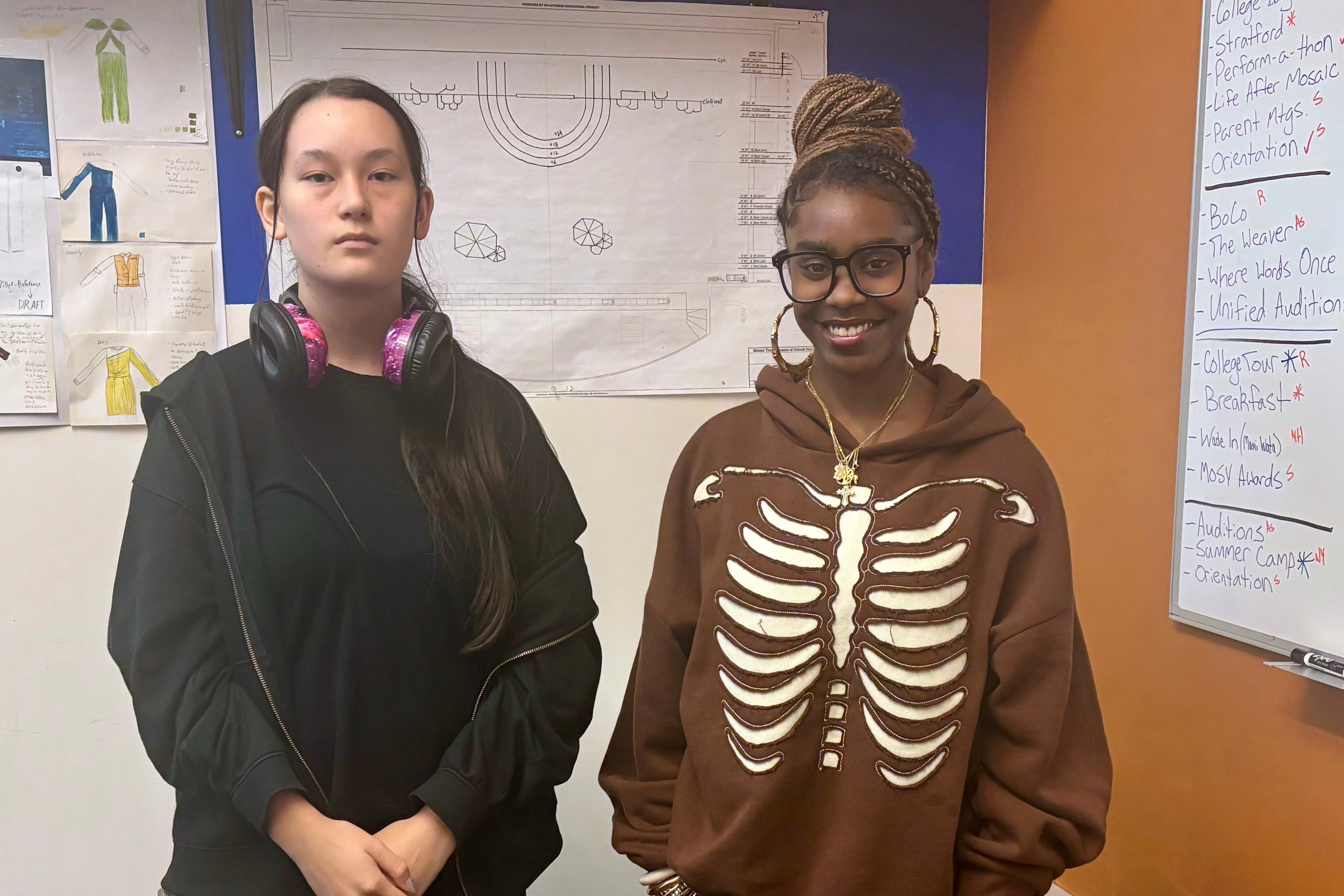
Charity McQueen, 17, Detroit School of Arts and Gwendolyn Wong, 15, The School at Marygrove
On a recent evening, the teens took a break from rehearsal at University Prep Science & Math Elementary School, where they were going over scenes for Mosaic Youth Theatre’s upcoming production, “Ordinary Fire,” to discuss what they want to see from the district board and leadership.
McQueen wants a new board with a focus on providing more extracurricular activities for DPSCD students. While the School of Arts has activities like band, theater, and after-school tutoring, the high school senior said she wants to see more variety for schools districtwide.
“I feel like a lot of that (extracurriculars) have disappeared over the years,” she said.
Last month, Mayor Mary Sheffield announced seven new after-school sites will open across Detroit this school year using $2.2 million in city funding. The funding will allow the existing after-school program Get On And Learn, or GOAL Line Detroit, to expand to parts of the city lacking access to affordable out-of-school opportunities. The free program also will provide transportation for K-8 students from city schools to the new sites. GOAL Line also offers after-school programming at 17 DPSCD elementary-middle schools.
McQueen also hopes to see the board prioritize processes that cultivate more respectful relationships between students and staff. For example, she said she wants board members to help with the vetting process for new hires, ensuring that teachers and staff members are evaluated not just on their education and experience but their teaching styles.
DPSCD’s existing hiring process includes a phone, video, or in-person interview, a conditional offer and a pre-hire orientation and electronic onboarding.
“I feel like if they (the district) are hiring a teacher, they should see how they teach and not just if they’ve ever taught before,” McQueen said. “A lot of students learn differently, and some teachers choose to only teach one certain way, and that causes other students to fall behind or feel less than because they simply can’t understand what the teacher is teaching. Same with counselors, deans, principals. It’s not a background check, but it’s seeing who you are as a person and how you are going to show up for the children.”
McQueen and Wong both want additional learning materials in schools. In some of Wong’s classes at Marygrove, there’s not enough textbooks for each student, she said. And both teens have had to share laptops with other students.
“There could be a bit more funding for textbooks or even digital versions that could be supplied to the teachers easily so that they could print out pages,” Wong said.
The sophomore also wants more classroom support for students with disabilities.
“For people with dyslexia or dyscalculia (math dyslexia), the student teachers or teachers assistants could help them on a more personal level,” Wong said.
Sibma Olea-Cruz, 16, Cass Technical High School
The high school junior said her experience at Cass Tech has been mostly positive the last two years, but one area that needs improvement is transportation.
While students in the city can ride Detroit Department of Transportation, or DDOT, buses free of charge, there is no yellow bus service for Cass. DPSCD does not provide yellow bus service to most high school students. Exceptions are made in some cases, including for students with disabilities and those experiencing homelessness.
The teen wants the new board to make transportation a priority, Olea-Cruz recently told BridgeDetroit while she worked on homework in Cass Park.
“We are a big school and we’re a big district. It’s a problem for us to not have transportation,” she said.
As of October, there were 49,480 students in the district, with more than 2,400 students at Cass, according to the high school’s website
School conditions at Cass are also a concern for Olea-Cruz. There’s brown spots on the walls, tiles missing, and leaky classrooms, she said.
As part of DPSCD’s facility master plan, the high school is receiving a $7.3 million investment this fall in upgrades like heating, Americans with Disabilities Act access, and LED lighting. The projects are expected to be completed by the fall of 2029.
Overcrowding in classrooms is also an issue, Olea-Cruz said.
“In my French class, we didn’t have enough chairs for everybody to sit down,” Olea-Cruz said. “There were 40-plus students in the classroom, which is outrageous.”
DPSCD Superintendent Nikolai Vitti told BridgeDetroit the target class size for the district’s high schools is 35 students, with the maximum being 41. Currently, the average class size at Cass Tech is 32 students per class, with core classrooms (English, math, science classes) containing about 40 students.
“We will work with the principal to offer teachers another class period with additional pay to lower the class sizes in core classrooms,” Vitti said of schools districtwide. “This is our standard process across the district to ensure smaller class sizes, or we add or shift teacher positions when class sizes are higher in certain grade levels or subject areas.
Olea-Cruz would also like the board to pass a policy that requires the district to observe religious holidays like Eid-al-Fitr. Last school year, students, teachers, and community members spoke out at board meetings, urging the district not to hold class on the holiday. Although the holiday counts as an excused absence, Muslim students said they sometimes have to make up tests and assignments after missing the day. They also miss out on receiving a weekly perfect attendance incentive the district offers from January through March.
“I know that our school is not the only one having these problems,” Olea-Cruz said.
Patrick Jean, 17, Cody High School
One thing the high school senior wants to see the board prioritize is letting students have more of a say in the type of classes they take.
“We need to set aside a time where students can come in and it’s like, ‘Hey, choose what you want. This is your life. These are the classes you should be able to learn,’” Jean said. “If I teach a culinary student about culinary arts, he’s going to be invested in that class and want to do more work because that’s what he’s interested in.”

The district in August rolled out a high school redesign plan for ninth graders. Freshmen at the district’s 11 neighborhood high schools will explore career pathways during a seminar class, which will help them choose the dual enrollment, career and technical education, or advanced placement courses they want to take through graduation.
However, there’s little flexibility with students’ core courses because of Michigan Merit Curriculum requirements. Students must complete at least 18 course credits to graduate with a diploma, which includes courses in math, English language arts, science, social studies, physical education, world language and a visual, applied or performing art.
Jean also wants the board to allow schools more leeway for the district’s cellphone policy. Michigan has a new law banning smartphones from school classrooms during instructional time, but school districts are required to adopt their own policies that restrict the use of cellphones and other electronic devices.
DPSCD’s policy states that cellphones are not to be used from the entry bell to the dismissal bell. Individual schools will communicate to families if their school policy is to collect and return devices daily, or if devices can stay in students’ possession but remain off and put away.
Jean said students have to lock their phones using Yondr pouches at the beginning of the school day. The fabric pouches are unlocked at the end of the day. While he doesn’t mind putting his phone away during class, Jean believes students should be allowed to use their phones at lunch and other free periods during the school day.
“Last time I checked, you don’t learn at lunch,” he said. “The hallway is not learning time. That should be a time where students can at least check up on their family or have their chill time on their own devices.”
Samuel Williams, 17, Cody High School
Williams also wants to see more Detroit school buildings receive upgrades and renovations. At Cody, the building is often too hot or too cold, he said.
“When it gets hot, we usually just use fans,” Williams said. “The air conditioning is a little finicky.”
In 2022, DPSCD launched its $700 million facility master plan to rebuild, reopen, or demolish certain schools. The district is constructing a new building for Cody, which is expected to be completed by the fall of 2027.
The high school senior also wants more consistency with the teaching staff at DPSCD. When he was a student at Ann Arbor Trail Magnet School, Williams said he fell behind in math because he didn’t have a consistent teacher during his fourth, fifth, and sixth grade years. At Cody, Williams’ English teacher retired a few weeks ago and the class has had a rotation of subs ever since.
“Pretty much every day there’s a different sub,” he said. “I don’t do anything in that class anymore.”
Conversely, a 2025 report by Wayne State University researchers discovered that DPSCD has a much higher than average rate of teacher retention compared to its peers in suburban school districts and city charter schools.
This is an improvement from the years when the district was under state oversight and typically began the school year with hundreds of teacher vacancies. As of September, DPSCD has 38 teacher vacancies and 42 support staff vacancies.
Justin Ward, 17, Detroit School of Arts
Ward, the DSA student, said his view on the current board is positive, citing its focus on improving literacy rates and gift card incentive for attendance to curb chronic absenteeism.
The junior said he’s received $1,000 in Visa gift cards since the attendance initiative began last year. Ward said he wants the new board to continue the work to reduce chronic absenteeism, including having attendance agents and staff conduct home visits.
“They could go to kids’ houses and ask their parents or ask them why they aren’t going to school,” Ward said. “Is there a reason? Do you not feel motivated?”
During the height of the COVID-19 pandemic, DPSCD used $11 million in federal stimulus funds on canvassing efforts for students who were not reporting to school. In addition, the district has hired more attendance agents and concentrated them in neighborhood schools with the highest rates of absenteeism. The agents have a number of duties, including home visits, data collection, dropping off resources to families, making connections to wraparound services, and more. DPSCD spends around $14 million a year on improving attendance, with most of the funding going toward attendance agents.
For the 2025-26 school year, the number of students chronically absent was 60%, down from 76.7% in the 2021-22 school year.
Ward believes he is receiving a good education at DSA overall.
“The arts will definitely prepare you for a workplace environment,” he said. “DSA prepares you academically and artistically for the real world.”
Micah Walker is a reporter for BridgeDetroit. You can reach her at mwalker@bridgedetroit.com.