Did you know search engines like Google are changing the way you see news? Keep Chalkbeat’s valuable education coverage at the top of your feeds by clicking here and checking the box next to our name.
Democrats swept key midterm races across the country, potentially setting the stage for a harder line against President Donald Trump’s education agenda in Congress and more voucher oversight in the states.
Democrats took control of the U.S. Senate and House, and they won governors’ races in Iowa, Texas, Ohio, and Georgia, all previously Republican strongholds. In Iowa and Texas in particular, Democratic candidates made inroads by criticizing the expansion of universal voucher programs that are at the center of Republicans’ education policy agenda, coupled with promises to bolster spending on public schools.
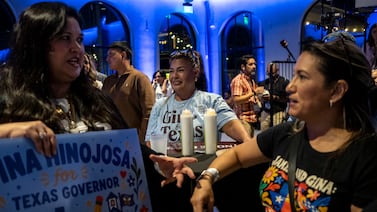
“The days of treating our public schools like they are for sale are over,” said Texas Governor-elect Gina Hinojosa in a victory speech Tuesday night, to jubilant cheers from the crowd. Hinojosa sailed to a stunning victory over Republican incumbent Greg Abbott, who has served as Texas’ governor since 2015.
Congressional Democrats have pledged to do more to protect the Education Department and hold Education Secretary Linda McMahon responsible for deep cuts to the agency.
But it’s not clear where education ultimately will rank in the priorities of newly elected leaders whose agendas also include reining in healthcare costs and gas prices and fighting the Trump administration on multiple fronts.
Trump told The New York Times he would accept the results and was prepared to work with Democrats — but he still holds veto power.
Top of mind for many education advocates is reversing budget cuts and ensuring money allocated by Congress actually makes it to schools, universities, and researchers.
“Everything really hinges on Congress’ ability to do its job and making sure that money that is allocated actually gets out there,” said Constance Lindsay, an education professor at the University of North Carolina.
In an election that centered on affordability, voters appeared likely to send more money to schools in Colorado and Minnesota, while limiting taxes in Florida and North Carolina.
Amid a strong night for Democrats, voters in Colorado and Washington were poised to bar transgender athletes from girls’ sports teams. The two blue states had embraced more inclusive policies even after threats from the Trump administration. But polling shows that many Democrats are uncomfortable with transgender athletes competing on teams that match their gender identity, and conservatives have hammered the issue for years.
As he cast his ballot in a Phoenix suburb, Pierce Benson, a 22-year-old Arizona voter, said he hoped a blue wave would bring with it more investment in education. He just graduated from Arizona State University, where he enrolled feeling “slightly behind” because of a year spent in online school due to the pandemic. These gaps still need attention from state and federal politicians, he said.
“Hopefully there’s just going to be more and more spending on the younger generation,” he said.
Democratic candidates flip governors’ seats with education message
In gubernatorial races where education — and particularly school vouchers — was a key talking point, voters opted for Democrats. On Tuesday, voters elected candidates calling for more oversight and accountability over universal programs, though several have been careful not to call for a complete reversal of these programs.
Texas voters delivered defeat to Abbott, who fought members of his own party to pass a universal school voucher program that launched this year. Hinojosa used the voucher program to attack Abbott, calling it his “voucher scam.” She also criticized GOP state leaders for taking control of major school districts including Houston and Fort Worth. Hinojosa in her victory speech said she will fire the state schools chief who has led those takeovers.
Iowa voters elected Democrat Rob Sand after 15 years of Republican leadership. Sand campaigned for more oversight of the state’s school voucher program. He said he wants to add income limits to the universal program and wants to require an annual audit, while investing more in public schools.
In Arizona, the state’s voucher-like program has divided even Republicans over whether it should be subjected to more oversight, particularly in the state’s superintendent race, where Democrat Teresa Leyba Ruiz is leading. Ruiz campaigned around oversight of a program widely criticized to be costly and a crucible for misspending. Incumbent Democratic Gov. Katie Hobbs also appears headed for reelection.
Voter Jerri Crandall, a retired substitute teacher in a suburb of Phoenix, said preserving Arizona’s Empowerment Scholarship Accounts program, which families can use like vouchers on home schooling, private school, and other expenses, was a priority for her in casting her vote. Crandall would not share how she voted.
“Parents need to be allowed to find the programs that work best for their kids,” she said. “We see how well the government has done with the schools. So I don’t necessarily want the government trying to decide how home schooling is going to work, either.”
Andy Smarick, a senior fellow at the conservative Manhattan Institute, said the coming political battles could further divide Republicans. Traditional conservatives who supported public school “might be more open to at least monitoring where this money is going, and you will see fierce opposition from the more libertarian side.”
State legislatures appear likely to change hands in many states, as well, changing what’s politically possible.
Oregon was a rare race where student achievement featured prominently. Parents and taxpayers have increasingly demanded better educational outcomes from public schools, blaming some of the state’s academic struggles on inadequate policymaking by Democratic Gov. Tina Kotek. In early returns, Kotek led Republican challenger Christine Drazan.
Democratic Congress could hold oversight hearings, pursue budget fights
Democrats took control of both chambers of Congress in a major repudiation of the president’s party. Most observers expect education to take a backseat to other issues voters prioritized, such as affordability and foreign policy.
But Democrats likely will hold oversight hearings to draw attention to the impacts of cuts to the Education Department and could do more to push back on the Trump administration’s aggressive use of executive authority.
The Trump administration has reorganized the Education Department without congressional approval, dramatically changed civil rights enforcement, held back money appropriated by Congress, and tried to place conditions on funding to block state and local diversity efforts.
Despite his Election Night promise to work with Democrats, it’s not clear if the Trump administration will scale back its efforts or how Democrats will choose to spend their political capital.
“It does not seem like the Trump administration is responsive to accountability,” Lindsay said. “So I don’t know what that looks like when Congress starts to actually exercise its authority.”
American Federation of Teachers President Randi Weingarten previously told Chalkbeat that when it comes to the organization of the Education Department, “function is more important than form.”
Even so, Democratic lawmakers are campaigning to chair the House education committee by arguing that they would more firmly thwart Trump administration efforts to gut the Department of Education.
Restoring cut grants and ensuring money flows to schools is a top priority, Weingarten said. So is undoing cuts to food stamps and Medicaid that hurt low-income kids and place a heavier budget on schools. “The next Congress must act not only to fix the damage Donald Trump and his cronies have wrought, but to build a better life for everyday Americans, she said in an Election Night statement.
Democrats have also said they want to restore protections that limited immigration enforcement near schools and protect school internet subsidies the Trump administration wants to limit.
Lily Altavena is a national reporter at Chalkbeat. Contact Lily at laltavena@chalkbeat.org. Lily is on Instagram, Tik Tok, and Facebook.
Erica Meltzer is Chalkbeat’s national editor based in Colorado. Contact Erica at emeltzer@chalkbeat.org.