Did you know search engines like Google are changing the way you see news? Keep Chalkbeat’s valuable education coverage at the top of your feeds by clicking here and checking the box next to our name.
CROTHERSVILLE, Ind. — Jared Kempton sized up the plastic buckets outside his classroom like a teacher grading a quiz.
His sixth graders had only gathered enough kindling to fill each bucket halfway — not nearly sufficient to build the fires that would keep the zombies away. And they were running out of time.
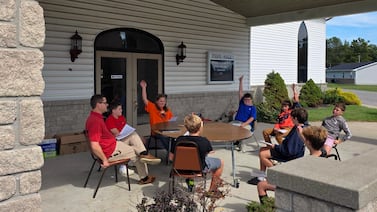
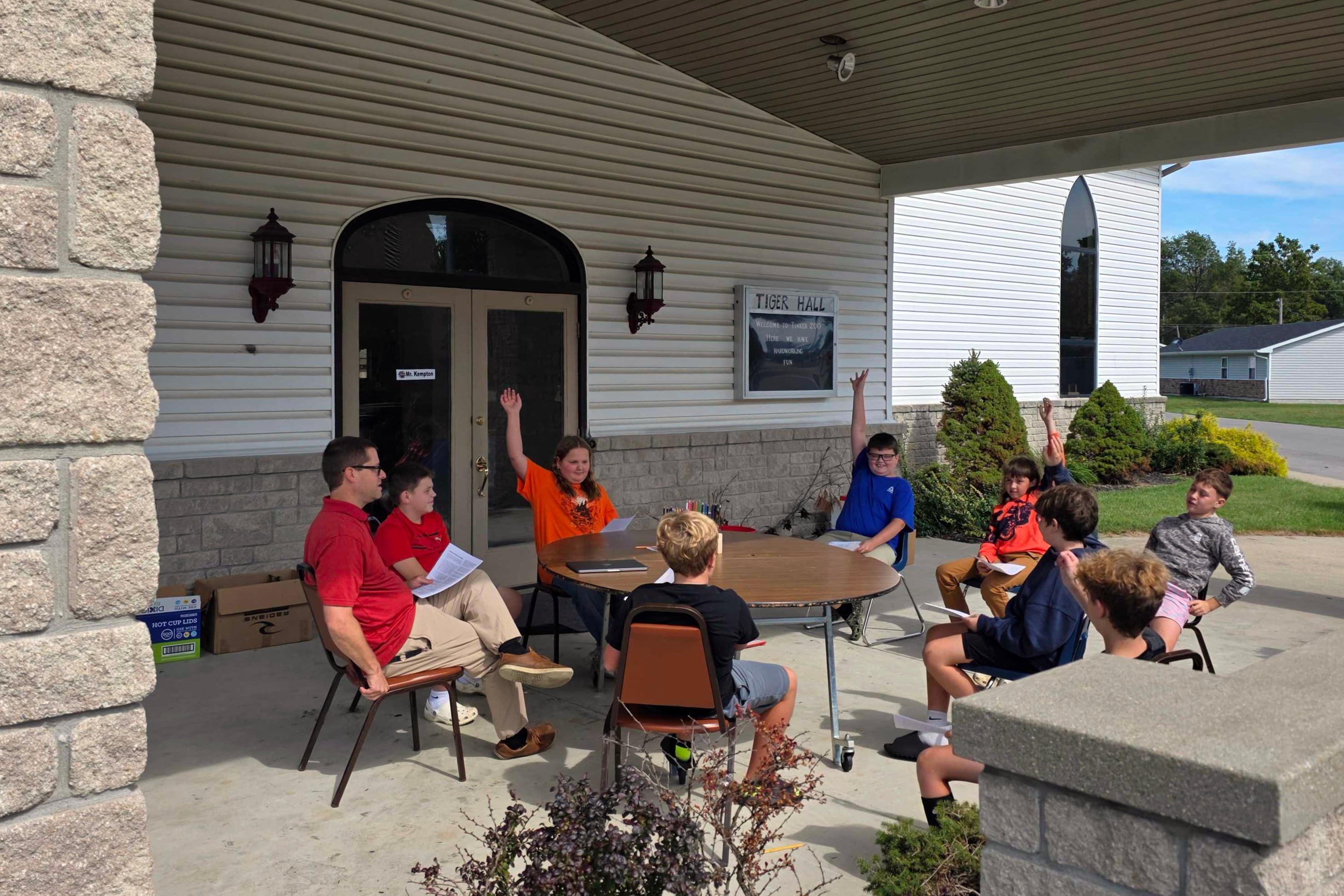
The firewood was for a class known as Tinker, an invention of Kempton’s. The location: across the street from Crothersville’s school building in a former church, where the large rooms and old furniture are well-suited to serve as a compound for survivors of the zombie apocalypse.
The topic — zombies — was chosen by the students themselves.
Tinker functions as a semester-long project in which students choose a theme and Kempton adapts lessons to it, like an exercise in improv. This semester, Kempton used the transmission of a zombie virus to teach them about microbiology, and the construction of zombie-proof armor to teach engineering.
That morning, students were due to begin discussing how to rebuild a zombie-stricken society, using the foundational documents of the United States as a template for how to weigh questions of safety against guarantees of liberty. The lesson was inspired in part by CREATE 250, a Ball State University initiative incorporating the nation’s 250th anniversary, that helps teachers build the confidence to bring civics and civil discourse into their classrooms.
The students were also supposed to build fires — the kind of off-beat, hands-on experience that defines Tinker.
As 25 students shuffled into the church, they immediately wanted to know: When were they getting to the fires?
Kempton offered them a deal: If they worked hard on rebuilding society during class, they could spend the last few minutes scavenging more wood for their fires.
Kempton originally started a cross-curricular program covering subjects like business, social studies, and math as a teacher at Madison High School. When he moved to Crothersville, he brought Tinker with him, to fight back against what he saw as a slow decline in interest in learning in middle school.
Tinker doesn’t replace required classes in science or civics, but it reinforces the concepts students are covering across the street through projects that revive a love for learning.
“By late elementary and junior high, even the smart kids quit caring,” Kempton said. “If a class isn’t dual credit or AP, they won’t take it. The places you see a kid care are shop, art, and music.”
Students debate rights and safety as zombies swarm
The sixth graders broke into groups to resume reading a story Kempton had created with AI to serve as a starting point for students’ discussions.
A debate quickly broke out among the students as the story delved into the plight of the survivors, whose leader had confiscated their food and weapons and instituted searches of their homes, while throwing dissenters in prison. They sat up to argue their positions, while Kempton sat back and let them discuss.
“It’s a little privacy-invading, but we’re trying to survive,” said one student.
But another disagreed: “If they’re confiscating weapons, how are we going to survive?”
Eventually, Kempton asked students to consider the Bill of Rights that had been delineated in the story, and pick which amendments they would most want to keep in their post-apocalyptic society.
The Second Amendment’s right to bear arms was popular, for zombie-fighting reasons. But not all students initially chose the First Amendment. So Kempton asked them to consider what it means to speak their minds without the possibility of prison — both in the zombie-apocalypse scenario, and in real life.
“Can you say mean things about Donald Trump?” he asked. The students thought about this before one of them brought up a sign outside of town that featured a negative sentiment about the president.
“And were they arrested for that?” Kempton said of the people who put up the sign. “No.”
Indiana teachers have warned about recent efforts in the state to restrict what teachers say about history and politics.
But Kempton said it doesn’t serve students to skip the current events they see and hear about every day, and that educators “have a commitment to teaching the Constitution and our rights.”
“As civics teachers, we can’t just avoid this stuff,” he said. “We need them to have civil discourse and if you bypass it, you’re not going to get that.”
Kempton said his experience with CREATE 250 has given him the confidence to broach these discussions. The initiative seeks not only to help teachers incorporate more civics lessons into their curriculum, but also to help them navigate the potentially challenging conversations that might come of it.
In monthly professional development sessions, teachers who are part of the CREATE 250 initiative share how they mediate classroom discussions, and communicate with parents and administrators to preempt any concerns, said David Roof, director of Ball State’s Center for Economic and Civic Learning, which oversees CREATE 250.
“So many students think of civics only as … voting and jury duty. I think it’s helpful for them to gain a wider domain of what civic engagement means — listening to others, talking with others, that’s part of the process,” Roof said.
Kempton said he hopes to one day make Tinker an all-day experience for students they could take to meet the requirements of their core classes, like civics.
The school purchased the church building three years ago for Tinker. What’s needed now are more teachers, he said.
Two Crothersville seniors who are on the school’s teaching pathway assist with Tinker classes. One of them, senior Bella Riley, said teaching a Tinker class is not like teaching in any other class.
“I have students tell me they wait all day for this class,” she said. “It’s so much more freedom and fun.”
She hopes to incorporate Tinker’s project learning style into her future classroom.
Riley’s group of students in Kempton’s class eventually chose the Fourth Amendment, which prohibits unreasonable searches and seizures by the government, as one of their highest priorities.
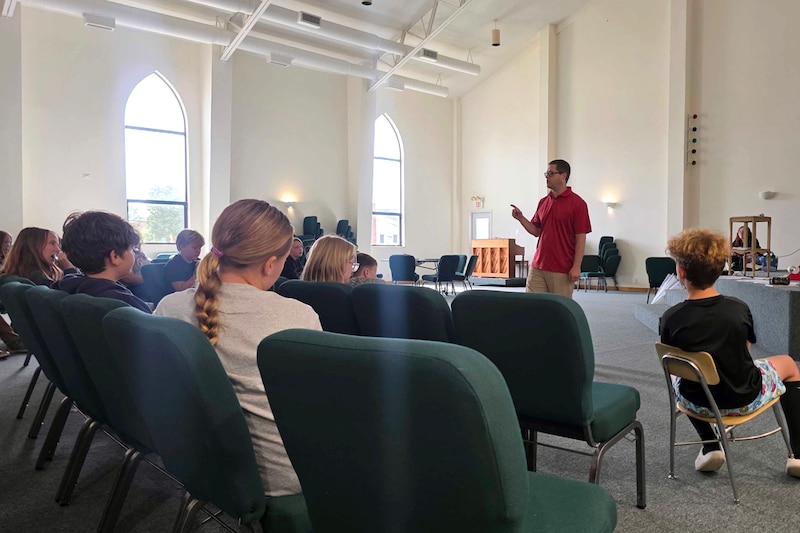
Satisfied with their discussion, Kempton gave the students a few minutes at the end of class to conduct their own searches — for more firewood. It paid off. They collected enough to light fires the next day.
After that, the sixth graders left the building, and silence filled the old church nave for the first time in more than an hour.
It wouldn’t last. The next period was a Tinker class for seventh graders, who were using the Pythagorean theorem to make solar ovens.
Aleksandra Appleton covers Indiana education policy and writes about K-12 schools across the state. Contact her at aappleton@chalkbeat.org.