This story was initially published in Healthbeat, public health, explained. Sign up to receive Healthbeat’s free New York City newsletter here.
Holograms are no longer just the stuff of Star Wars and Star Trek. One Staten Island high school plans to use the technology to beam in therapists, hoping to make mental health services more accessible to students.
After three years of planning and construction, Ralph R. McKee Career and Technical Education High School is set to open a nearly $500,000 studio focused on student wellness. The space, which also aims to encourage students to explore creative uses for technology, is expected to be ready in the coming weeks, Principal Gregory Bowen said.
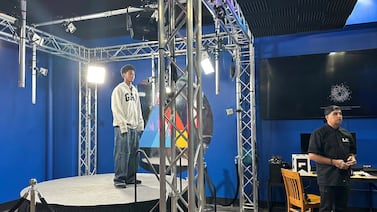
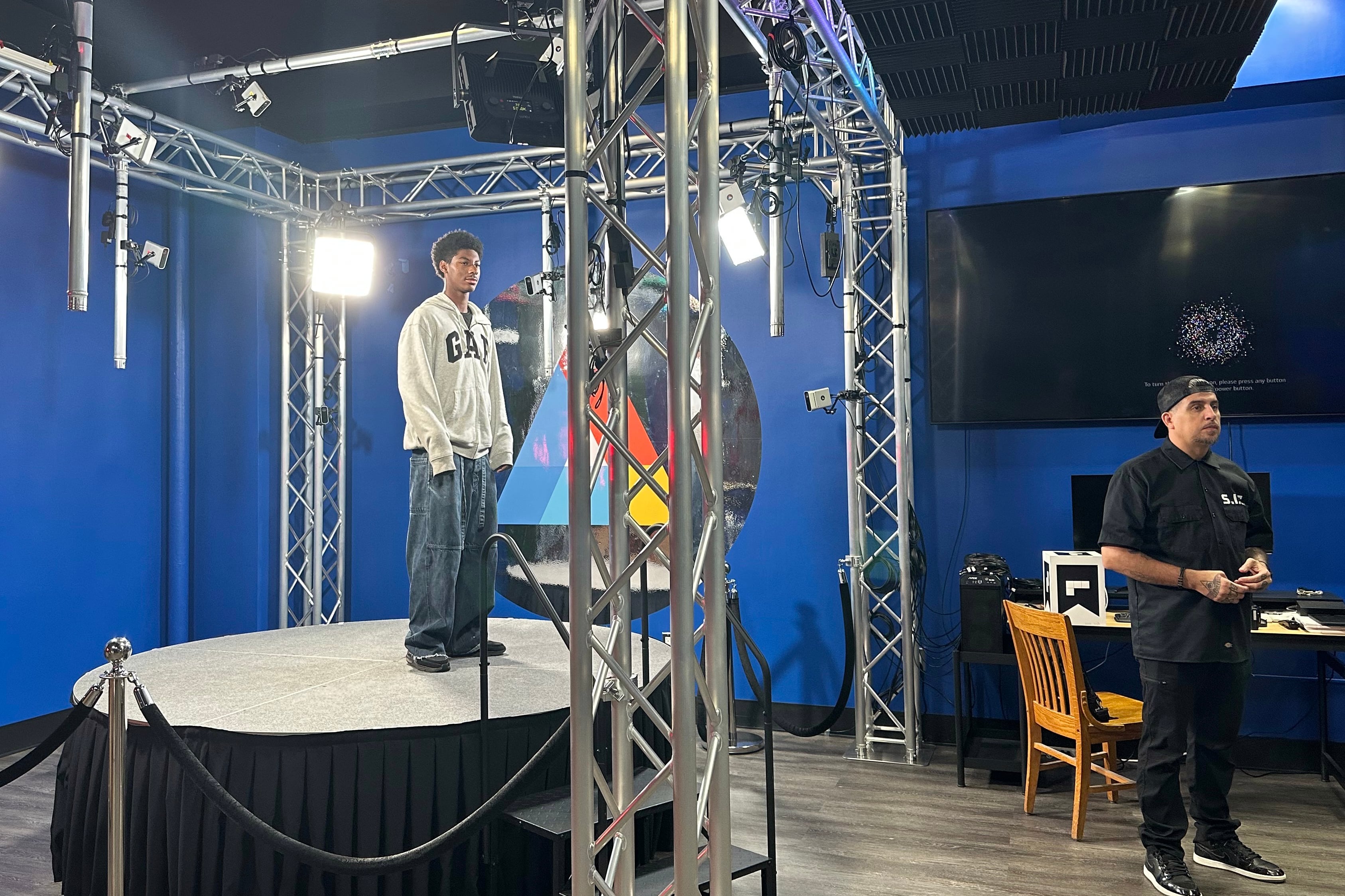
About two dozen students got a sneak preview of the space earlier this month, which was created in partnership with the S.I.C. Film School, an education platform and production company based in Hillside, New Jersey.
Among its features is a private room where students will be able to speak with therapists miles away through a “holographic device” that projects life-sized, 3-D images of them.
The hologram device, created by Proto Hologram Inc., is already being used at more than 40 universities around the world. McKee will be the company’s first K-12 school to use the technology, company representatives said.
The studio’s launch, and the school’s bet on using technology to address student mental health challenges, comes as parents and experts increasingly scrutinize technology’s role in adolescents’ struggles. New York City’s Education Department recently introduced limits on artificial intelligence and screen time, though high schools have more flexibility than schools serving younger students.
Youth mental health in New York City has been declining for more than a decade, according to the Department of Health and Mental Hygiene. In 2021, 38% of the city’s high school students reported feeling sad or depressed in the past year, up from 27% a decade prior. A 2024 Health Department report found that teens who use social media experience anxiety and depression at higher rates than those who do not.
Against that backdrop, McKee hopes technology can also play a role in improving students’ mental health.
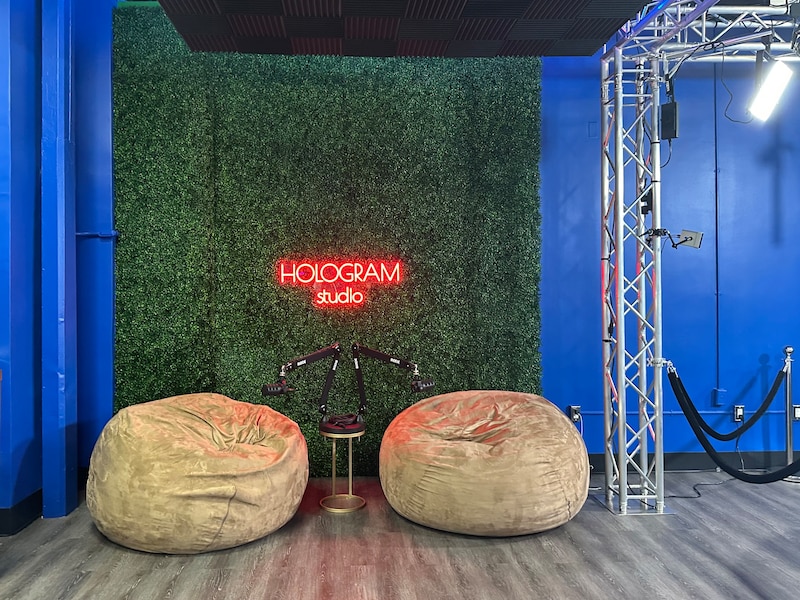
The studio has four sections, including the private room where students can meet with beamed-in therapists. Another area features a beanbag chair surrounded by a U-shaped screen displaying images of beaches or forests. Nearby, students can record podcasts about mental health issues affecting teens. A stage rounds out the studio, allowing students to create their own holograms, with the aim of sharing positive messages, S.I.C. Film School representatives said.
Bowen told students the technology could help them “deescalate a little bit” and refocus during the school day, especially amid the pressures of AP courses and Regents exams.
Funding and privacy of holographic therapy
The idea for the studio dates back several years to a chance encounter between Bowen and Hezues Scott, a media entrepreneur who goes by Hezues R and founded the S.I.C. Film School.
Bowen said the school received “big support” from Staten Island Borough President Vito Fossella to help cover the cost. Fossella’s office didn’t respond to inquiries about its contribution to the project.
“It’s worth the price because look at the experience that they’re getting,” Bowen said.
Questions remain about how the school’s virtual therapy services will operate, including who will provide the sessions and how students’ privacy will be protected. Bowen said it was too early to say which agencies would provide therapists, though he said they will be vetted by the Education Department.
David Nussbaum, the Los Angeles-based inventor of Proto’s technology, said the company’s engineers worked to ensure the device and its operating system received cybersecurity and patient privacy approval.
“If you’re talking to a doctor, or your therapist, or a family member, you want to know your communications are private and safe,” he said.
Nicholas Lanzieri, a clinical professor at the NYU Silver School of Social Work who has extensively researched education technology but wasn’t familiar with this particular program, said such tools can be attractive but cautioned that schools must carefully consider how they will be implemented.
“This is not a science fair,” Lanzieri said. “You want to really be intentional with what you’re trying to create.”
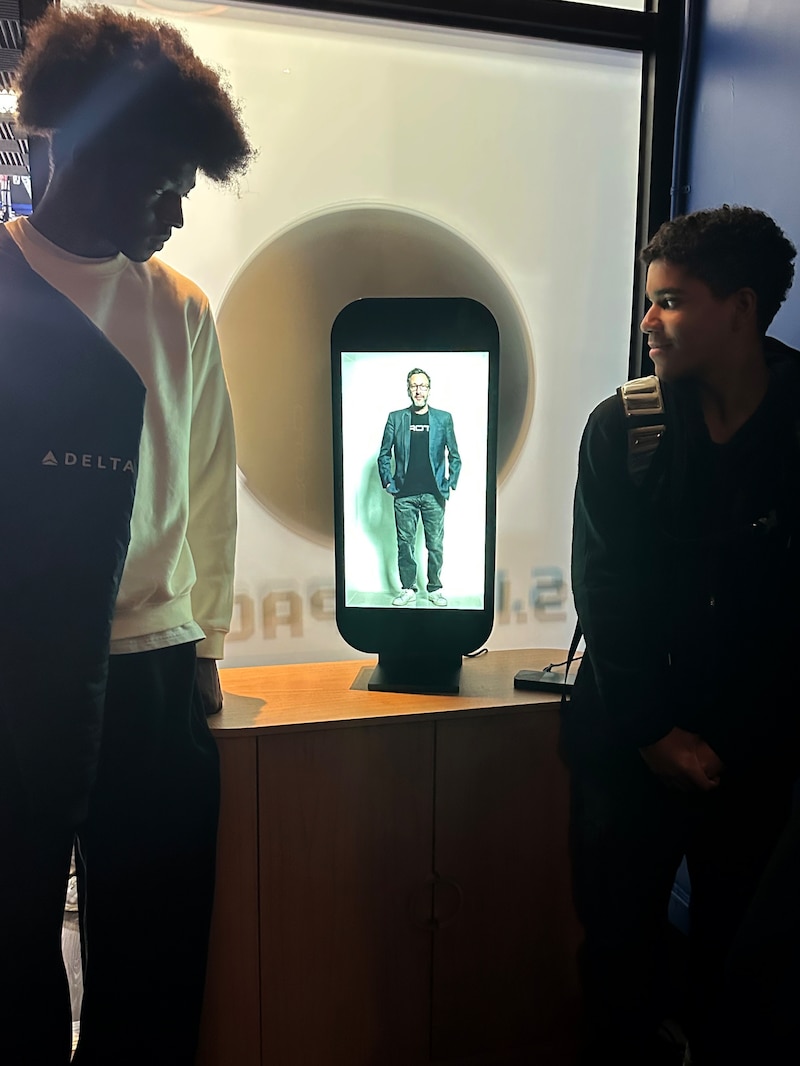
During the tour, students crowded into the private room as Nussbaum appeared in a holographic device to greet them. In the tabletop device — a miniature version of the one the school plans to use — he appeared to be standing in the room, with his shadow faintly visible behind him.
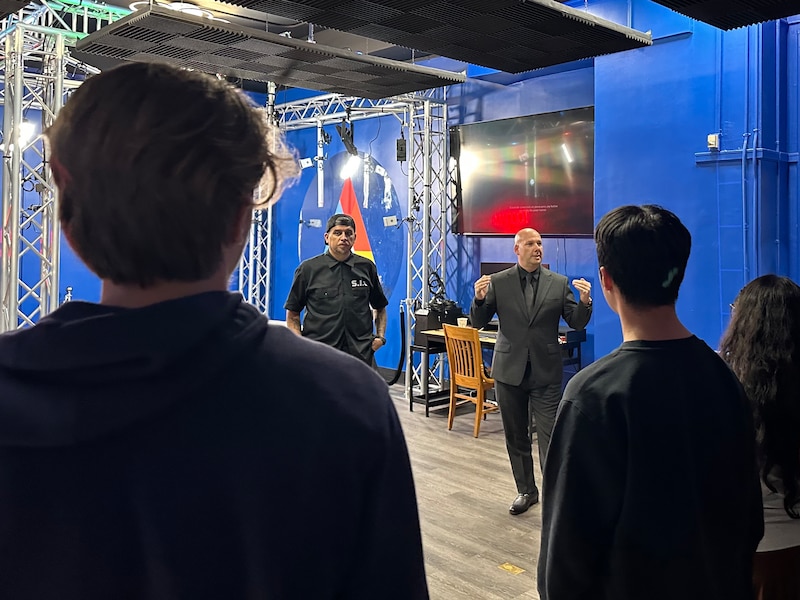
“The best therapist can be in any school for any reason at any time,” Nussbaum said. “It’s really incredible.”
Remote therapy is common, including through video calls and text messaging. Thousands of teenagers signed up for New York City’s Teenspace program after the city launched the free online therapy service in November 2023.
With those options already available, some McKee students questioned holographic therapy’s benefits.
“How does this technology differ from, like, a regular phone?” Jade Saavedra, a 16-year-old junior, asked.
Nussbaum said the device creates a “feeling of presence” that a phone or video call cannot replicate. “We make it feel like the person is in the room.”
Expanding mental health technology to other schools
Bowen said McKee’s mental health studio could serve as a model for other city schools, provided they can secure additional funding.
“There’s not a school out there that can do this straight from their budget,” Bowen said. “You’d have to have a monster budget to do that, and so it’s counting on the electeds, the elected officials to provide that funding.”
McKee enrolled nearly 570 students last year, more than 82% of whom were from low-income families. Roughly 36% had disabilities, compared to 22% citywide, according to Education Department data.
The school currently employs four full-time guidance counselors, including one who is bilingual, and a social worker, according to budget documents. That amounts to roughly one counselor or social worker for every 114 students, compared with one for every 125 students across New York City high schools.
For Josias Alarcon, a 16-year-old junior, the studio offered an example of how technology that can contribute to teenagers’ mental health struggles might also help address them.
“That we’re using something that could cause us damage if not used appropriately to actually help us out really shows the importance of how we should use technology,” he said.
Trenton Daniel is a reporter covering public health in New York for Healthbeat. Contact Trenton at tdaniel@healthbeat.org or on the messaging app Signal at trentondaniel.88.