
Did you know search engines like Google are changing the way you see news? Keep Chalkbeat’s valuable education coverage at the top of your feeds by clicking here and checking the box next to our name.
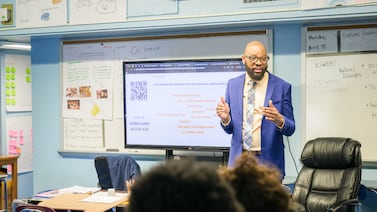
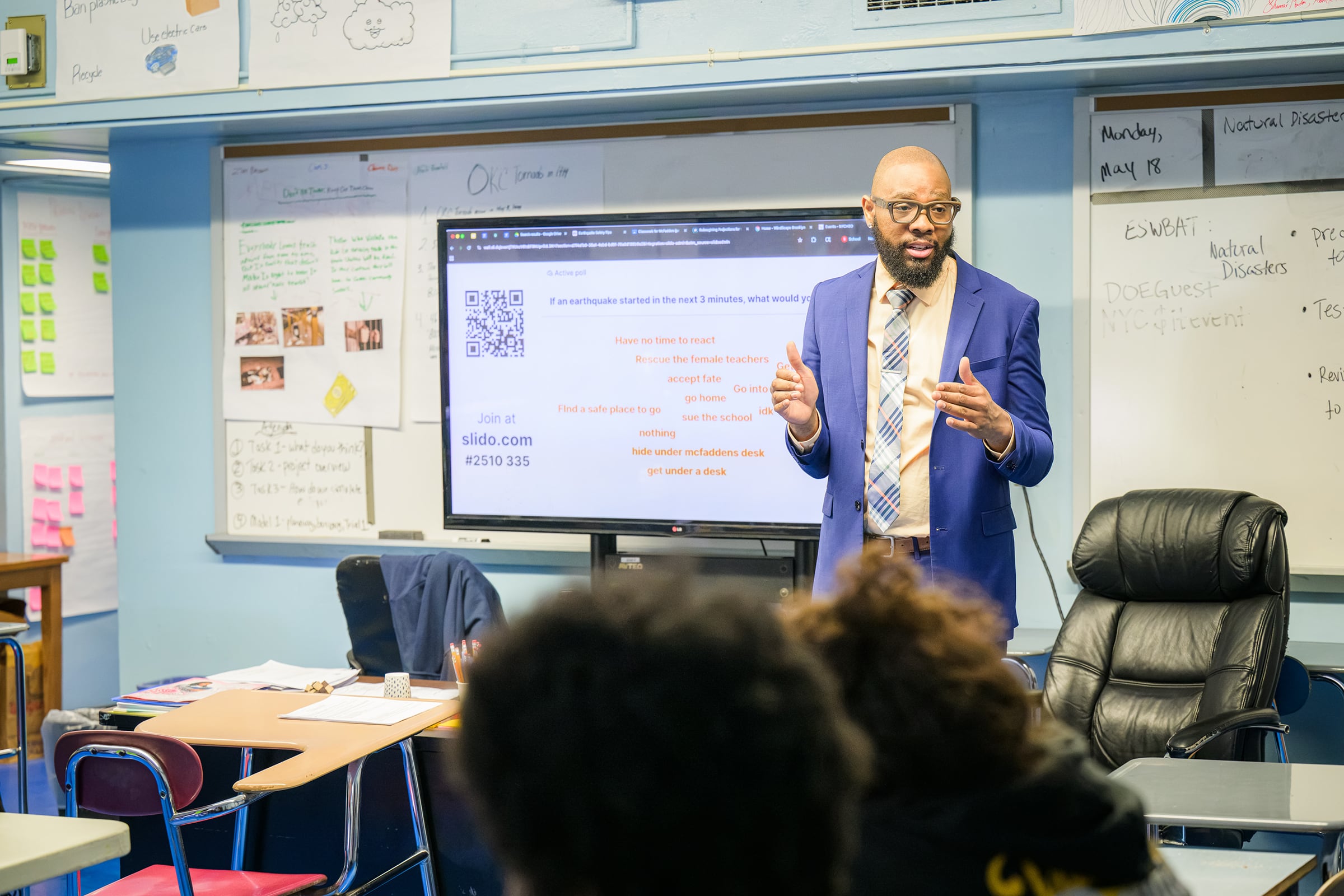
Brooklyn science teacher Sean McFadden doesn’t just reach his students at the Eagle Academy for Young Men II. His work on climate education shapes schools across New York City.
As co-chair of the Education Department’s Climate Education Team, he helps lead a group of about 40 educators on creating “equitable, meaningful” climate education lessons as the nation’s largest school system gears up for a new state mandate next school year to phase in climate education.
“Climate change can be meaningfully integrated into science, social studies, economics, literature, and more,” he said. “But requiring climate education is only the first step. Teachers need time, training, confidence, and ready-to-use materials.”
McFadden also helped develop the climate curriculum the city has used the past two years for its K-8 Summer Rising program. And he’s helping lead a civic science pilot with 11 teachers across four boroughs where students will use sensors to collect air quality data at their schools as a way to capture a picture of environmental conditions across the city.
Now, he is now being recognized for his work. He’s among 10 New York City educators who won the 2026 Julian Robertson Award for Excellence in Teaching, which comes with a $20,000 unrestricted cash prize for each winner. (The 3-year-old award is accepting nominations through Oct. 31.)
For the past 13 years, McFadden has been at Eagle Academy, an all-boys public school designed to support young men of color. His path to the school where he currently teaches AP Environmental Science and a cClimate cChange elective was somewhat winding. He studied meteorology and began a Ph.D. program in atmospheric science. But he soon realized that he “enjoyed connecting with people more than conducting research.”
Through his work in City Year, an AmeriCorps program that partners with public schools in high-need communities, McFadden found his calling. He’s following in the footsteps of his mother, who taught elementary school in the Bronx for 30 years and developed lasting connections with her students.
“I mentored high school students in Brooklyn and developed a brotherly bond with a group of young Black men,” McFadden said of his City Year experience 15 years ago. “I’m still in touch with many of them today.”
This interview has been edited for length and clarity.
What drew you specifically to climate education?
As an Earth science teacher, I sometimes struggled to make abstract concepts feel relevant. Most of my scholars had never seen an igneous rock outcrop or a meandering stream, but they could see and feel climate change’s impacts in New York City.
Climate education also connects science with economics, government, and social justice. As a Black educator teaching predominantly Black boys, I want to amplify perspectives often missing from environmental conversations and help scholars see themselves as people who can shape solutions.
What’s your favorite lesson to teach and why?
Our urban heat island investigation is a favorite! We take infrared thermometers outside and compare the temperatures of grass, concrete, asphalt, and other surfaces around the school. Scholars develop hypotheses and choose some of their own measurement sites.
We’re doing authentic science without leaving school grounds. I love telling scholars they’ve just done the kind of work scientists do to study urban heat. Seeing their pride is priceless.
What does centering student experiences and inclusiveness look like in your classroom?
I begin lessons with opinion questions connected to scholars’ lives. If a vacant Brooklyn lot were redeveloped, should it become a park, affordable housing, or businesses? There’s no single right answer. Everyone can contribute, and we practice supporting opinions with evidence and listening to different perspectives.
Can you share an example of how you foster student leadership?
One scholar joined my hydroponics club as a quiet freshman looking for extra credit. As he learned to care for plants and manage our systems, his confidence blossomed. At my suggestion, he became club president and joined NYC Public Schools’ Youth Leadership Council.
Now he’s leading sustainability workshops for the city, encouraging classmates to get involved, and helping me develop a proposal for an outdoor greenhouse. Watching that transformation has been incredibly rewarding.
What’s happening in your community that affects your classroom or school?
Fresh, healthy food isn’t always easily accessible around our school. Our hydroponics systems let scholars grow, harvest, and eat produce while learning about food apartheid.
One scholar took home cilantro that his mother used in soup. We also share our harvests at the school’s Thanksgiving feast. It’s wonderful seeing classroom learning become part of family and school life.
You are also your school’s sustainability coordinator. Can you tell us more about that role?
I lead our Green Team of scholars and staff, organize Climate Action Days, and coordinate with custodial staff on recycling and composting.
For Energy Climate Action Day, scholars in grades 6-12 were invited to pledge an everyday action, such as switching off unused lights or fully shutting down gaming consoles. We posted pledge menus on every floor. The next day, Green Team members interviewed scholars from each grade about whether they honored their pledges, what obstacles they encountered, and whether they’d keep going. I love that scholars led both the action and the reflection.
How did your own experiences in school shape the educator you are today?
My kindergarten teacher, Mrs. Styles, made me feel welcome when I was the only Black student at a new school. Her warmth made an unfamiliar environment feel less frightening and helped me feel comfortable enough to let my guard down and make friends. She still asks my mother about me! I strive to create that same sense of belonging for my scholars.
Later, my Earth science teacher, Mr. Cosgrove, and chemistry teacher, Ms. George, geeked out with me and fueled my curiosity.
I never had a Black male teacher in K-12. I hope to be the example of an educated Black man that I didn’t have growing up.
What do you plan to do with the award money?
Much of the award money paid for veterinary care for my beloved cat, who underwent several procedures and surgeries. Sadly, he passed away, but I’m grateful I could get him the care he needed. I used the rest to invest in my future and help family members.
Is there anything else you’d like to share?
I hope this award shows my scholars that growth doesn’t stop when you become an adult with a career. I’m still challenging myself and setting new goals, and I hope they’ll do the same.
Amy Zimmer is the bureau chief for Chalkbeat New York. Contact Amy at azimmer@chalkbeat.org.