Sign up for Chalkbeat Colorado’s free daily newsletter to get the latest reporting from us, plus curated news from other Colorado outlets, delivered to your inbox.
Colorado lawmakers rejected a bill Thursday to cut back on teacher evaluations.
House Bill 1291 would have allowed teachers with Colorado’s version of tenure to be evaluated every three years instead of annually.
There was a tiny catch: The once-every-three-years evaluation would not have applied to teachers rated partially effective or ineffective. The catch was tiny because less than 4% of all Colorado teachers were rated that way last school year, state data shows.
The bill would also have only applied to teachers with nonprobationary status. To earn that status, a teacher must be rated effective or highly effective three years in a row. Probationary teachers would have still been evaluated every year.
An amendment would have allowed districts to evaluate nonprobationary teachers more often if they had “documented and substantiated performance deficiencies.”
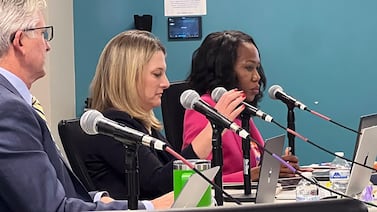
But state lawmakers on the House Education Committee still said no, voting the bill down 10-3. Several said that Colorado’s teacher evaluation system is flawed, but this wasn’t the way to fix it. Others were concerned about the estimated $528,000 cost of switching to a new system, given that Colorado is once again facing a major budget deficit.
Assistant Majority Leader Rep. Jennifer Bacon, a Denver Democrat and former teacher, cited another reason: Without regular evaluations, she said, it would be unclear how teachers are serving students of color and other marginalized groups.
“Our data ain’t great right now, and I’m not going to risk it,” Bacon said.
How best to evaluate teachers is a hot topic with a history of controversy in Colorado. In 2010, state lawmakers passed a law that required 50% of a teacher’s evaluation to be based on student test scores. That law also required teachers to be evaluated every year. It was so notorious that teachers and lawmakers still refer to the law by its bill number, 191.
In 2022, after more than a decade of pushback, state lawmakers reduced to 30% the percentage of the evaluation based on test scores. The 2022 law also simplified evaluations for teachers who are rated highly effective three years in a row.
Supporters said this year’s bill would have reduced the burden on time-strapped principals. Instead of having to evaluate good teachers — whom Adams 12 Superintendent Chris Gdowski called “the Peyton Manning equivalents” — principals could focus on helping the struggling ones.
Some teachers testified that fewer evaluations would free them up, too.
“I love watching a kid finally understand that they’re a brilliant mathematician,” said Benji Stock, an eighth grade math teacher in Denver Public Schools. “Our current annual evaluation situation pulls me and my peers away from those moments more than it should.”
The bill was inspired by students on the Colorado Youth Advisory Council and educators in the St. Vrain Valley school district, according to sponsor Rep. Eliza Hamrick, a Centennial Democrat and former teacher. Hamrick and others emphasized that Colorado’s teacher evaluation system hasn’t dramatically improved student achievement.
But at least one teacher who testified said she values being evaluated each year and worries that it would be bad for students if it occurred less frequently.
“If a teacher is doing something poorly and they don’t know,” said Jean Niederkorn, a seventh grade math teacher in the rural Garfield Re-2 school district, “then for three years, they will be poorly teaching that next generation.”
Melanie Asmar is the bureau chief for Chalkbeat Colorado. Contact Melanie at masmar@chalkbeat.org.