Did you know search engines like Google are changing the way you see news? Keep Chalkbeat’s valuable education coverage at the top of your feeds by clicking here and checking the box next to our name.
Top Illinois House leaders say they don’t expect public education to get extra funds during the state legislature’s ongoing veto session, making it likely Chicago Public Schools will have midyear layoffs.
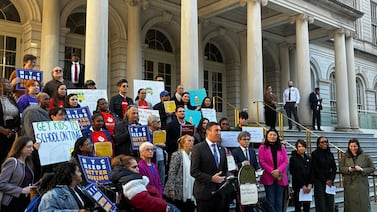
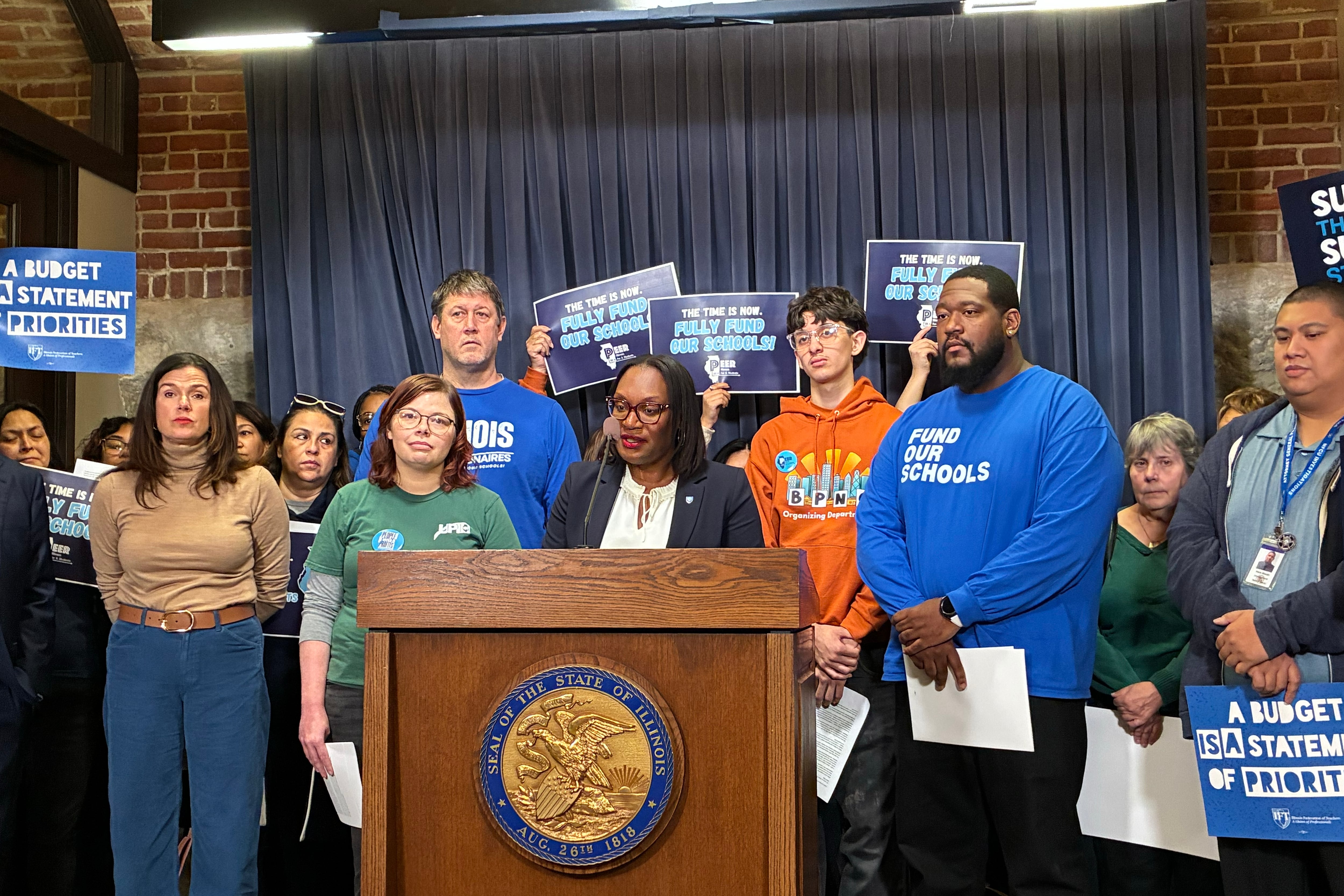
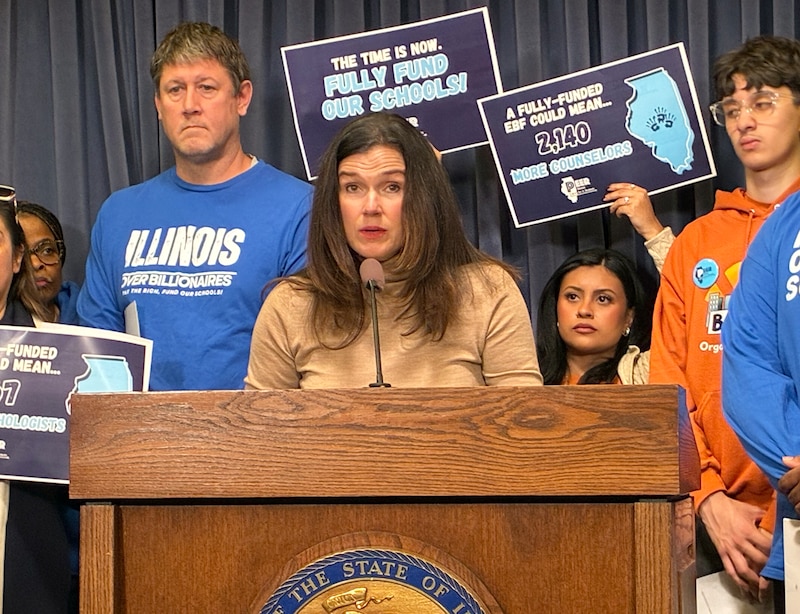
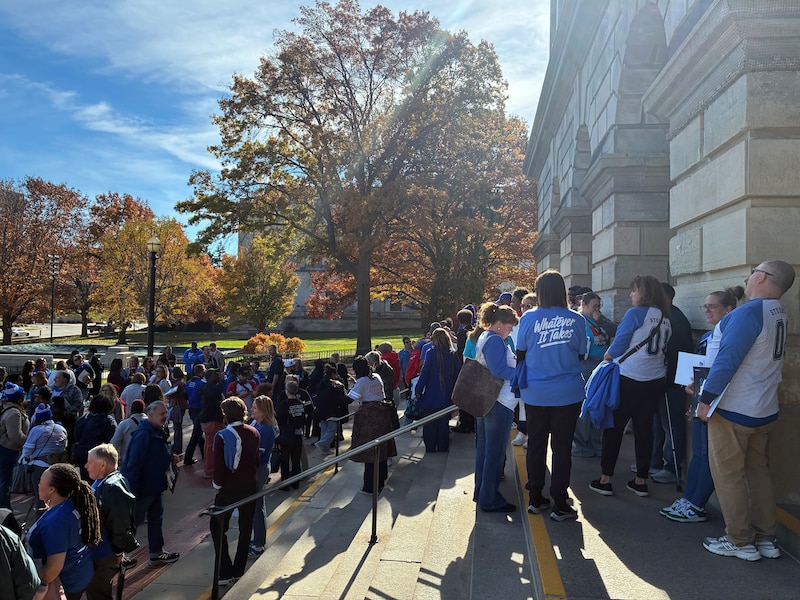
Still, more than 100 people from education unions and advocacy groups across the state, including the Illinois Federation of Teachers, Service Employees International Union, and the Partnership for Equity and Education Rights Illinois, visited the Capitol Wednesday to demand more funding for public schools.
“This is not asking for special treatment, but it’s asking for a fair opportunity, which our students do deserve. Our ZIP code should not determine how much funding our students get,” said Joshua Webster, president of a school staff union in Madison, a city located along Illinois’ border with St. Louis.
Since the legislative session concluded in May, advocates planned to push for a funding increase during the veto session, which takes place this week and the first week of December, said Cyndi Oberle-Dahm, executive vice president of IFT, which also oversees the Chicago Teachers Union.
Lawmakers are in Springfield to consider the governor’s vetoes, but they also can bring forth new legislation. If they want to pass a law that takes immediate effect, it would need a supermajority vote in both chambers, requiring approval from 71 House members and 36 Senate members.
“There are still some things with this additional revenue that we could ask for during this veto session, so that is why we are here,” Oberle-Dahm said. “Our long game, we’re already planning out for the next two years, for the election in 2028.”
That extra revenue was announced last week as a part of the annual report from the Governor’s Office of Management and Budget. The state projects it will have a $927 million surplus. Gov. JB Pritzker suggests the bulk of that money should address any deficits that come as a result of changes to federal programs such as the Supplemental Nutrition Assistance Program. Pritzker has previously warned additional money will not go to education.
If the money goes where Pritzker wants, then the state will be operating with a surplus of about $200 million, according to the governor’s budget office.
Top lawmakers overseeing education legislation also don’t seem as optimistic about putting new revenue toward schools this veto session.
Rep. Will Davis of East Hazel Crest, who chairs the House elementary and secondary education appropriations committee charged with passing school funding, said he doesn’t see a path forward for more funding in 2026. He doubts that additional money could be allocated at the start of 2027, either.
Illinois lawmakers are trying to be “prudent” about the state’s finances amid federal funding uncertainties, Rep. Michelle Mussman told Chalkbeat. Without a long-term spending plan, her colleagues would be “reluctant to artificially support” schools with a onetime cash influx, said the Schaumburg representative, who is the House education policy committee chairwoman.
Education advocates had to compete for lawmakers’ attention this week with other groups advocating against data centers or pushing to secure a deal to keep the Chicago Bears in Illinois. And CPS entered the veto session in an unfavorable position due to a massive financial shortfall baked into the district’s budget earlier this year.
Like most other public school districts in Illinois, CPS is regressing from having enough money to meet student needs defined by the state’s evidence-based funding formula. This year, CPS received about a fifth of all new education funds from the state, bringing its total financial support from EBF to about $1.9 billion.
“Students are being denied opportunities because our schools aren’t receiving the support they need,” Curie Metro High School student Jesus Lechuga said. “So while legislators discuss the deal for the new Bears stadium, I ask, what about investing in the students who might one day play in it, design it, build it, or lead the communities around it?”
In July, the Chicago Board of Education approved a $10 billion budget that assumed CPS would receive an additional $150 million from the state. The decision amended a budget proposal from CEO Macquline King that included staff layoffs to loosen the district’s financial constraints. The district has already overspent its special education budget by $27 million less than halfway through the school year, WBEZ reported last week.
King and her team warned the board’s approved budget may result in midyear cuts. Still, CPS rehired about a third of previously laid off staffers this fall who were eligible to return. About 45% returned to their old schools. The district said in a written statement the number of employees who could be impacted by the budgetary shortfall is constantly changing as employees accept other jobs.
A district spokesperson said CPS is still committed to securing more funding but acknowledged the challenges of passing it during the veto session.
“We were encouraged to hear that lawmakers are having more focused discussions about public education during the veto session. Those conversations give us a starting point for working together on funding solutions in future legislative sessions,” the statement said.
Addressing CPS’ budget deficit emerged as a key issue in Chicago’s recent school board elections. Many candidates suggested different remedies such as auditing the district or petitioning the state for money.
No race displayed those rifts on how to approach budgetary gaps more publicly than in the campaigns for school board president. Jessica Biggs, who Chicagoans voted to lead the board earlier this month, positioned herself as a fiscally responsible candidate concerned about how revenue assumptions could lead to furloughs and layoffs. Biggs reiterated that message when she was elected, telling supporters that she was ready to take on the district’s financial challenges.
Hilario Dominguez, the CTU-backed candidate for school board president, said he would continue to push for state dollars and was at the Capitol Wednesday, as well as current school board members Michilla Blaise and Anusha Thotakura.
Chicagoans might see discourse about CPS’ budget seep into February’s mayoral election. The school district has increasingly relied on surpluses from the city’s tax-increment financing districts, which the mayor decides how to distribute.
Reema Amin contributed to this report.
Makiya Seminera is a reporter covering how the state and federal government affect education in Chicago and across Illinois. Contact Makiya at mseminera@chalkbeat.org.