Sign up for Chalkbeat Tennessee’s free newsletter to keep up with statewide education policy and Memphis-Shelby County Schools.
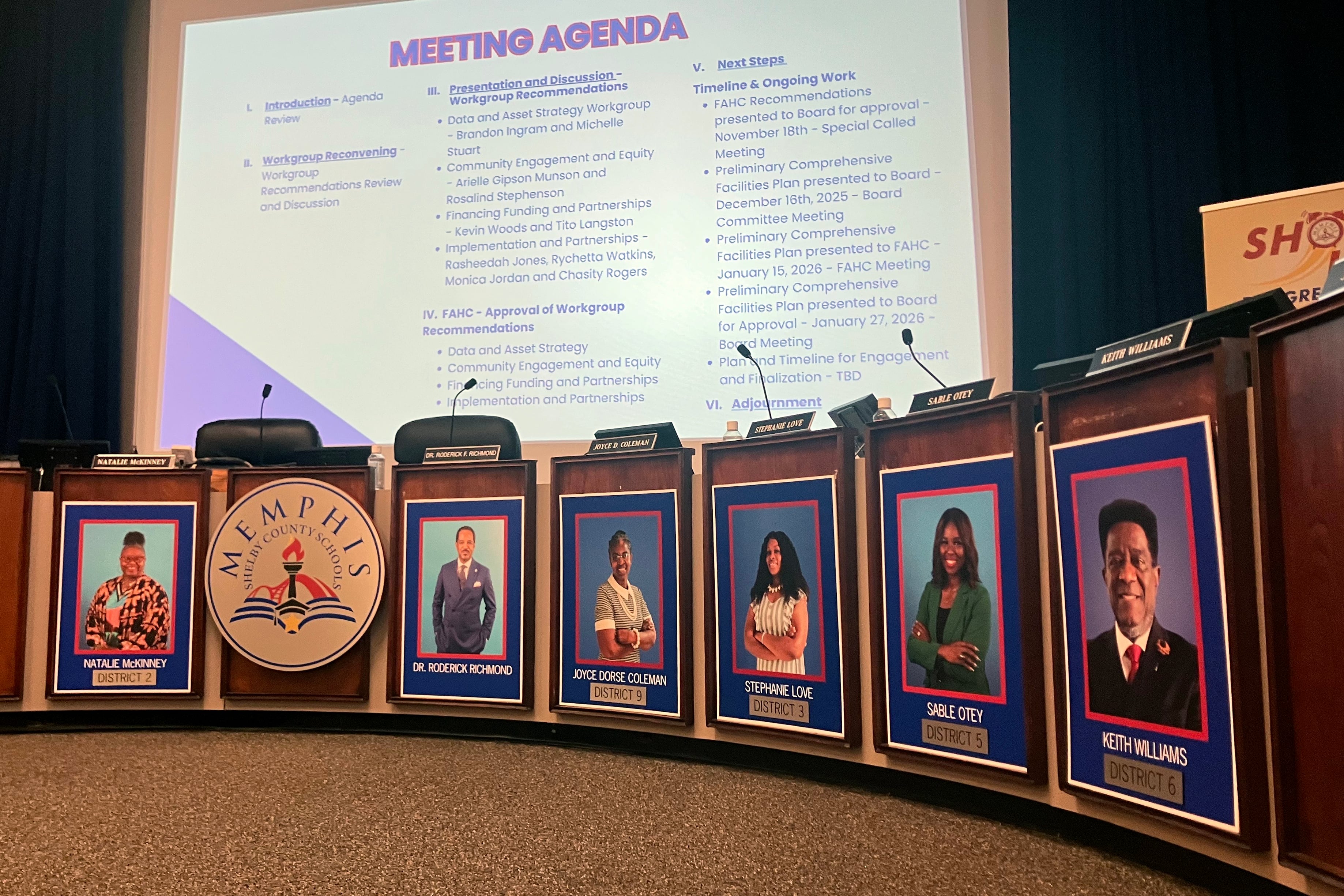
Five Memphis school board members will not have to seek reelection in May after a Monday court ruling invalidated the monthslong push from the county government to put all nine seats on the ballot.
A Shelby County judge ruled that the September resolution passed by the county commission is invalid and void because it would cut five Memphis-Shelby County school board members’ elected terms short.
Chancellor Melanie Taylor Jefferson said the Shelby County Commission “exceeded their authority” by adopting a resolution that specified changes needed to happen in the next election cycle and across all districts. Those details were not included in the 2025 state law that authorized local governments to restructure election dates.
In an emailed statement, MSCS praised the court for making a “measured and thoughtful” decision.
“The court’s decision upholds both the letter and spirit of the law and reinforces the principle that locally elected officials should serve the full terms to which they were duly elected,” the statement said.
MSCS sued the Shelby County Election Commission in December for implementing the county’s resolution and won a temporary restraining order to stop candidate filing for districts 2, 3, 4, 5 and 7. Current MSCS board members filling those seats had called the move retaliation for firing former Superintendent Marie Feagins last January.
The initial lawsuit didn’t include the county commission. But on Jan. 15, the board amended its complaint to include the county government as a defendant and then dismissed the entire election commission a week later.
Lee Whitwell, the lawyer representing the Shelby County Commission, argued Thursday that those moves were “procedurally problematic,” giving the commission no time to prepare a legal argument. The MSCS team also hasn’t filed an updated complaint against the commission at large.
“We’re backed into a corner because of the way the plaintiffs handled this case,” Whitwell said Thursday. “Because they didn’t comply … they’re really not entitled to the relief that they’re seeking today at all.”
The judge agreed that MSCS didn’t follow proper procedure. But she said she couldn’t allow a technicality to result in the abridgement of elected terms. The court also was running out of time to issue a ruling, with candidate filings for 2026 races due in less than two weeks.
Taylor Jefferson declined to rule on whether the county commission’s resolution violates the Tennessee constitution, another claim alleged by MSCS in its initial lawsuit. Whitwell confirmed that those issues could be argued in an appeal to a higher court. But he declined to say whether the Shelby County Commission will appeal Thursday’s ruling.
Wade said the constitutional questions are a moot point, because the county exceeded what state law authorized.
“That alone is enough to disqualify,” he said. “You don’t have to have a constitutional basis.”
As of early last month, 22 challengers had completed the first step to run against incumbents in the May 5 primary, which this year is a partisan race for the first time. Districts 1, 6, 8 and 9 will still be on the ballot according to the usual four-year election schedule.
Bri Hatch covers Memphis-Shelby County Schools for Chalkbeat Tennessee. Reach Bri at bhatch@chalkbeat.org.