Did you know search engines like Google are changing the way you see news? Keep Chalkbeat’s valuable education coverage at the top of your feeds by clicking here and checking the box next to our name.
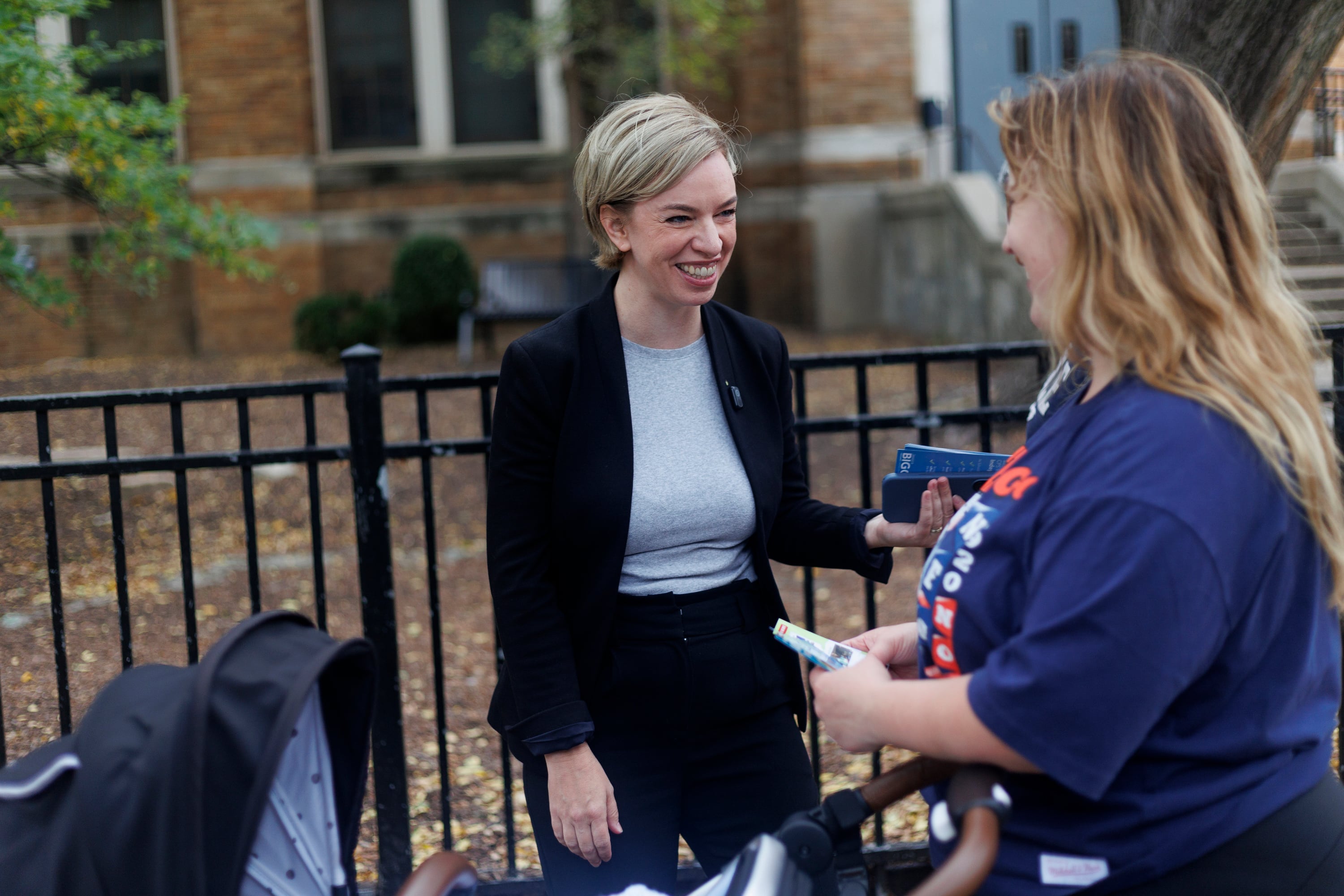
Jessica Biggs will take over as Chicago’s first elected school board president in January. But the former principal and current board member says she’s already spent weeks reaching out to future colleagues on the board and weighing steps to stabilize Chicago Public Schools’ precarious finances.
Biggs told Chalkbeat she wants the new board to pass a legislative agenda outlining its policy and funding priorities for state lawmakers at its first regular board meeting in late January. The current board didn’t do so until June this year, after the legislature adjourned.
She said she plans to focus on securing more state funding next spring rather than persuading lawmakers to deliver another $150 million for CPS this fall — what she sees as a largely lost cause.
Biggs is also busy recruiting city and civic leaders, state legislators, and others for a new intergovernmental task force to address the district’s fiscal challenges.
Biggs spoke to Chalkbeat about her thoughts on how the new fully elected board can refocus on student academic growth, tackle declining enrollment, and address turbulence in the charter sector.
This conversation has been lightly edited for clarity and length.
Voters elected a group of school board members who ran with varied backing and divided allegiances. What outreach and coalition-building are you doing now so you can hit the ground running in January?
I reject the premise of the question a little bit. There are 21 people who have been elected, many of whom talked about many of the same things throughout the campaign, regardless of their backing. So I am really eager to get us all together in a space and understand who everyone is, what moves them, and what they hope to achieve. I am in the process of scheduling one-on-one conversations with all board members. I would really like to have those conversations with new board members complete by the time we come together for pre-boarding on Dec. 14 and to have sat down with everyone by early January.
What are your goals for these conversations?
First and foremost, I want to understand who people are. What experiences led them to run? What did they learn about themselves and about their communities through the campaign? What do they hope to achieve? I am going to be actively listening for how they understand their role as a board member. I fully intend to pass a legislative agenda at our first full board meeting on Jan. 28. So it will be important that we’re talking through those legislative priorities because I would love to have some real alignment there.
Speaking of legislative priorities, you voted against the current CPS budget, which assumed an additional $150 million from the state that lawmakers had not provided. How involved have you been in efforts to persuade them to give the district that money?
I have talked about it with any state legislator that I have come into contact with for the past many months. I met with our chief of intergovernmental affairs and Dr. (Macquline) King this morning about our plan for the second week of veto session. Dr. King and I will be in Springfield together on Dec. 1. A lot of the work that we’re doing now is around rebuilding relationships and trust with legislators, letting them know that there is a united front between the board and the district, and setting ourselves up well for the spring session. We’ve known for a while that it does not look like there is a path to $150 million for Chicago in the veto session.
Beyond efforts to secure more funding from the state, are you already thinking about other steps CPS needs to take in the coming months to get on more stable financial footing?
I am actively working on the campaign promise that I made around pulling together an intergovernmental body on CPS funding. I’m already having conversations with people who I would like to be a part of that body come January. I’m not going to name names until we come together. But I will tell you the types of people I am planning to pull together: key leaders from City Council, key leaders in the state legislature, civic actors in Chicago, labor partners, board members, leadership from the district. The goal there really is to think about solutions beyond a single budget cycle.
During the race for school board president, the Chicago Teachers Union criticized funding you received from wealthy Illinoisans and your alignment with former officials from the Rahm Emanuel administration. Are you feeling pressure from your funders or high-profile supporters of your campaign to take certain steps once you become school board president? Has anyone made specific asks?
I am not feeling any pressure from anyone who donated to my campaign. Those were political attacks. You certainly expect that in a campaign. My body of work and my record very much stands in opposition to that characterization. I am moving forward with the same set of values that I have always acted with.
In recent years, the board has spent relatively little time talking about how students are faring academically. How will you refocus the board on student achievement and outcomes?
There are two things I am working to make sure are in place from the time that we are seated. First and foremost, you can count on a vote on committee assignments and structure in that very first meeting. You can also expect work right away from board members coming together around a common set of goals and priorities. My intention is that those goals are going to help focus the questions from the board, our requests for information from the district, and the topics of conversation that we spend our time on as a board.
I talked throughout my campaign about the importance of early literacy, which has been a focus of my career and is also supported by research. I think there’s some real alignment based on what I heard others talk about through their campaigns.
What are existing efforts that CPS needs to double down on or perhaps new initiatives that could help drive academic growth for CPS students?
From a funding perspective, a policy that I very much support is the use of an opportunity index to decide on funding levels for particular schools, making sure that we are providing greater resources and support to schools and communities that have the greatest need. That’s where I would double down. But we also need to establish some coherence of vision and a clear direction so that the district and our school leaders can focus their work. This has been a very unstable district for a while now, and that makes it hard to achieve any outcome, let alone academic ones.
I understand a resolution on extending the district’s school closure moratorium could come to the current board in December. What is your take on it, and how would it affect your work starting in January?
I would certainly hope that our board president would allow the fully elected board to be seated before making a decision that would be so impactful. I think it is fine to have the discussion, but I believe that we need to make sure that the district has the flexibility that it needs to provide the kind of experience that we want for all of our students.
And in some cases that might require closing or merging schools?
Potentially, certainly as a last resort, but this really is about making sure that the district has the flexibility that it needs.
If the current board approves a moratorium, can the new fully elected board simply rescind that?
I would think so.
Charters in Chicago and nationally are facing the existential crisis as they’ve been hit hard by both enrollment declines and fiscal uncertainty. Here in Chicago, some recent charter closures have also shown self-inflicted wounds with questionable financial moves. How can the district prevent a collapse in the charter sector while at the same time continuing to hold operators accountable?
I think it is fine to have high standards of accountability if you are consistent and clear about what those expectations are. One of the things that has been so challenging in the last couple of years is that the level of accountability and the standards around renewal have been a moving target, which has made it hard for charter operators to plan. I voted in favor of greater accountability, but I’ve also been clear that in the future, charter operators should know well in advance. We can’t keep moving the goal post all over the place and expect people to be able to rise to the occasion. As we move forward, I fully intend to vote on a governance calendar in our first board meeting so that the whole district will know when key votes are taken, including charter renewals. That predictability is really important.
What do you make of recent district efforts to rethink and strengthen special education services, and how do you plan to oversee them?
One of the obstacles has been around funding. We do need the state to step up and make significantly greater appropriation to those mandated categoricals. A wondering I have is around the increase in the number of cluster classrooms across the district. Why so many more? Why predominantly on the South and West sides of our city? Is that telling us something about our student needs, or is it telling us something about adult needs? I have more questions than I have answers at this point. But I have a lot of confidence in the team that we have in place to continue to work to figure this out.
Mila Koumpilova is Chalkbeat Chicago’s senior reporter covering Chicago Public Schools. Contact Mila at mkoumpilova@chalkbeat.org.