Did you know search engines like Google are changing the way you see news? Keep Chalkbeat’s valuable education coverage at the top of your feeds by clicking here and checking the box next to our name.
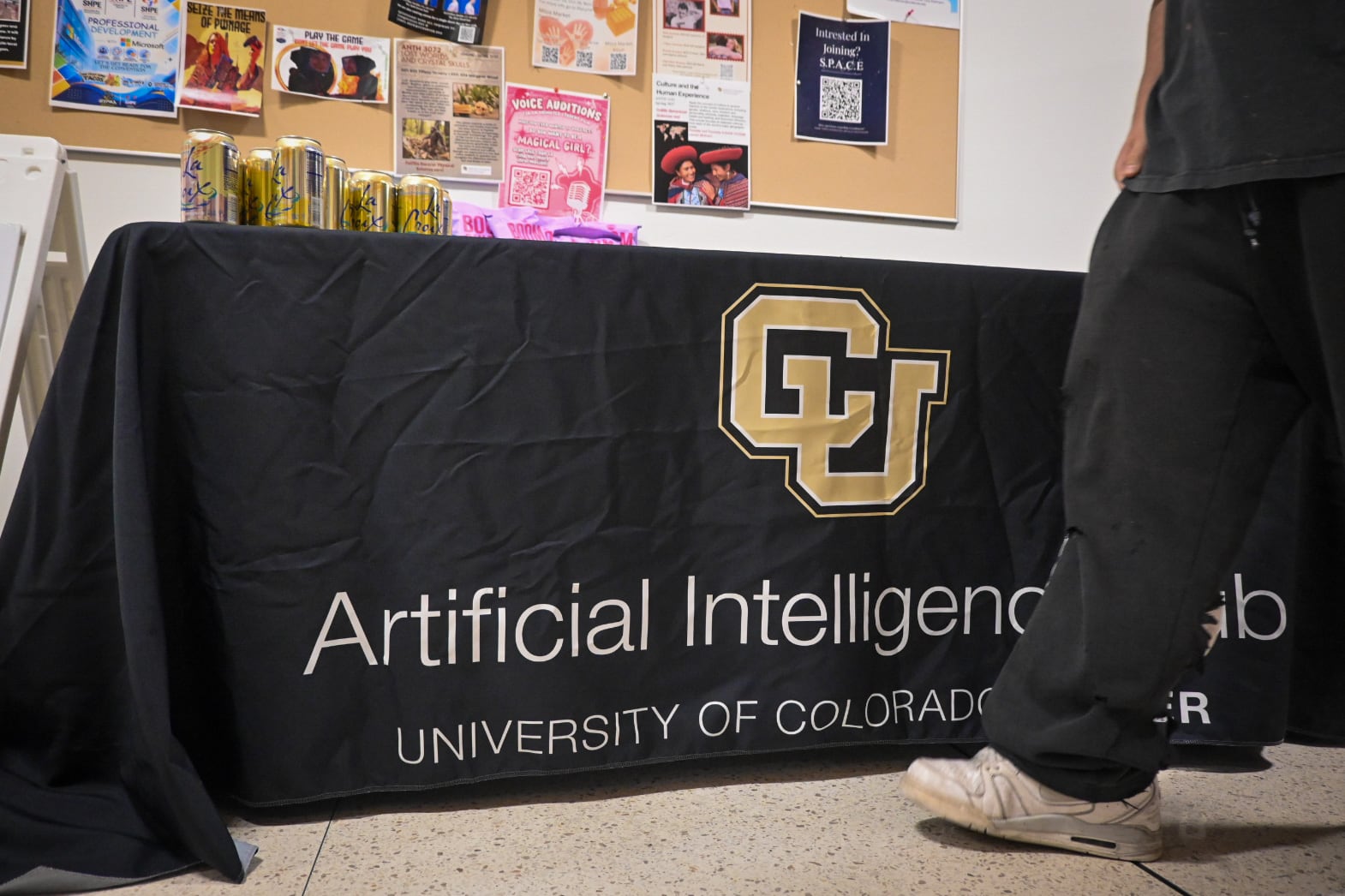
A plain white computer room at the University of Colorado Denver will now double as a meeting space for students to learn about artificial intelligence as the college goes all in on AI at a time when universities have received pushback for adopting the technology.
Faculty plan to use the new Artificial Intelligence Hub to host lectures about AI, teach students how to use the technology, and discuss best research and innovation practices.
To Jack Clark, a 19-year-old sophomore math major who attended the hub’s opening on Wednesday, the new lab signifies CU Denver’s dedication to preparing students for a job market undergoing significant changes since AI’s introduction.
“You can’t know where it will go, but you can be prepared in how you will attack whatever will come,” Clark said. “AI is a tool at the end of the day, but for students to be able to know how to use this tool is very important.”
Nationally, AI has raised questions about its responsible use in academic settings and whether research or personal information could be at risk. Campus leaders have responded in numerous ways, including banning the use of AI in some programs or opening AI centers with goals similar to the one at CU Denver.
Karen Marrongelle, the school’s provost and vice chancellor for academic affairs, said she hopes the hub will provide a safe space to learn about and experiment with AI. The school doesn’t want to limit or mandate its use in classrooms, but instructors can set their own rules.
She expects the learning that happens in the hub will help administrators to create campus policies needed in the face of the shifting technology.
“This is a place where students, staff, and faculty can come together responsibly and practically to ask questions and interrogate AI,” Marrongelle said.
The hub’s opening comes after the University of Colorado System announced a $2 million agreement in February with OpenAI to provide ChatGPT Edu services to faculty, staff, and students across its four campuses, which includes CU Denver. Students and faculty gained access to the platform in August. Individual campuses will need to pay to extend use of the platform after the first year.
CU Denver computer science and engineering professor Farnoush Banaei-Kashani said faculty at CU Denver’s campus met in April to discuss the adoption of the AI platform. There were concerns and excitement about the announcement, he said.
From those meetings, he came to the conclusion that AI is an elephant in a pitch black room that no one fully knows what to do with in an academic setting. He said the engineering and liberal arts departments, as well as the campus information technology office, came together to create a common space to discuss AI.
The school received a grant from the Lakewood philanthropic organization Clarence V. LaGuardia Foundation to support the hub through renaming the room, providing staffing, and paying for infrastructure upgrades. The donation will be used to renovate the room.
He said the faculty is still planning events and lectures, but the goal will be to address the biggest issues facing the campus about AI.
“We think we are looking at it very, very systematically,” he said. “We want to come up with plans to get things done rather than being reactive.”
CU Denver computer sciences student Thomas Phommarath, a fourth-year student, said he will use the hub to dive deeper into AI. He also has many concerns, including about AI’s impact on the environment and art.
“There’s a lot of danger and a lot of controversy,” he said. “I can completely understand that, because it can be used for mass surveillance on a population that never really asked for it, and it can be used for decisions that require human judgment.”
Phommarath said he has high hopes. If the hub gets it right, CU Denver students and graduates learning about the technology could not only figure out how to responsibly use the technology, he said, but use it to tackle some of the world’s biggest problems.
Jason Gonzales is a reporter covering higher education and the Colorado legislature. Chalkbeat Colorado partners with Open Campus on higher education coverage. Contact Jason at jgonzales@chalkbeat.org.