Did you know search engines like Google are changing the way you see news? Keep Chalkbeat’s valuable education coverage at the top of your feeds by clicking here and checking the box next to our name.
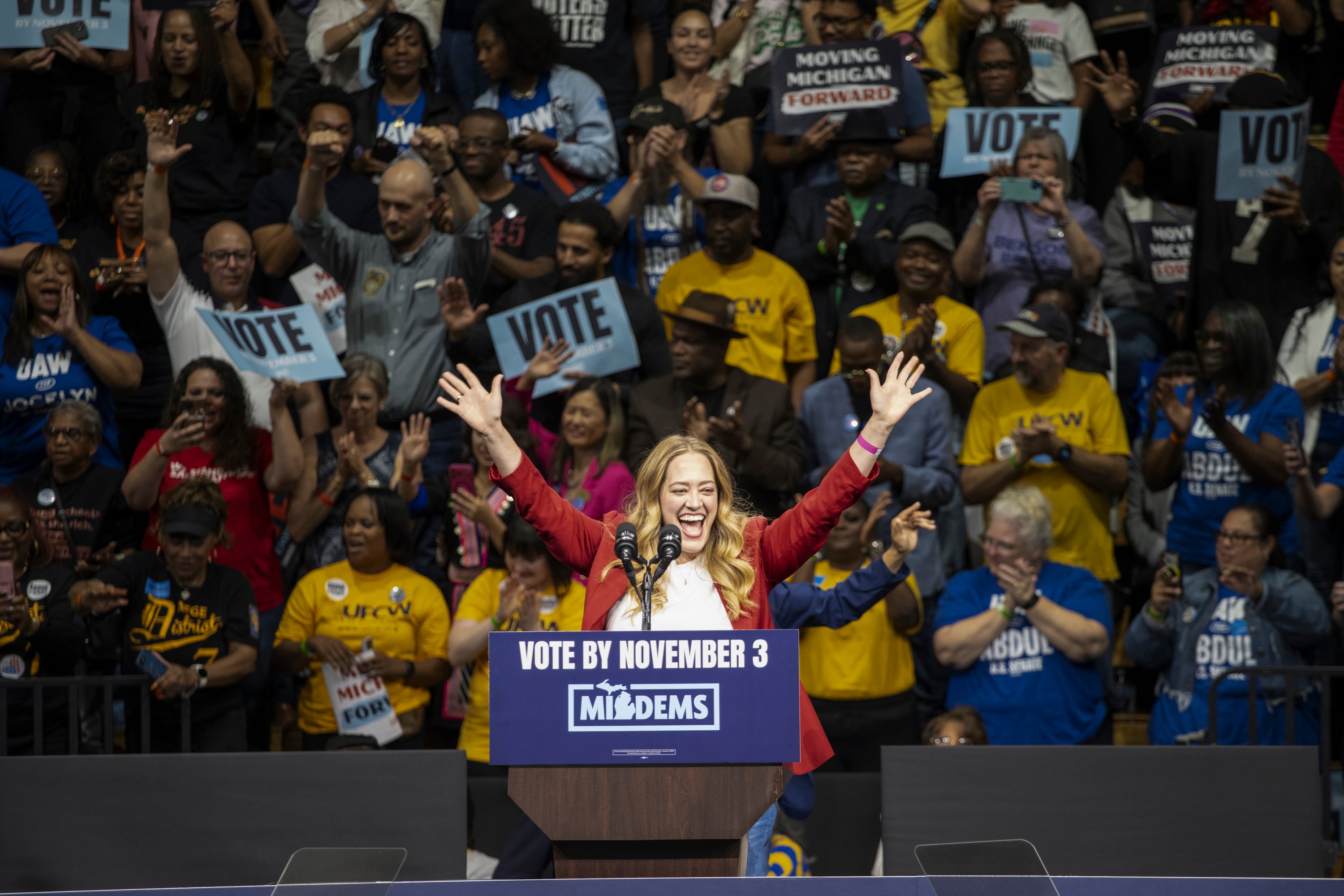
Michigan voters have elected a new governor, Jocelyn Benson, who promises to transform education and guarantee that when students graduate from the public school system, they are college and career ready.
The Associated Press called the race between Benson and U.S. Rep. John James at 1:45 a.m. The results show Benson winning with 55% of the vote.
Benson, the daughter of special education teachers, has a plan for addressing the state’s current literacy crisis by taking steps similar to what the state already has been doing: Investing in curriculum and training for teachers based on the science of reading, a longstanding body of research about how children learn to read. Her education plan says she would also “enable statewide tracking of literacy rates and improvements.” Benson would also ensure first-year teachers receive starting salaries of $60,000 a year minimum. Currently, the average in Michigan is around $41,000 annually.
What she calls her “Michigan Education Guarantee,” which she touted as she campaigned, would be an ambitious promise, particularly when it comes to college readiness. Just 24% of students met the SAT’s rigorous definition of being college ready on the exam taken earlier this year.
Benson will take office in the midst of an education crisis in Michigan. Just 44% of Michigan students in grades 3-8 were proficient in reading on the Michigan Student Test of Educational Progress, according to results released in August. The proficiency rate for third graders on the exam was at its lowest level in the 12-year history of the M-STEP. Meanwhile, Michigan ranks 42nd in the nation in education in the most recent Kids Count report.
She and James have opposing views on many education issues. For instance, James said on his first day as governor, he would sign on to the federal scholarship tax credit program. Benson said opting in would be reckless, citing a lack of clear guidance for how the program will be implemented. James favors bringing back a law requiring schools to retain third graders struggling with reading. Benson says teachers are the ones who should be making calls about retention.
Here’s what Michigan can expect on education in Benson’s administration.
A right to a world-class education
In addition to her Michigan Guarantee, Benson says she will push to establish a constitutional right to “a world-class education for every young Michigander.” She said this would give parents and educators with “an enforceable pathway to hold lawmakers accountable to our education excellence goals.”
Expanding early childhood education and tax cuts to pay for childcare
Benson would expand Michigan’s PreK for All program, which provides free preschool for 4-year-olds, regardless of their family’s income, to 3-year-olds. She plans to Increase the availability of high-quality childcare by streamlining the approval and certification process. And she says she will ensure increased pay for early childhood workers.
Tax cuts for parents paying for childcare are also part of Benson’s plan.
“I believe childcare costs need to go down if we’re going to improve education and give our kids a good start and support the hardworking parents who are supporting their kids,” Benson said during an Oct. 6 gubernatorial debate with James.
A funding system focused on student needs
Benson has said she believes Michigan’s schools have been underfunded for years. She wants a system that is focused on funding student needs. She favors the weighted funding system, which lawmakers have experimented with in recent years and codified into state law this year, because it provides additional funding for students who need greater resources, such as students from low-income homes and students who are English language learners.
She also plans to stop the practice of Michigan lawmakers funding higher education out of the School Aid Act, which advocates say was intended solely for K-12 schools. She would do that by creating separate funding for the state’s colleges and universities. She wants to mandate that if lawmakers fail to enact a state budget by the required July 1 deadline, an inflation-adjusted version of the previous year’s education budget would go into effect.
Improving outcomes for students with disabilities
Multiple pieces of Benson’s education plan focus on students with disabilities. She wants to create a strategic plan “for how Michigan will improve the education level and employment rates … so that they are able to thrive,” she says in her plan.
She’ll create an independent state office that will have the authority to provide advocacy support and resolve disputes between families of children with disabilities and school districts. She also plans to fix funding for special education, citing in her plan an overhaul proposed by the Autism Alliance of Michigan.
Creating an education cabinet
Governors usually have a cabinet made up of the heads of key state agencies and departments. Benson would create a separate cabinet focused on education.
The cabinet would include the heads of the Department of Education, the Department of Lifelong Education, Advancement, and Potential, the Department of Health and Human Services, the Department of Labor and Economic Opportunity, and the Department of Licensing and Regulatory Affairs, her plan says.
This cabinet will be focused on using disaggregated student data to set a statewide strategy aimed at improving schools.
Lori Higgins is the bureau chief for Chalkbeat Detroit. You can reach her at lhiggins@chalkbeat.org.