Sign up for Chalkbeat New York’s free daily newsletter to get essential news about NYC’s public schools delivered to your inbox.
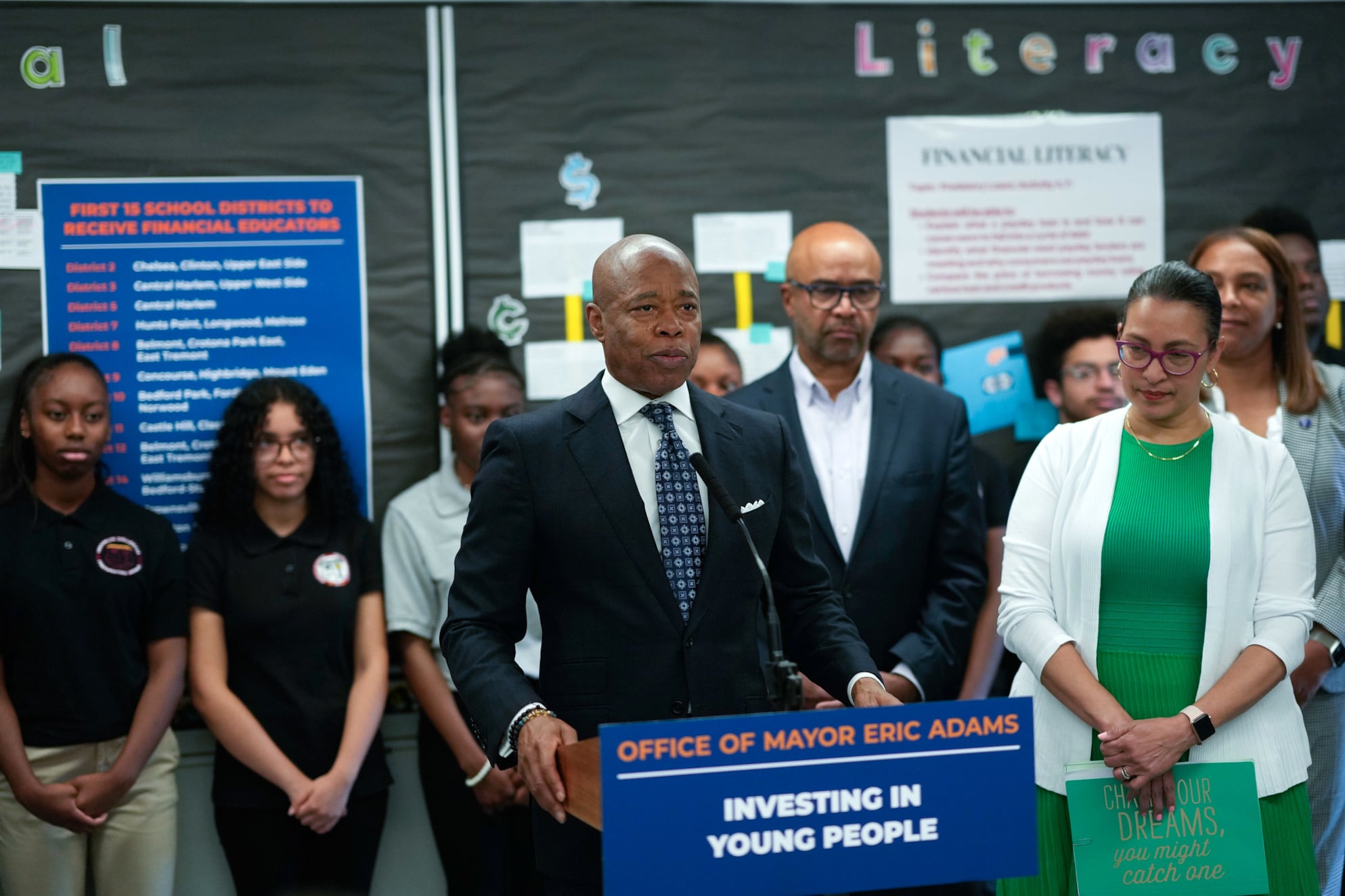
Starting in the fall, 15 of New York City’s local school districts serving 350,000 students will get financial educators who will provide free financial counseling and workshops to students and their families, Mayor Eric Adams announced on Wednesday.
The “financial literacy for youth,” or “fly,” initiative — which Adams previewed in his January State of the City address — is expected to expand to all 32 local school districts by 2030. The program will also pilot in-school banking to give students hands-on experience with saving and managing money with access to affordable banking options, city officials said.
The program will cost $25 million over five years, city officials said, with financial educators covering such topics as credit and money management basics, different types of banking products, and spotting consumer financial scams.
“We teach our children and our scholars … chemical bonds but not stocks and bonds,” Adams said at a press conference at Brooklyn Collegiate Preparatory High School. “We have to learn both. We have to learn treasury bonds and chemical bonds. We have to learn how to save, how to use our money.”
The districts in this first group were selected because they include neighborhoods with high rates of families without bank accounts, and they also participate in the Education Department’s FutureReadyNYC program,a signature Adams administration initiative that provides schools with resources to launch new career tracks, along with paid work experience, in the education, technology, business, and health care sectors. Six out of the 15 districts are in the Bronx, followed by four in Brooklyn, three in Manhattan, and one in Queens and Staten Island.
There’s been a growing push for financial literacy in schools from city and state leaders and beyond. At least 35 states require students to take a personal finance course to graduate, according to a 2024 report from the Council for Economic Education. In New York, the state said it’s adding new mandates for financial literacy to its updated graduation requirements — something that some students from across the city have been pushing for.
“Financial literacy is not a topic only some students should get to understand,” Anisha Singhal, previously wrote for Chalkbeat about Stuyvesant High School’s financial literacy elective. “It’s like a health class: a field of critical knowledge every high schooler needs (yes, even if that means yet another graduation requirement).”
But some critics argue that the push for financial literacy puts the onus on the consumer rather than on strengthening regulation of the players in the financial world, such as banks, investment firms, and insurance companies — many of whom are big advocates for school-based financial literacy. Some research has cast doubt on the effectiveness of financial literacy programs, and some observers are concerned that programs, many of which are offered free of charge to schools and sponsored by banks, could be used as marketing tools in an attempt to get potential customers.
In-school banking has been explored in other parts of the country and the state. City officials declined to provide more information about the in-school banking branches, saying to expect more information on that “soon.”
Here are the districts in the first wave of the new youth financial literacy program:
Manhattan
District 2 (Chelsea, Hell’s Kitchen, Upper East Side)
District 3 (Upper West Side, Central Harlem)
District 5 (Central Harlem)
Bronx
District 7 (Hunts Point, Melrose, Longwood)
District 8 (Belmont, Crotona Park East, East Tremont)
District 9 (Concourse, Highbridge, Mount Eden)
District 10 (Bedford Park, Fordham North, Norwood)
District 11 (Castle Hill, Clason Point, Parkchester)
District 12 (Baychester, Eastchester, Williamsbridge, Wakefield)
Brooklyn
District 14 (Williamsburg, Greenpoint, Bedford-Stuyvesant)
District 19 (Brownsville, Canarsie)
District 21 (Brighton Beach, Coney Island)
District 23 (Brownsville)
Queens
District 30 (Astoria, Long Island City, Jackson Hights, North Corona)
Staten Island
District 31
Amy Zimmer is the bureau chief for Chalkbeat New York. Contact Amy atazimmer@chalkbeat.org.