Did you know search engines like Google are changing the way you see news? Keep Chalkbeat’s valuable education coverage at the top of your feeds by clicking here and checking the box next to our name.
This story was originally published by The Trace, a nonprofit newsroom covering gun violence in America. Sign up for its newsletters here.
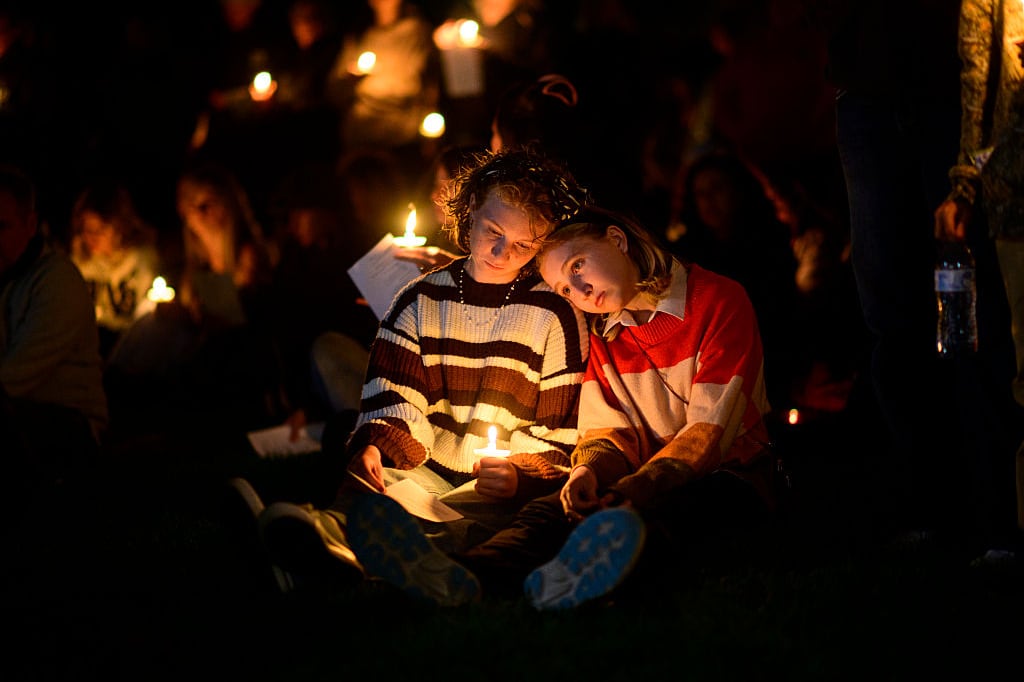
On October 15, a 16-year-old boy opened fire at Silver Rail Elementary School in Bend, Oregon, killing three children and a teacher and critically wounding two others. The incident is the deadliest school shooting since the one in 2024 at Apalachee High School in Georgia, which also resulted in four deaths.
Shortly after the Oregon shooting, gun control groups lamented weak federal gun laws and urged people to vote for reform-minded leaders. Gun rights advocates, meanwhile, argued that the state’s strong gun laws — including universal background checks, a red flag law, and a ghost gun ban — didn’t prevent the shooting.
Do gun rights advocates have a point? While research has shown that states with the loosest gun laws and highest rates of gun ownership have the highest rates of gun death, high-profile incidents like the tragedy in Bend still happen all over the country. Eight of the deadliest school shootings in the past 15 years have occurred in blue states, including California, Oregon, and Washington, according to Gun Violence Archive. Those states routinely earn top scores on the annual gun law scorecard from the advocacy group Giffords, which ranks each state by the strength of its gun laws.
“Public mass shootings represent less than 1% of gun violence in this country,” said Michael Anestis, director of the New Jersey Gun Violence Research Center at Rutgers University. “Research has shown time and time again that specific forms of firearm legislation are effective at reducing specific forms of injury and death,” he added, pointing to interventions that have reduced community violence.
Ali Rowhani-Rahbar, director of the Center for Firearm Injury Prevention at the University of Washington, agrees that there’s no single solution for reducing all types of gun violence. “Certain gun laws can reduce gun deaths, but no law can fully eliminate the risk of school shootings,” he said. “We should judge laws by their overall impact, not individual incidents.”
So what’s going on?
Experts and gun violence prevention advocates told The Trace that mass shootings, and gun violence in general, still happen in blue states for a number of reasons: the estimated 400 million guns in civilian hands around the country, laws that vary by state, and weak penalties for unsafely storing firearms. Gun laws also take time to become fully effective, they said, so a zero-sum framing isn’t useful.
“We have a patchwork of gun laws in the United States, and our federal laws are weak,” Emma Brown, the executive director of Giffords, told The Trace. “States with strong gun laws can be neighboring states with weak gun laws, making interstate trafficking easier. We also face emerging technology designed to skirt laws, like 3D-printed guns, that make it possible for people to build guns at home without a background check.”
A few experts pointed to state-by-state variations in gun death rates as proof that strong gun laws can be effective. “If you look at the difference between Massachusetts and Mississippi, gun death is 10 times higher in Mississippi,” said Josh Horwitz, co-director of the Johns Hopkins Center for Gun Violence Solutions at the Bloomberg School of Public Health. “So I’ll argue that gun laws do work. But they can’t stop everything.”
Safe storage laws also require education, enforcement
In some cases, owners aren’t locking up their weapons around children, Horwitz said. That may have been the case in Bend, where the attacker reportedly used a shotgun purchased by his mother. When a child is able to access an unsecured gun in their home and uses it to shoot someone, Horwitz said, it means the adult gun owner has failed to act responsibly.
Oregon imposes a civil penalty for leaving guns unsupervised around children, but no criminal penalty. Most states impose a misdemeanor or a fine for letting children access guns, and in many cases the penalty only kicks in when the child shoots someone, according to a Trace analysis of state laws.
Just passing a law “isn’t enough,” said Andrew Willinger, an assistant law professor at Georgia State University College of Law. “There needs to be active, sustained work over years to raise public awareness about their existence and how they operate. These laws have potential in situations like this, but a lot depends on how they are implemented on the ground.”
Even in states with the strongest safe storage and child access laws, there’s no enforcement unless something tragic happens. Police don’t come to your home and inspect your gun storage like they do in some other countries, and most Americans, Horwitz said, wouldn’t take kindly to that kind of intrusion. One way to encourage adults to lock up their guns is through safe storage requirements. He noted the availability of biometric safes and gun locks, which local governments and gun violence prevention groups often distribute for free.
Anestis, the researcher from Rutgers, promotes safe gun storage practices but cautions against prosecuting our way out of this problem because of how it disproportionately affects people of color.
“My fear about secure storage laws is that they’re most frequently going to be utilized when someone comes into contact with police,” he said. “And marginalized communities come in contact with police more often than others do. I worry about folks who are already vulnerable becoming even more vulnerable.”
Gun violence prevention experts agree that a cultural shift is needed by creating a stigma around leaving guns accessible to children. Christian Heyne, the chief programs and policy officer at the gun reform group Brady, said the gun industry and its lobby have spent decades promoting the idea that self-defense required keeping an unlocked, loaded gun close at hand. “When in reality, it exponentially increases the likelihood that you’re going to get shot.”
Many new gun owners, particularly the tens of millions who acquired guns for the first time during the COVID-19 pandemic, don’t fully understand how failing to store their weapons securely can contribute to violence, experts told us. One way criminals get guns is by stealing them, particularly from unlocked cars.
“Irresponsible practices lead to more gun deaths,” said Tanya Schardt, senior counsel and director of state and federal policy at Brady. “You need people to understand what they’re required to do, what the social contract is, regarding securely storing guns.”
Over the past decade, prosecutors have increasingly sought to hold parents accountable for shootings committed by their children. In at least five high-profile cases, parents have been convicted of involuntary manslaughter for giving guns to their children. Those parents include the father of the Apalachee High School shooter. Gun safety advocates hope these prosecutions will discourage parents from unsafely storing their guns. Brady’s Heyne likens it to hot car deaths. Arresting parents whose kids died because they left them in a car on a summer day “is a hard step to take with families who are going through unthinkable tragedy,” he said, but it’s brought national awareness to irresponsible behavior.
Jonathan Lowy, founder of Global Action Against Gun Violence and longtime gun reform advocate, said the United States needs to look abroad for solutions. Other countries, particularly ones with high gun ownership like Switzerland, “sensibly regulate guns, and they don’t have repeated gun massacres. Their experience teaches us that we don’t have to live like this.”