Did you know search engines like Google are changing the way you see news? Keep Chalkbeat’s valuable education coverage at the top of your feeds by clicking here and checking the box next to our name.
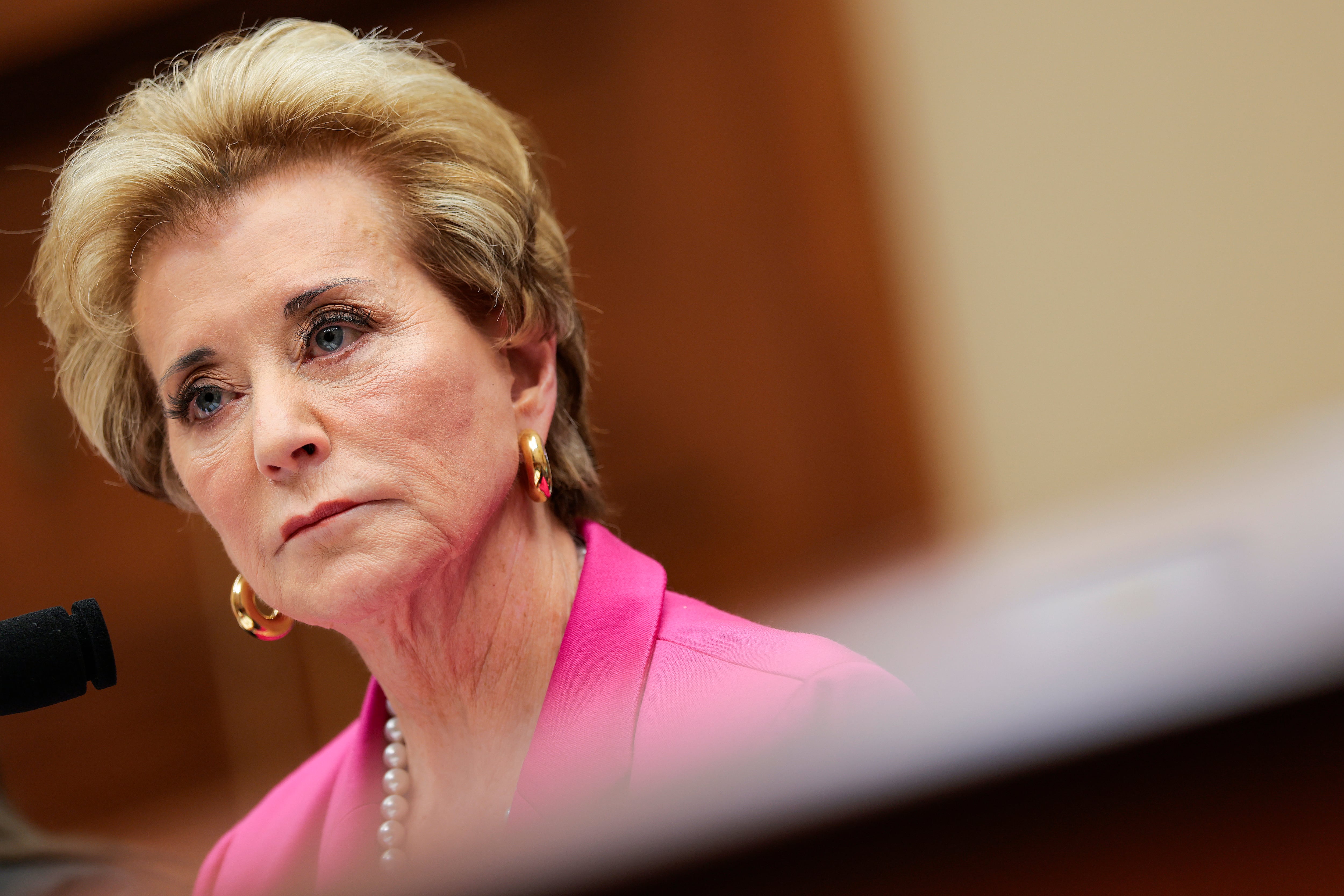
Education Secretary Linda McMahon has long said she wants to “make education great again.”
“American schooling, for generations, was the envy of the world,” she explained in a speech last week at a charter school near Salt Lake City. “Our classrooms were grounded in the fundamentals of reading, math, and science.”
In McMahon’s telling, American education has deteriorated over the last several decades, as federal power has grown. Key decisions, she said, were “pulled farther from families, teachers, and children — and into a labyrinth of districts, departments, and administrative offices.” (We’ll hold aside for the moment the fact that the Trump administration is expanding its own authority over schools in a number of ways.)
McMahon is offering a pointed interpretation of American educational history: one of an inspiring rise and then a long, alarming fall. This is, in short, her case for eliminating the U.S. Department of Education. But the history she tells is incomplete and simplistic.
Asked for comment, Sabin Sidney, an Education Department spokesperson pointed to low proficiency rates on national tests. “Washington’s bloated education bureaucracy has failed American students,” Sidney said in a statement. “By dismantling federal overreach and handing power back to the states, it won’t just be a Mississippi Miracle, but an American education renaissance.”
The U.S. was indeed once the clear global leader in access to public education. Beginning over a century and a half ago, America was much quicker than other countries to create relatively accessible systems of elementary and secondary schools. By the 1960s, a solid majority of U.S. students had completed high school, then the highest rate in the world. “We were pioneers in the provision of mass public education,” says University of Pennsylvania education historian Jonathan Zimmerman. Economists say this educational growth helped turn the U.S. into an economic powerhouse.
This doesn’t necessarily mean that U.S. schools were better than other countries’, Zimmerman notes. They were just more broadly accessible — but not fully so. As McMahon delicately acknowledges in her speech, “no era in our nation’s education has been perfect.”
Even into the mid ‘60s, schools across the American South were segregated by race and often deeply unequal. In the North, more subtle laws and customs also separated the races in housing and in schools. Children with disabilities were often kept out of public schools entirely. Girls and women had much less access to higher education and had little recourse if they were discriminated against. Students in poverty tended to go to poorly funded schools.
“Over time, we have made great strides to expand equal opportunity and access to education to millions of students,” McMahon said in her speech. She didn’t mention that the federal government was a key driver of many of these strides.
Perhaps the most significant federal intrusion into schools came from the 1965 Elementary and Secondary Education Act. Title I of the law — which is still the country’s largest federal funding stream for schools — was meant to improve the education of children in poverty. This provision also provided critical leverage to pressure Southern schools to desegregate.
In the following decades, federal authority grew further with the 1972 passage of Title IX, which bans sex discrimination in federally funded schools. Next there was a 1975 law, now known as the Individuals with Disabilities Education Act or IDEA. This protects the right of students with disabilities to a publicly funded education.
There is good evidence students have benefited from these efforts, and the laws have become foundational to American education. Although she wants to eliminate the Education Department, which was created in 1979, McMahon has vowed to protect the underlying laws that have expanded federal power.
Still in McMahon’s telling, around this point in history was when things started to fall apart. “For the past five decades, our education system has been co-opted to place the enrichment and priorities of adults over the flourishing of children,” she said.
Indeed, the growth of federal power coincided with growing angst about the state of American education, starting in the mid-70s. Other countries began to catch up to the U.S. in basic access. New national and international testing regimes showed that American students did not perform especially well. U.S. high school completion rates, which had been marching upward for over half a century, suddenly stalled.
These concerns culminated in the 1983 report “A Nation at Risk,” which offered an apocalyptic indictment of American schooling. Plenty of critics at the time — including President Ronald Reagan — blamed the federal government for these emergent problems. Some suggested then that the feds had sacrificed excellence in the name of equity, although this was based more on conjecture than hard evidence.
In any event, over the following decades, education in the U.S. resumed an upward trajectory by many measures. By the 2010s, math scores in elementary and middle schools had risen substantially, while reading scores trended up albeit more modestly. High school completion and college attendance had also grown. In many cases, gaps between advantaged and disadvantaged students, while still large, had shrunk.
Then two historically important things happened. The federal government pulled back from K-12 education, with a 2015 law that eased pressure on low-performing schools. Meanwhile, test scores had started to stagnate, and then, with the pandemic, to fall precipitously. This happened not just in the U.S. but in many other countries. Experts continue to debate the precise causes of these trends. (Some contend that less federal involvement contributed to learning declines, though this remains just a theory.)
So where does this leave McMahon’s gloss on history?
Reasonable people can debate the appropriate federal role in American schools now, but McMahon’s speech “engages in a lot of common mythmaking about schools in the past and the present,” says Zimmerman, the historian.
The broader history of American education is not one of epic rise and agonizing descent coinciding with more federal control. Instead there have been decades of real improvements followed by a sudden and sharp drop. The question now is whether this recent decline will be a temporary blip or a historical turning point.
Matt Barnum is Chalkbeat’s ideas editor. Reach him at mbarnum@chalkbeat.org.