Sign up for Chalkbeat Tennessee’s free newsletter to keep up with statewide education policy and Memphis-Shelby County Schools.
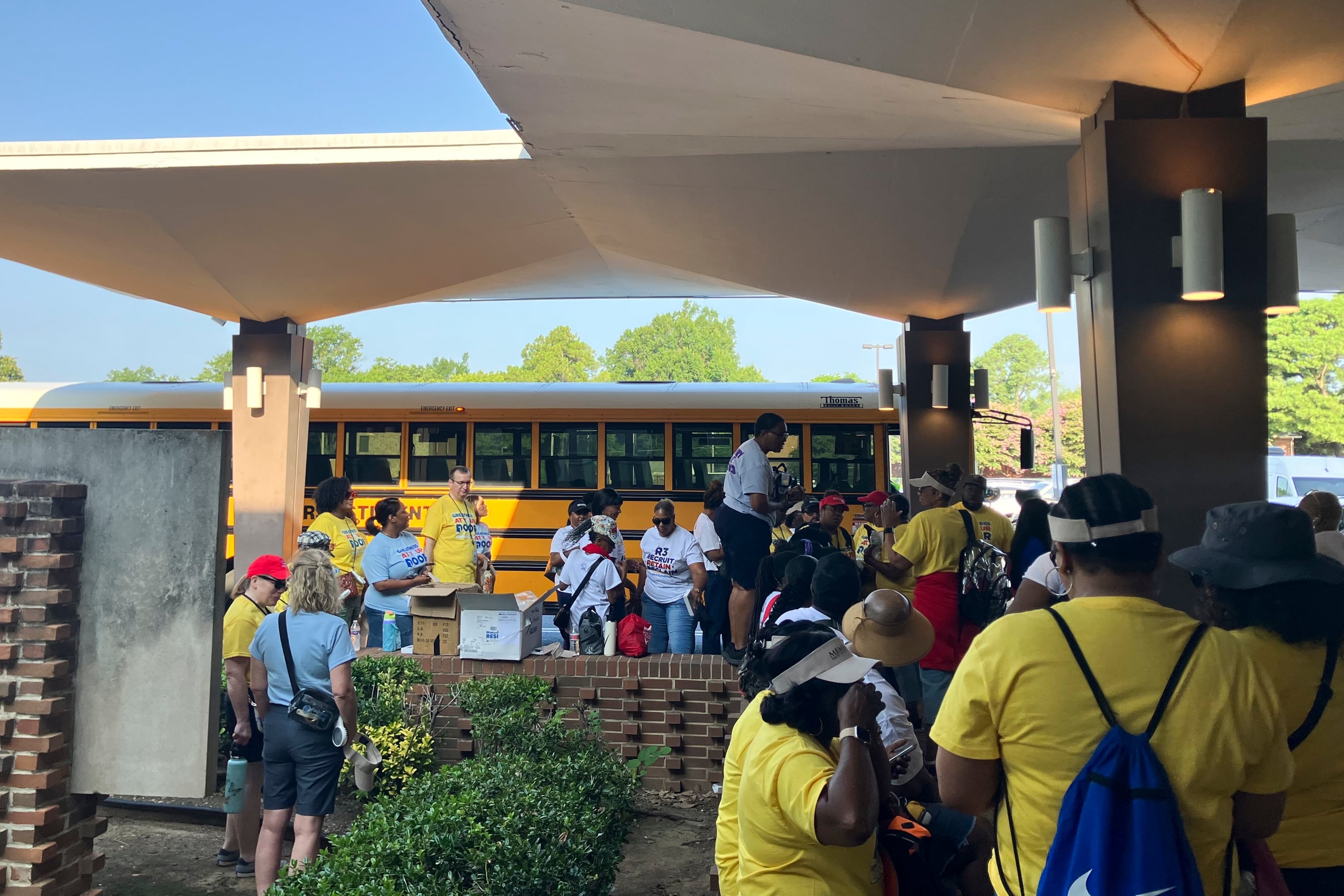
On an early Thursday morning in July, around 150 Memphis school leaders and attendance staff convened in front of the district administration building, clutching handheld fans and wearing matching visors.
The group, decked out in matching “Recruit, Retain & Reclaim” T-shirts, was heading to northwest Memphis to knock on doors and encourage families to enroll their students in Memphis-Shelby County Schools.
It was the sixth excursion since April for the district’s Greatness At Your Door attendance campaign, this time focused on students displaced by the closure of Lucy Elementary.
MSCS enrollment has suffered in the past decade, declining by over 9%, compared with a 2.5% drop statewide. But the district doesn’t just struggle to get students in the door, it also has trouble keeping them in their seats day after day.
Just over 30% of MSCS students were considered chronically absent in the 2024-25 school year, meaning they missed 18 or more days of school. Statewide, 18.3% of students hit that mark.
The district’s history of high chronic absenteeism is one of four criteria that induced the controversial state takeover of MSCS, which a federal court temporarily blocked at the end of June. Members of the new state-appointed oversight board would be tasked with reducing chronic absenteeism as part of their directive to improve overall district performance.
Students who are chronically absent are less likely to read on grade level by third grade and more likely to drop out of high school.
Final state data for last school year won’t be released until December. But Memphis officials believe, based on internal data, that the district improved its chronic absenteeism rate for the first time in nearly a decade. The rate increased from 13% in 2017 to last year’s decade high.
MSCS has seen the most improvement in reducing absenteeism in younger grades, said Stacey Davis, the district’s director of enrollment and attendance. But high school remains a challenge. In February, nearly 40% of Memphis high schoolers were on track to be chronically absent by the end of the year.
“A lot of our high school students are responsible for the younger siblings because their parents work,” Davis said. “A lot of our high school students need mental health breaks. We’re trying to help them to understand that we’re going to support your needs, but we still need you to come to school.”
The door-knocking campaign is one of the strategies MSCS is bringing back this year to boost enrollment and attendance.
“Putting a face to the name matters,” Eboni Williams, an attendance liaison at Raleigh-Bartlett Meadows Elementary, told Chalkbeat Thursday. “It significantly improves the community’s perspective of us.”
Davis said the team typically targets neighborhoods with low registration and high chronic absenteeism, such as Orange Mound and Frayser. Last year, Greatness At Your Door yielded mixed results across neighborhoods.
Over 1,000 previously unregistered students enrolled in MSCS after three rounds of the initiative. Daily attendance rates increased by around 5 percentage points in Frayser and South Memphis. But in Orange Mound, the rate fell from 78% to 63%.
At a board meeting last Tuesday, MSCS leaders said the daily attendance rate for the district increased by half a percentage point this year to 91.9%. That fell short of their 93.4% goal.
But Cathy Mumphrey, an attendance liaison at Cummings Elementary, said going door to door helps ease parents’ anxieties and identify specific barriers.
“We’re trying to make a connection with those parents,” she told Chalkbeat Thursday. “We’re trying to be that person they can rely on.”
Mumphrey said the staff come equipped with extra uniforms and public transportation vouchers to address barriers that keep students from attending school. They also pass out information about food pantries and mental health services.
During the school year, attendance liaisons are responsible for bridging those gaps in resources and access in real time. Last year, the attendance specialists split their time across multiple schools to cover the entire district.
This year, each of the 69 liaisons will work full time at one of MSCS’ lowest-performing schools or schools with the highest chronic absenteeism rates.
“We realized that we needed full time support at those particular schools,” Davis said.
Attendance liaisons make daily phone calls for absent students, track attendance data and trends, and hold family meetings for students on the cusp of missing 10% of the school year. MSCS charter schools that have had the most success in reducing absenteeism use the same strategy, though they often have more than one person dedicated to the job.
Bri Hatch covers Memphis-Shelby County Schools for Chalkbeat Tennessee. Reach Bri at bhatch@chalkbeat.org.