Sign up for Chalkbeat’s free weekly newsletter to keep up with how education is changing across the U.S.
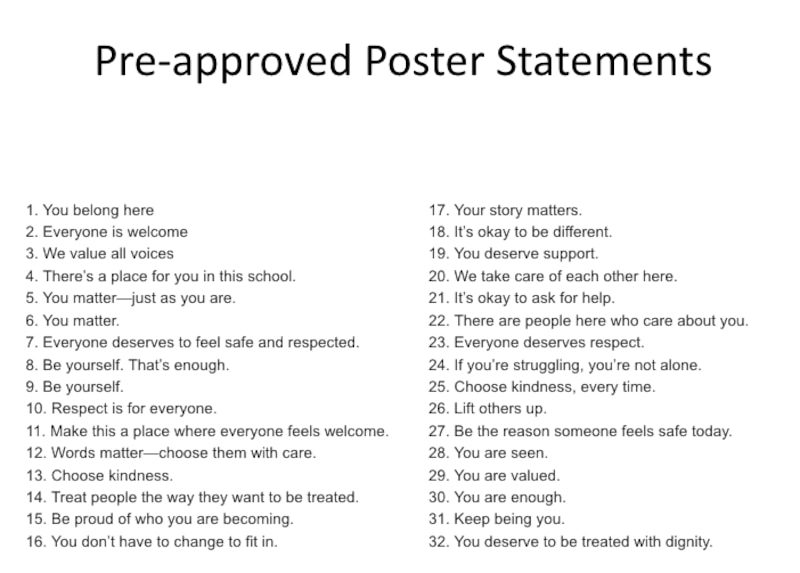
Teachers in Michigan’s Romeo Community Schools have 32 motivational phrases they’ll be able to display in their classrooms next school year.
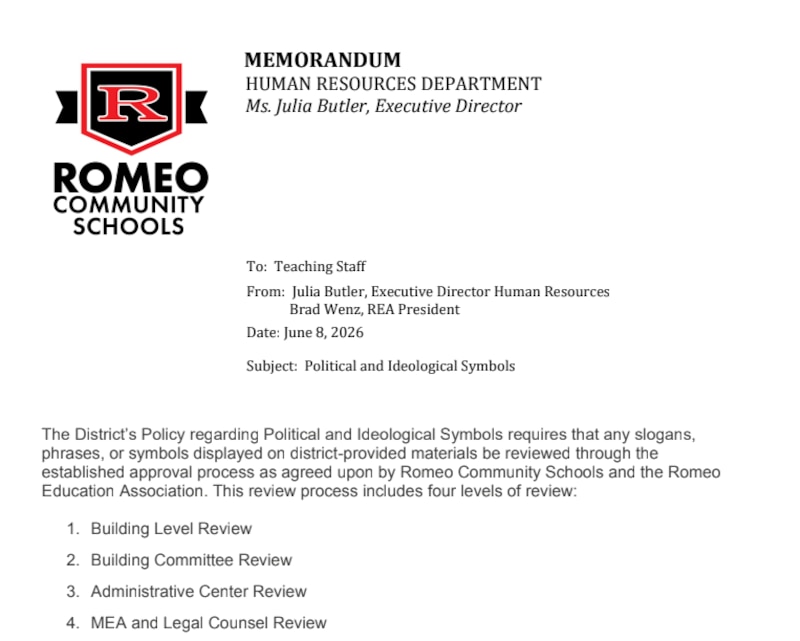
And if they want to display another motivational phrase? It could take four layers of review, including sign-off from legal counsel.
The approved messages are inoffensive: “Everyone is welcome.” “Be Yourself.” “We value all voices.” But a few phrases missing from the list, like “Hate has no home here” or “All are welcome here,” have become synonymous with LGBTQ acceptance — along with lawsuits and disputes in school board meetings across America.
Teachers and parents in Romeo Community Schools, about 40 miles north of Detroit, said the approved phrases themselves aren’t what they find offensive. But they said the list grew out of what they describe as an effort by the school board to root out signs and symbols associated with LGBTQ pride, and a policy the school board passed last year banning displays of political ideology.
That a “Hang In There, Baby” poster or a sign with an Albert Einstein quote could be subjected to legal review before making it onto a classroom wall might just be a sign of the times. The dispute in Romeo reflects a broader fight ensuing over what belongs in America’s classrooms, with school districts and states exerting more control over what’s plastered on classroom walls, what’s said in the classroom, and what books students read.
“A picture is worth 1,000 words,” said one Romeo teacher, who like other teachers spoke to Chalkbeat on the condition of anonymity due to fears about losing their jobs. She said the board is unsettled by “the depiction of your multicultural learner, your LGBTQ (students) — that they’re still not okay with, and that’s a problem.”
A growing number of state policymakers have proposed and enacted bans on LGBTQ topics in classrooms since 2021, according to a PEN America analysis. But a few lawsuits in federal court are testing those limits by challenging the removal of posters featuring rainbow colors or the phrase “Hate has no home here.” In one Ohio case, for example, a teacher sued his district after it ordered the removal of a rainbow poster from his classroom.
Romeo Schools officials have argued their policy is intended to remove symbolism and displays that aren’t aligned with district curriculum, and to create consistency between classrooms.
Legal experts told Chalkbeat that school districts are within their rights to nix classroom displays and even LGBTQ Pride flags, although Romeo’s policy could represent a relatively prescriptive approach.
Josh Blackman, a constitutional law professor with the South Texas College of Law, said as long as districts are applying a fair and equal standard when they create these limits, teachers don’t have much free speech to exercise within the classroom.
“I think the school has pretty broad control over what is said in the classroom,” he said.
Romeo Community Schools cracks down on classroom displays
The Romeo school district’s human resources department sent teachers a memo June 8, two days before the last day of the school year, listing 32 approved phrases for classroom signs and displays on district-provided materials.
The memo was the result of an effort to regulate “the display of ideological and political symbols,” spokeswoman MaryAnne Brush wrote in an emailed statement to Chalkbeat.
It came after the school board for the district, which educates about 5,400 students, passed a policy in April 2025 banning “political and ideological symbols” in materials displayed by teachers, unless directly related to curriculum. The policy was passed almost unanimously — only one board member opposed it — with little commentary by the board, even after a public commenter asked members to clarify what would be considered forbidden under the policy.
Several Romeo teachers told Chalkbeat that after the board adopted the policy, administrators instructed teachers to remove certain displays. They said Pride flags and signs with rainbow colors were singled out for removal.
One teacher said patriotic slogans, posters featuring President Donald Trump, and “thin blue line” messages supporting law enforcement remained in the classroom.
“I really feel especially for our marginalized communities, our LGBTQ kids, who already feel a bit like they’re in the minority,” said another teacher. “They are seeing something about them that is being erased.”
In response to questions about alleged disparate treatment of classroom posters, Brush wrote that specific building administrators weren’t available to answer questions about those messages.
She added that the district stood by the policy “as a joint effort to keep non-curricular ideologies and partisan politics out of the classroom.”
Some experts said it seemed unusual for a district to limit classroom displays as narrowly as Romeo did.
Emily Gold Waldman, a Pace University law professor who has written about free speech in schools, said she hasn’t seen another example of a district limiting displays like Romeo. But in general, she said, the policy is an example of attempts by districts across the country to try to ward off discussions of controversial topics.
That might be a good idea, said Samuel Abrams, a senior fellow with the right-leaning think tank the American Enterprise Institute. That’s because teachers aren’t just raising LGBTQ issues in classrooms, he said, but also sharing strongly-held opinions about political topics including the Israel-Hamas war. Those views aren’t appropriate to share with students, according to Abrams.
“Teachers are not supposed to be activists in the classroom in any direction,” he said. “We’re supposed to be educators and lift up everyone across the board.”
Brad Wenz, president of the district’s labor union, told Chalkbeat that the union filed a grievance last fall over how the signs policy would be implemented. The district’s pre-approved statements and review process are the resolution to the union’s grievance, he wrote.
But there’s something lost in the impulse to scrub the American classroom of symbols representing different identities, said John Rogers, an education professor at the University of California, Los Angeles.
“Districts feel somewhat caught and want to avoid being at the center of national media, but at the same time I think it’s very important for district leadership to give educators the space to communicate in meaningful and authentic ways with their students,” he said.
Christy Seitz believes Romeo’s policy is a mistake. A politically active parent with two children in Romeo schools, Seitz said she’s seen conservative board members attack imagery that would represent LGBTQ students, including Pride flags.
Back when she was a fourth grader in the district in 1996, Seitz recalled that there was a poster with a rainbow declaring that “Kindness matters” in her classroom, and that such sentiments have been an important part of the community’s ethos.
“That has always been a part of Romeo’s messaging,” she said, “that we are a community and everybody here belongs, and now it feels like if you don’t fall in line to this messaging … then you don’t belong here.”
Legal battles over classroom posters brewing
A few fights over classroom displays are winding through federal court.
Earlier this year, Idaho teacher Sarah Inama sued the state and her school district over a state law prohibiting “flags or banners that represent political, religious, or ideological views, including but not limited to political parties, race, gender, sexual orientation, or political ideologies” in public schools.
Inama resigned and drew national attention after refusing to take down a poster reading “Everyone is welcome here” and featuring drawings of hands of different skin tones. Her lawsuit is pending in U.S. District Court in Idaho.
In April, Ohio high school social studies teacher George McIntyre sued his school district after the Little Miami school board voted 4-1 to force him to take down a “Hate has no home here” poster featuring the American flag, transgender flag, and Pride flag colors.
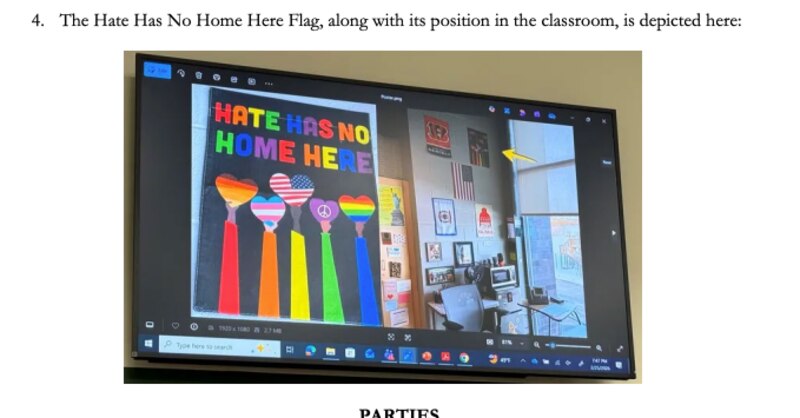
The lawsuit in the U.S. District Court for the Southern District of Ohio alleges the decision violated McIntyre’s free speech rights. McIntyre’s lawsuit also argues that by displaying the poster — alongside family photos and posters featuring Batman, Rosie the Riveter, and the film “A Christmas Story” — he sought to represent his students’ identities proudly.
Board members said they objected not to the message itself but to the rainbow and transgender flag colors.
One of the board members, Diane Horvath, argued that the diversity of public education means everyone needs to “veil certain parts” of their identities to come together in classrooms.
“If you could just have the message without bringing in certain aspects and certain values that not everyone else has, that it would be more acceptable,” Horvath said during a February meeting where the board deliberated over the poster.
In an email included in the lawsuit, a district attorney suggested McIntyre search for a “more neutral” version of the poster. McIntyre rejected that suggestion.
“My concern is that attempting to find a different, ‘neutral’ image may inadvertently lead to the erasure of LGBTQ+ representation,” he wrote in his response to the attorney.
McIntyre suggested finding ways to represent additional groups, rather than subtract.
Lily Altavena is a national reporter at Chalkbeat. Contact Lily at laltavena@chalkbeat.org.