Did you know search engines like Google are changing the way you see news? Keep Chalkbeat’s valuable education coverage at the top of your feeds by clicking here and checking the box next to our name.
A sleek Minneapolis school district webpage markets a “districtwide effort to reimagine a district where every student thrives.”
A Tucson, Arizona school district presentation promises that the community is “Reimagining Our Schools Together.” In Fort Worth, Texas, parents can read about how students will be afforded “Better Spaces. Greater Opportunities.”
They are moving “Forward Together.” They are becoming “Future Ready,” in order to “Reinvent” and “Reimagine.” They’re “Optimizing.” They’re “Rightsizing.” They are mixing fonts with abandon on flyers they’ve posted to Facebook and ClassDojo.
Cut through all the buzzwords, and you will realize all that transformation hinges on one of the most controversial decisions school leaders can make: closing schools.
Districts large and small are reckoning with a decline in birth rates, families relocating due to affordability concerns, charter schools’ growth, and a loss of immigrant students. All that has led districts to unveiling closure plans. They are often packed with buzzwords swearing that with closures will come a better future, more resources to help students, and thriving neighborhoods served by transformed campuses.
These public relations campaigns represent an effort by district leaders to wordsmith some optimism out of dire circumstances. And they’re getting help from consultants and firms specializing in the business of shrinking school districts, who say if bloated districts don’t reduce their footprint, their financial problems will worsen and push schools into a death spiral. But critics counter that the ambitious and glossy language school districts use doesn’t truly help maintain trust in communities that frequently suffer harsh consequences from closures.
Consultants say they help craft these messages to help families and community members understand the bigger picture: If districts close schools, they’ll have more flexibility to spend that money elsewhere.
And if they don’t shut down schools?
“The alternative when you don’t close schools is that your dollars get stretched even further,” said Lisa Relou, who last year launched Planfully Consulting, a Denver-based firm focused on helping districts through consolidation. Eventually, transformation and innovation really do become impossible, she said, because districts “can’t afford it.”
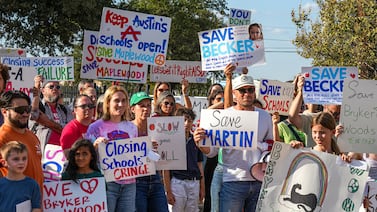
But in Tucson, the “reimagining” language doesn’t sit well with parent Alexis Cervantes, who is fighting the closure of Collier Elementary, which her second grader attends.
The district’s superintendent has told parents that proposed school closures are “about creating a superior academic product.” That sentiment feels disingenuous to Cervantes.
“We are absolutely open to improving our schools in any number of ways,” she said. “This does not feel like that. It feels like it was a label that they kind of slapped on it to make it seem nice and pretty.”
Consultants help craft language about school closures
School buildings that operate far under their capacity frequently lead districts to decide that closures are necessary. They’re a dilemma for districts across the country that erected buildings decades ago for a different, and often far larger, population of students.
While the process varies by district, deciding on school closures can take months and even years for school board members. People like Relou are sometimes behind that work.
Consultants helped craft Atlanta’s plan to close six schools at the end of this school year. They were also involved in Fort Worth’s decision to close seven schools this year.
Relou launched Planfully with business partner Claire Takhar after both worked for Jeffco Public Schools in Colorado, which closed more than a dozen schools in 2022 as the pandemic hastened a decline in enrollment.
Some have held up Jeffco’s closures as a “roadmap” for other financially beleaguered districts in similar circumstances. But budget problems persist in the district, raising questions about whether the closures accomplished what they were intended to do fiscally.
Community engagement, Relou said, is an important part of the process, but should be purposeful.
In Jeffco, the superintendent at the time was very clear that closures had to happen, Relou said. And district officials said they didn’t want to give families the illusion of choice. Because people usually don’t want to see their school closed, debates about which schools should close are difficult to have in earnest.
Relou said they instead try to help families understand which decisions they do have leverage over — namely, what happens after a closure is decided and identifying the services they want to see in their new, consolidated school.
“You don’t want to overpromise,” Relou said. “It is important to back those promises and see them through, and recognize that you’re going to have to spend some resources probably in that first year to get there.”
Another component to that engagement process is recognizing a community’s grief, said Bill de la Cruz, who runs a firm that’s consulted with several districts about closures, including Tucson’s current plan.
De la Cruz said some of his expertise comes from his time when he was a school board member in Boulder, Colorado during school closures.
“We had to sit through and do it in a way that we weren’t dismissive of what the public was feeling,” he said.
So why use rosy language when the bulk of the work can feel so bleak?
De La Cruz said district leaders in these situations genuinely want to see closures as an opportunity to do something new. Asking community leaders what officials can do better in the context of closures can even help a district attract new students.
“It’s a real valid effort to engage the community in thinking about what’s possible,” De La Cruz said.
Lawrence Robinson has school board experience too. He used to be a board member for the Roosevelt School District in Phoenix. He was the lone “no” vote when the district decided to shutter five schools last year.
He has a simple explanation for that vote: “You can’t reinvent something that you kill.”
Are communities buying the school closures districts are selling?
But community members don’t often take the hopeful language as intended. In fact, sometimes all the optimism districts project about redesigning schools might be confusing.
In Aurora, a diverse suburb of Denver, the district spent years gathering community feedback for Blueprint APS, a plan from a few years ago to manage shifting enrollment patterns. But community members were subsequently stunned to learn the plan also included closing schools.
“I wish they would have explained everything from the beginning,” said one parent, Brenda Pineda in 2022 as the closure plan came into focus.
Chicago represents a particularly long and rocky history of closures that have left families weary. They also haven’t always turned out the way officials planned — or advertised.
Back in 2004, Chicago officials labeled new schools they envisioned replacing the shuttered ones as “Renaissance 2010” schools. Two former mayors, Rahm Emanuel and Richard Daley, framed closures as a moral imperative, a way to help students escape underperforming schools, although the language they and others used to make the case could be blunt at times.
But studies of test scores for new schools created in the Renaissance plan didn’t show the dramatic academic improvements officials promised. Chicago Public Schools enrollment has fallen dramatically in recent years, and as of last year, there were 47 schools operating at less than one-third capacity.
Some communities may also balk at districts’ promises about closures because the closures themselves represent broken trust.
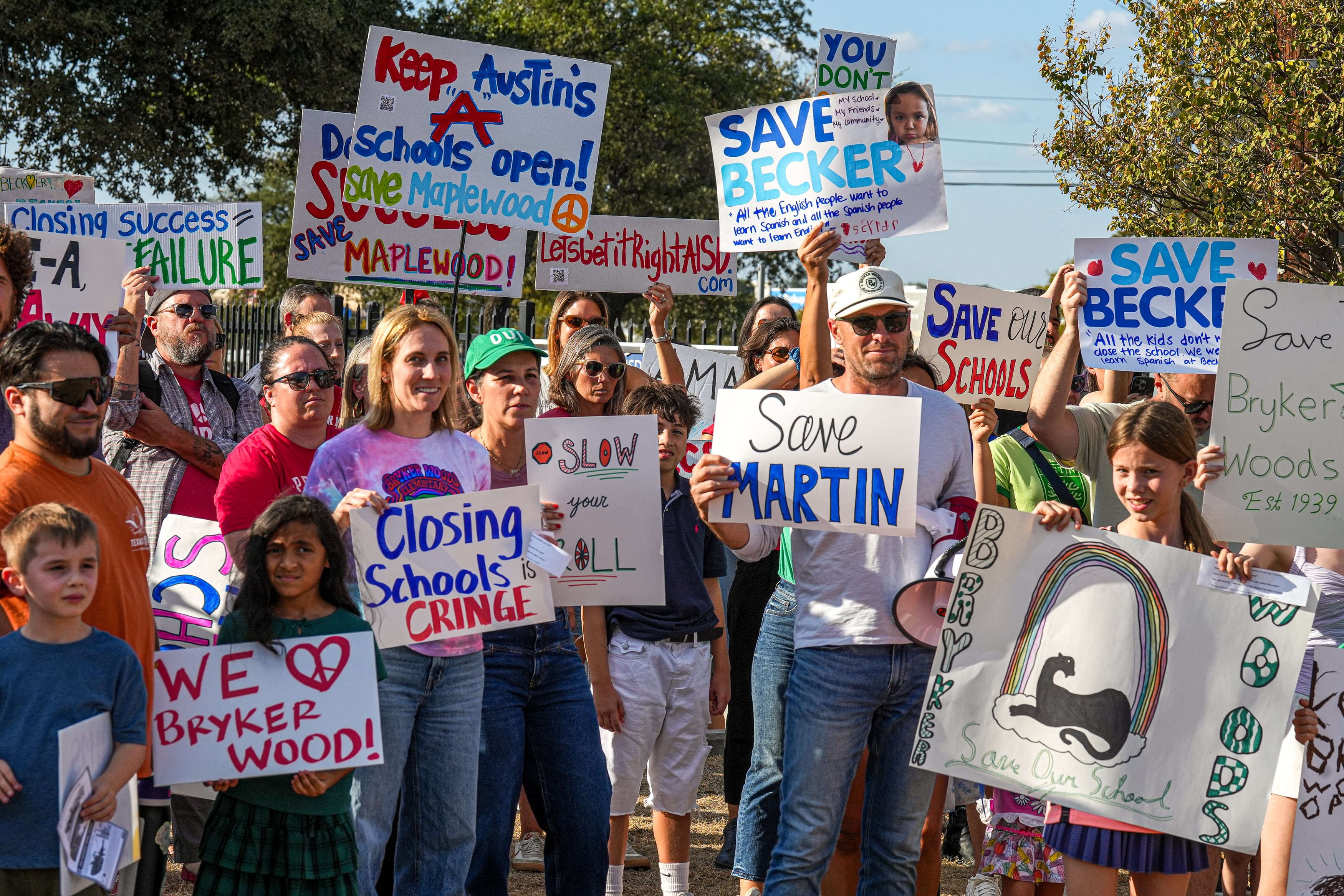
In 2019, the school district for Austin, Texas closed four elementary schools, including Pease Elementary, named after the governor who enacted legislation establishing the state’s public school system. The district branded the decision as “Reimagine, Reinvest, Reinvent.”
Before the decision to close them, one of the people publicly protesting the move was then-state Democratic Rep. Gina Hinojosa. She told a local news outlet that the district had vowed it would try to keep schools open just a few years ago when officials were seeking approval for a $1.1 billion bond.
This year, she ran for governor and won. She capped her campaign on Nov. 3 by declaring to Texans that “your schools will not close.”
Back in 2019 as she resisted school closures, she had a simple message as well: “Public trust is paramount to public schools.”
Lily Altavena is a national reporter at Chalkbeat. Contact Lily at laltavena@chalkbeat.org. Lily is on Instagram, Tik Tok, and Facebook.