Did you know search engines like Google are changing the way you see news? Keep Chalkbeat’s valuable education coverage at the top of your feeds by clicking here and checking the box next to our name.
Education is often a secondary issue for voters, but elected leaders — from governors to school board members — shape the nation’s schools in significant ways.
Voters next Tuesday will decide key governors’ races that could lead to revamped graduation requirements, state superintendent races that might result in more oversight for voucher programs, and ballot measures that could change who gets to play sports.
A blue wave, meanwhile, could usher in a Congress that pushes back more aggressively on President Donald Trump’s education agenda.
Here are the issues we’re watching in the midterms:
Democrats are running on reining in vouchers
After Republican-led legislatures rapidly expanded state voucher programs, red-state Democrats are pointing to “waste, fraud and abuse” and making reining in voucher programs a key part of their campaign message.
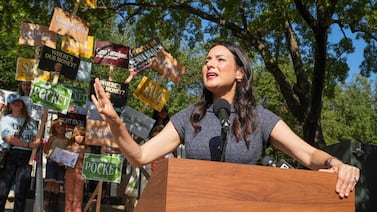
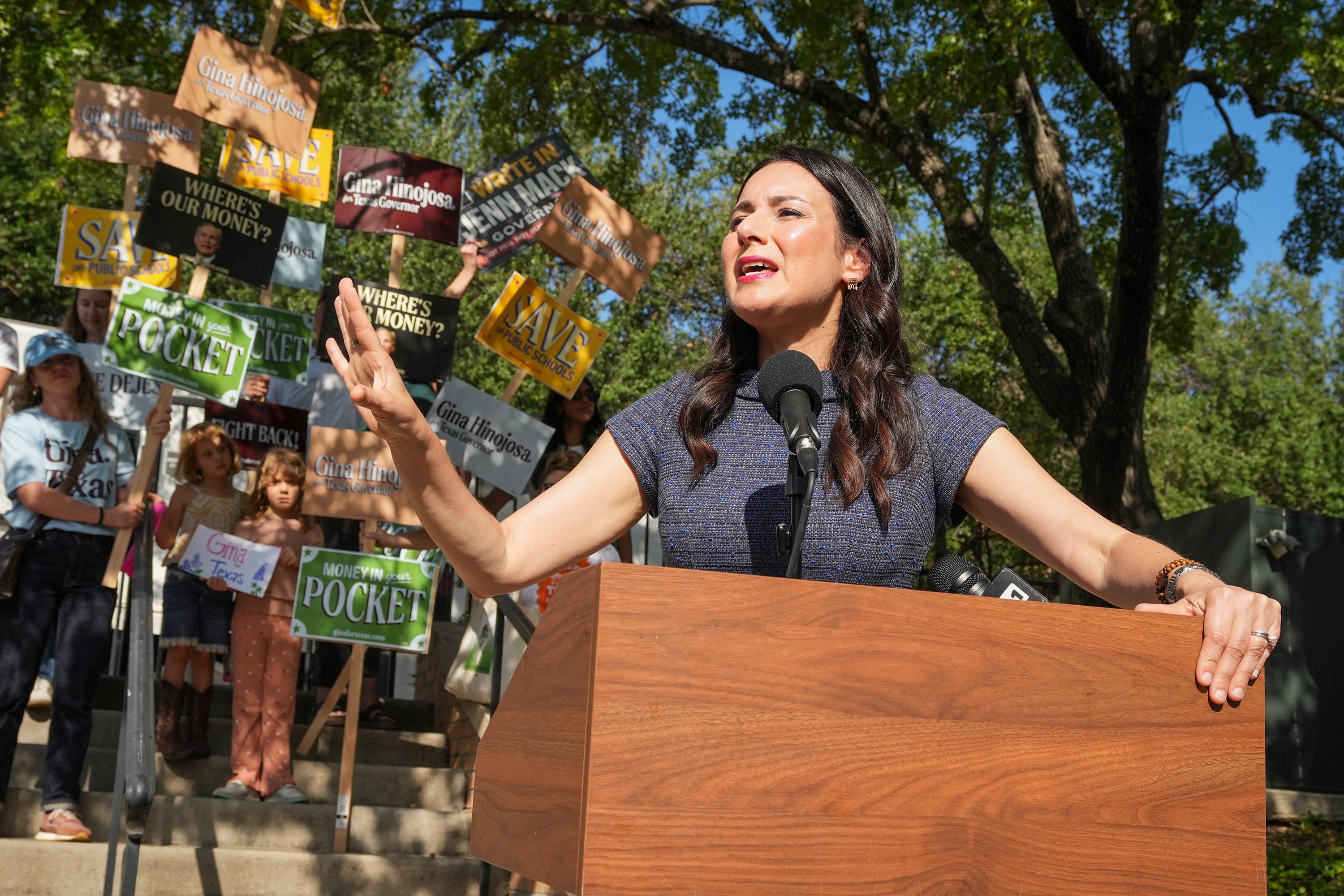
In Texas, Democrat Gina Hinojosa has pledged that if she becomes governor she will “save Texas schools” by ending the state’s newly-minted voucher program, a key achievement of her opponent, incumbent Republican Gov. Greg Abbott. In Iowa, Democrat Rob Sand, the state auditor who is now running for governor, wants to impose an income cap. And in Arizona, where the state’s supreme court killed a ballot measure to put guardrails on the program, how much to regulate education savings accounts is a major issue in the state superintendent’s race.
The message that voucher programs hurt enrollment and funding at public schools — whether that’s true or not — can be persuasive to voters, said Mike Petrilli, president of the Thomas B. Fordham Institute, a conservative education think tank.
“People love their public schools,” he said. “That can be a powerful message.”
Still, it’s unlikely these programs will vanish if a blue wave materializes in November. Sand acknowledges that “there’s no chance” of repealing Iowa’s voucher program, given the state legislature’s Republican supermajority. And in Wisconsin, Democrat David Crowley said that, if elected governor, he would not try to undo that state’s long-standing voucher program because public schools couldn’t absorb all the displaced students.
The midterm results could also influence whether more states currently led by Democrats opt into the federal scholarship tax credit.
School closures, budget woes loom large in school board races
Dozens of school districts have floated plans to close schools, proposals that often fuel fierce community opposition.
Now the issue is showing up in school board races. Candidates are running against school closures in St. Louis, where a school consolidation plan would shutter 14 schools, and in Minneapolis, where the current board just paused a controversial closure plan even as more than half of schools operate at under 70% capacity. Detroit also has a slate of candidates opposed to school closures — who also pledge to oust the superintendent.
But whoever wins these seats will still have to grapple with the challenges of declining enrollment, tight budgets, and underused buildings.
These issues are intersecting with major governance changes in some cities. In Indianapolis, the elected board recently lost important powers to an appointed oversight board created by the Republican legislature. School board candidates are divided on how to manage the district’s relationship with the appointed board — should they try to cooperate or defend the elected board’s authority where possible?
And in Chicago, voters are choosing a fully elected board after 30 years of mayoral control. The new board will inherit a $700 million budget deficit as a self-imposed moratorium on school closures expires. Another key question is how independent the board will be from Mayor Brandon Johnson, a former teachers union organizer facing his own difficult reelection campaign in early 2027.
Ballot measures test public support for trans rights
Voters in Washington and Colorado are being asked to bar transgender girls from girls’ sports teams. Voters in Nebraska are being asked to enshrine an existing ban in their state constitution. And in Arizona, voters will decide whether to expand an existing ban that covers school teams to include rec league teams, as well as to ban transgender boys from joining boys’ teams.
These ballot measures are part of a national strategy amid a broader attack on trans rights from the Trump administration. Earlier this year, the Supreme Court said state restrictions on transgender sports participation do not violate the Constitution, but the court did not require states to exclude these athletes, as some conservatives wanted.
The Washington and Colorado ballot measures are notable because these are blue states with laws that support transgender rights, including the ability of young athletes to play on teams that match their gender identity.
Activists on this issue hope they can sidestep state legislatures by asking voters directly. Polling finds that a large majority of Americans, including many Democrats, believe athletes should compete on teams that match their sex at birth.
The Washington measure goes much further than other transgender sports restrictions — it would require that all girls prove they are female in order to play sports. A birth certificate would not be sufficient. Instead, girls would need a health provider’s statement verifying their sex “based on reproductive anatomy, genetic makeup, or normal endogenously produced testosterone levels.”
Education reform ideas are back on the table — sort of
The bipartisan education reform consensus may be dead in Washington, D.C., but ideas from that playbook are showing up in governors’ races.
The basic question of whether students are learning enough has played a prominent role in Oregon, where the governor is also the state superintendent. Incumbent Democratic Gov. Tina Kotek is in a tight race with Republican challenger Christine Drazan.
Amid public outcry over the state’s slow pandemic recovery, Kotek has backed early literacy investments, a school accountability bill, and more class time for students — the state has a very short school year. Her education policies appear to have cost Kotek the support of the Oregon Education Association, which is sitting out the governor’s race.
Kotek says voters should give her four more years to see through these reforms. Drazan argues that education needs a more dramatic overhaul. She also wants Oregon to participate in the federal scholarship tax-credit to expand parental choice — something Kotek opposes.
Broadly speaking, Republicans are calling for more accountability measures while Democrats want schools to have more resources. The way those issues interact makes accountability a “tricky beast” for both parties, said Patrick McGuinn, a political science professor at Drew University.
In Michigan, both gubernatorial candidates say literacy is a priority, but Democrat Jocelyn Benson focuses on more resources for teachers and schools, while Republican John James has called for restoring third-grade retention as part of a bid to follow Mississippi’s path toward higher reading scores.
But in Nevada, incumbent Republican Gov. Joe Lombardo and Democratic challenger Attorney General Aaron Ford both support holding back third graders who are struggling to read, a policy that the state’s superintendents say is misguided.
Democratic Congress could push back on Trump education changes
Democrats are widely expected to take the House, while the Senate would be a harder pickup. Accountability for the Trump administration and affordability top the Democrats’ larger agenda.
If Democrats do win more power, expect lots of oversight hearings.
Already, Politico reports, two Democratic lawmakers, Reps. Suzanne Bonamici of Oregon and Jahana Hayes of Connecticut, are campaigning to chair the House education committee by arguing they would stand more firmly against efforts to dismantle the Education Department than the current ranking Democrat, Rep. Bobby Scott of Virginia.
Democrats are likely to “take a hard look at DOGE’s cuts to education contracts and staff, the push to dismantle the Department of Education, the legal settlements with elite universities, and the way the administration has approached civil rights enforcement,” Rick Hess wrote for the conservative American Enterprise Institute. “If the Democrats take both chambers, they’ll have added bandwidth for more such investigations.”
Potential areas of bipartisan agreement include guardrails on AI in the classroom, literacy, and career and technical education.
Democrats have introduced legislation to repeal the federal scholarship tax-credit, Republicans’ signature education accomplishment, but getting contested bills out of the Senate or past the president’s veto will be nearly impossible.
Still, it’s important to try, said American Federation for Teachers President Randi Weingarten. Congress needs to reverse Medicaid and SNAP cuts that hurt low-income families, restore research funding, and make sure money appropriated by Congress reaches schools and students, she said.
“Instead of being a passive lapdog for this president’s excesses and abuse of power, they can do something about it,” Weingarten said.
Lily Altavena is a national reporter at Chalkbeat. Contact Lily at laltavena@chalkbeat.org. Lily is on Instagram, Tik Tok, and Facebook.
Erica Meltzer is Chalkbeat’s national editor based in Colorado. Contact Erica at emeltzer@chalkbeat.org.